
A Worm That Ruins the Roots
Several nematodes parasitise a wide variety of plants and animals, including human beings. One of them, the nematode Meloidogyne incognita, infects the roots of tobacco plants and causes a great reduction in yield. Attacking the roots quietly and from below, it is exactly the kind of pest that ordinary sprays struggle to reach.
A novel strategy was worked out to protect the plant from this infestation, and it did not rely on any pesticide at all. Instead, it turned one of the cell's own defence mechanisms into a weapon against the parasite. That mechanism is RNA interference.
What RNA Interference Actually Does
RNA interference (RNAi) is a method of cellular defence that takes place in all eukaryotic organisms. The process involves the silencing of a specific mRNA caused by a complementary double-stranded RNA (dsRNA) molecule that binds to it and prevents its translation. In other words, once the target mRNA is tied up in a double-stranded form, it can no longer be read to make protein — the gene it carries is effectively switched off.
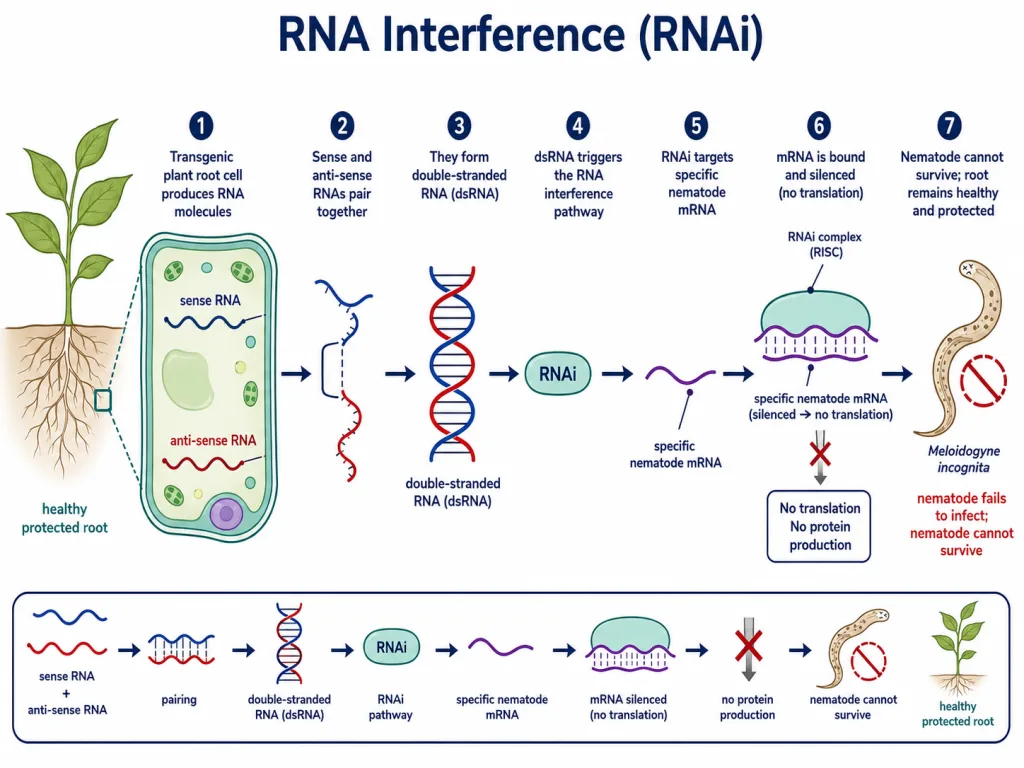
In nature, the complementary RNA that triggers this response can come from an infection by viruses with RNA genomes or from mobile genetic elements (transposons) that replicate through an RNA intermediate. The cell, in effect, recognises the intruding double-stranded RNA and shuts down the matching message.
Turning the Plant into Its Own Guardian
To protect tobacco from the nematode, scientists used Agrobacterium vectors to introduce nematode-specific genes into the host plant. The clever part lay in how the DNA was arranged: it was designed so that the host cells produced both sense and anti-sense RNA.
Because these two RNA strands are complementary to each other, they came together to form a double-stranded RNA (dsRNA). That dsRNA initiated RNAi and silenced the specific mRNA of the nematode. Note where the silencing acts — not on any tobacco gene, but on a gene the parasite needs to survive.
The Result: A Protected Plant
Once the parasite's essential mRNA was silenced, the consequence was direct: the nematode could not survive in a transgenic host that was expressing the specific interfering RNA. The transgenic plant had, in effect, become its own guardian, and it was protected from the parasite.
This is a neat illustration of what modern biotechnology can achieve in agriculture. Rather than dousing a field in chemicals, a single, well-designed genetic change lets the crop defend itself — cutting pesticide use while keeping yields safe.
Quick Recap
- The nematode Meloidogyne incognita infects the roots of tobacco and greatly reduces yield.
- RNA interference (RNAi) is a cellular defence present in all eukaryotic organisms; it silences a specific mRNA using a complementary double-stranded RNA (dsRNA) that prevents translation.
- The natural source of the complementary RNA can be RNA viruses or transposons that replicate via an RNA intermediate.
- Using Agrobacterium vectors, nematode-specific genes were introduced so the plant made both sense and anti-sense RNA, which paired into a dsRNA.
- This dsRNA triggered RNAi and silenced the nematode's mRNA, so the parasite could not survive and the transgenic plant was protected.
Solved Examples — Section 6
Q1. Which nematode infects tobacco roots, and what is its effect?
Answer: Meloidogyne incognita; it infects the roots of tobacco plants and causes a great reduction in yield.
Q2. In which organisms does RNA interference occur?
Answer: In all eukaryotic organisms, where it acts as a method of cellular defence.
Q3. How does RNAi silence a gene?
Answer: A complementary double-stranded RNA (dsRNA) binds to a specific mRNA and prevents its translation, silencing that mRNA.
Q4. What are the natural sources of the complementary RNA that can trigger RNAi?
Answer: Infection by viruses with RNA genomes, or mobile genetic elements (transposons) that replicate via an RNA intermediate.
Q5. Which vector was used to introduce the nematode-specific genes into the host plant, and what RNA did the plant then make?
Answer: Agrobacterium vectors were used, and the host cells produced both sense and anti-sense RNA.
Q6. Why could the parasite not survive in the transgenic plant?
Answer: The sense and anti-sense RNA formed a dsRNA that initiated RNAi and silenced the nematode's specific mRNA, so the parasite could not survive and the plant was protected.