
What Decomposition Is
Decomposers break down complex organic matter into inorganic substances such as carbon dioxide, water and nutrients, and this process is called decomposition. It is the step that returns the materials locked up in dead bodies back to the soil and the air, ready to be used again.
The raw material for decomposition is detritus — dead plant remains such as leaves, bark and flowers, together with the dead remains of animals, including faecal matter. All of this dead organic matter is what the decomposers act upon.
The Steps of Decomposition
The important steps in decomposition are fragmentation, leaching, catabolism, humification and mineralisation. It is important to note that these steps do not happen one strictly after another — they operate simultaneously on the detritus.
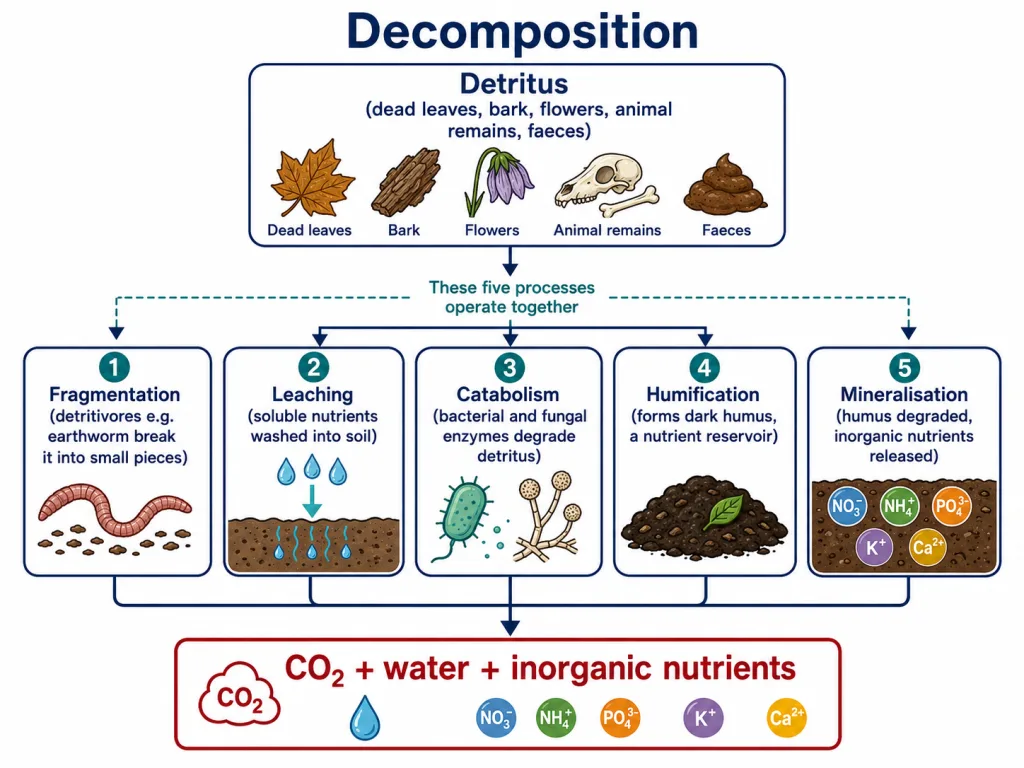
In fragmentation, detritivores such as the earthworm break down the detritus into smaller particles. In leaching, water-soluble inorganic nutrients go down into the soil horizon and get precipitated as unavailable salts. In catabolism, bacterial and fungal enzymes degrade the detritus into simpler inorganic substances.
Humification and Mineralisation
Humification leads to the accumulation of a dark-coloured amorphous substance called humus. Humus is highly resistant to microbial action and so decomposes very slowly. Being colloidal in nature, it serves as a reservoir of nutrients, holding them in the soil.
Humus is not the end of the story. It is further degraded by some microbes, and the release of inorganic nutrients from it occurs by the process known as mineralisation. Through mineralisation the nutrients held in humus are finally freed for reuse.
What Controls the Rate
Decomposition is largely an oxygen-requiring process. Its rate is controlled by two things: the chemical composition of the detritus and the climatic factors of the site.
The make-up of the detritus matters a great deal. Decomposition is slower if the detritus is rich in lignin and chitin, and quicker if it is rich in nitrogen and water-soluble substances like sugars. Among the climatic factors, temperature and soil moisture are the most important. A warm and moist environment favours decomposition, whereas low temperature and anaerobiosis inhibit it, which leads to a build-up of organic material.
Quick Recap
- Decomposers break down complex organic matter into inorganic substances (carbon dioxide, water and nutrients); this is decomposition.
- The raw material is detritus — dead plant remains (leaves, bark, flowers) and dead animal remains, including faecal matter.
- The steps, all operating simultaneously, are fragmentation (detritivores like earthworm break detritus into small particles), leaching (soluble nutrients wash down and precipitate as unavailable salts), catabolism (bacterial and fungal enzymes make simpler inorganic substances), humification (dark, colloidal, resistant humus accumulates as a nutrient reservoir) and mineralisation (humus is degraded, releasing inorganic nutrients).
- Decomposition is largely oxygen-requiring; rate depends on chemical composition of detritus and climatic factors.
- It is slower with lignin and chitin, quicker with nitrogen and sugars; warm and moist conditions favour it, while low temperature and anaerobiosis inhibit it.
Solved Examples — Section 4
Q1. What is decomposition?
Answer: The process by which decomposers break down complex organic matter into inorganic substances such as carbon dioxide, water and nutrients.
Q2. What is detritus?
Answer: The raw material for decomposition — dead plant remains such as leaves, bark and flowers, and dead animal remains, including faecal matter.
Q3. Name the five steps of decomposition.
Answer: Fragmentation, leaching, catabolism, humification and mineralisation.
Q4. What happens during fragmentation, and give an example of a detritivore.
Answer: Detritivores break detritus into smaller particles; the earthworm is an example.
Q5. Why is humus described as a reservoir of nutrients?
Answer: Humus is dark, amorphous and colloidal, highly resistant to microbial action and decomposes very slowly, so it holds nutrients in the soil until mineralisation releases them.
Q6. How do temperature and moisture affect decomposition?
Answer: A warm and moist environment favours decomposition, while low temperature and anaerobiosis inhibit it, causing a build-up of organic material.