
Biotic and Abiotic Components
Every ecosystem has two kinds of components: abiotic (the non-living, physico-chemical factors such as air, water and soil) and biotic (the living organisms — producers, consumers and decomposers). It is the interaction of these two that gives each type of ecosystem its own characteristic physical structure.
Understanding an ecosystem means seeing these components not in isolation but in an integrated way — as parts that together shape how energy flows through the system.
Species Composition and Stratification
Two structural features describe an ecosystem. The first is species composition — the identification and enumeration of the plant and animal species present. The second is stratification — the vertical distribution of different species occupying different levels.
A forest shows stratification clearly: trees occupy the top vertical layer, shrubs the second, and herbs and grasses the bottom layers. This layering is not accidental — it reflects how different species share the same space and light.
A Pond as a Model Ecosystem
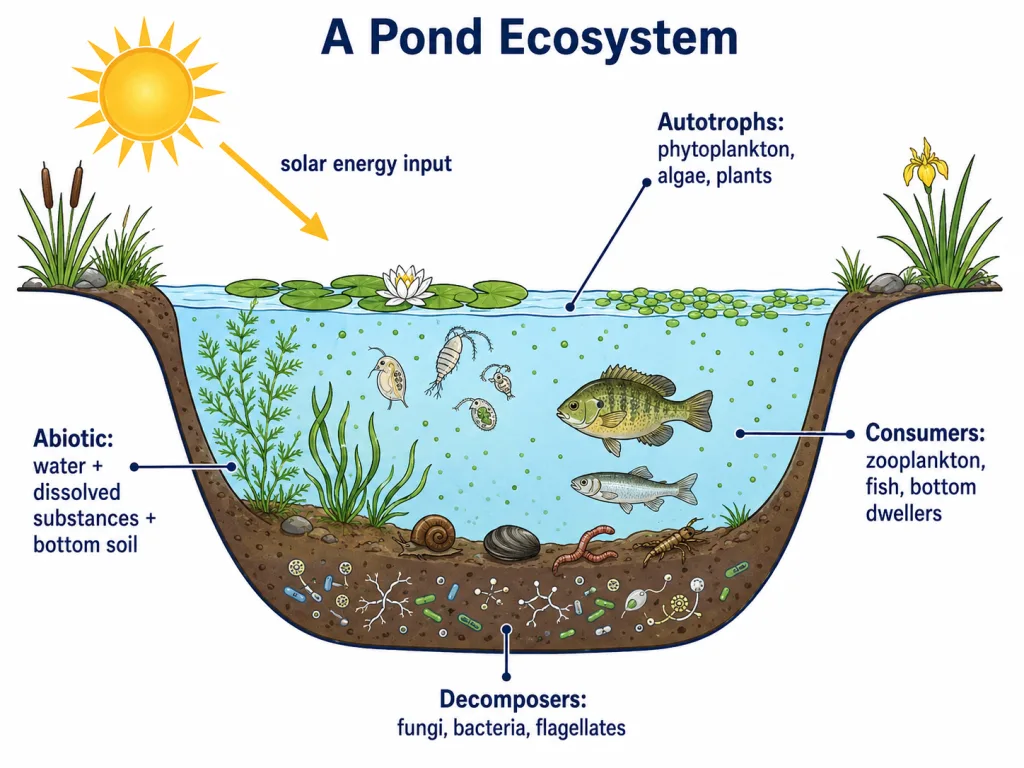
A small pond is a simple, largely self-sustaining example that shows all four functions of an ecosystem at work. Its components map neatly onto the biotic and abiotic categories.
The abiotic component is the water with its dissolved inorganic and organic substances, plus the rich mud deposits at the bottom; solar input, temperature, day-length and other climatic conditions regulate the pond's functioning. The autotrophs include the phytoplankton, some algae, and the floating, submerged and marginal plants. The consumers are the zooplankton and the free-swimming and bottom-dwelling animals. The decomposers are the fungi, bacteria and flagellates, especially abundant at the bottom.
How the Pond Works as a Whole
The pond performs every function of an ecosystem — and of the biosphere as a whole. Autotrophs convert inorganic material into organic material using the sun's radiant energy; heterotrophs consume the autotrophs; and decomposers carry out decomposition and mineralisation of the dead matter, releasing nutrients back for reuse by the autotrophs. These events repeat over and over again.
Through it all runs one key theme of the chapter: there is a unidirectional movement of energy towards the higher trophic levels, with energy continually dissipated and lost as heat to the environment.
Quick Recap
- Ecosystems have abiotic components (air, water, soil) and biotic components (producers, consumers, decomposers); their interaction gives a characteristic physical structure.
- Two structural features: species composition (which species, how many) and stratification (vertical layering — trees, then shrubs, then herbs/grasses).
- A pond models all four functions: abiotic (water + bottom mud), autotrophs (phytoplankton, algae, plants), consumers (zooplankton, swimming and bottom forms), decomposers (fungi, bacteria, flagellates).
- Functions repeat: autotrophs build organic matter, heterotrophs consume it, decomposers mineralise dead matter for reuse.
- Energy movement is unidirectional to higher trophic levels, with continual loss as heat.
Solved Examples — Section 2
Q1. Name the two components of an ecosystem.
Answer: Abiotic (non-living, physico-chemical factors) and biotic (living organisms — producers, consumers and decomposers).
Q2. What is stratification? Give an example.
Answer: The vertical distribution of different species at different levels; e.g. in a forest, trees occupy the top layer, shrubs the middle, and herbs and grasses the bottom.
Q3. What is species composition?
Answer: The identification and enumeration of the plant and animal species present in an ecosystem.
Q4. In a pond, what constitutes the abiotic component?
Answer: The water with its dissolved inorganic and organic substances and the rich mud deposits at the bottom, regulated by solar input and climate.
Q5. Which organisms act as decomposers in a pond?
Answer: Fungi, bacteria and flagellates, especially abundant at the bottom of the pond.
Q6. In which direction does energy move through an ecosystem?
Answer: Unidirectionally, towards higher trophic levels, with continual dissipation and loss as heat.