
What a Trophic Level Means
Every organism occupies a place in its community according to its feeding relationships. Based on the source of its nutrition, an organism sits at a specific place in the food chain, and that place is called its trophic level.
The levels follow the food chain in order. Producers belong to the first trophic level, herbivores (primary consumers) to the second, and carnivores (secondary consumers) to the third. Each level is defined not by what an organism is, but by where it gets its energy.
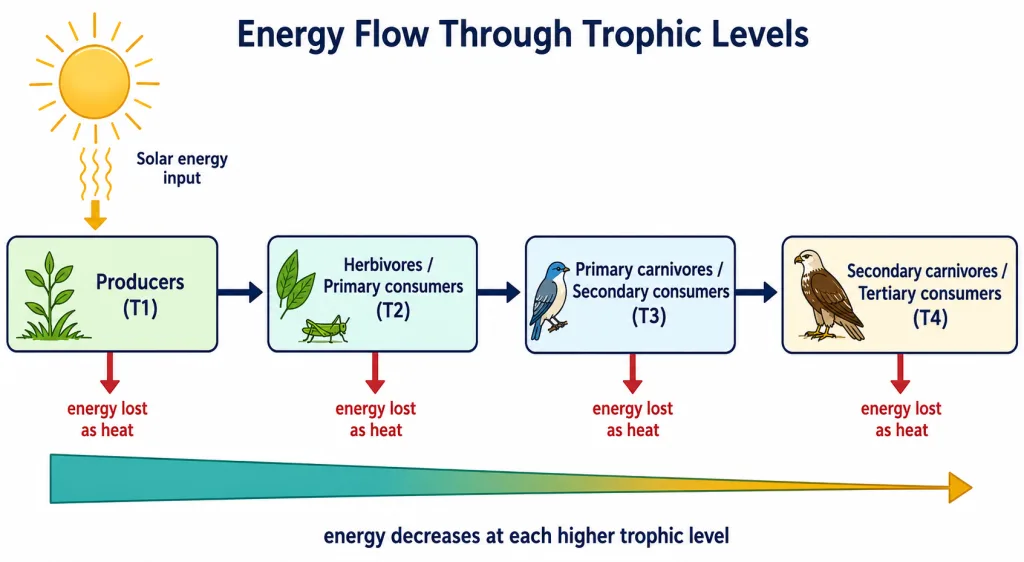
Energy Decreases at Every Level
The most important point about trophic levels is that the amount of energy decreases at each successive level. Organisms at every level depend on those at the level below them for their energy demands, and only part of that energy is ever passed upward. This steady loss is why food chains cannot stretch on indefinitely.
When an organism dies, its energy is not wasted. The dead body is converted to detritus, or dead biomass, which then serves as an energy source for the decomposers. In this way even the organisms that leave the grazing food chain continue to feed the ecosystem.
Standing Crop and How It Is Measured
At any given moment, each trophic level holds a certain mass of living material. This is called the standing crop. It is a snapshot of how much life is present at that level at a particular time.
The standing crop can be measured in two ways: as the biomass — the mass of living organisms — or as the number of organisms in a unit area. Biomass itself is expressed as fresh weight or dry weight. Of the two, measurement in dry weight is more accurate, because the water content of living tissue varies a great deal and can distort a comparison based on fresh weight.
A Trophic Level Is a Function, Not a Species
A key idea to hold on to is that a trophic level is a functional level, not a species. It describes a role in feeding, so the same species can play different roles at different moments.
This means a given species may occupy more than one trophic level at the same time in the same ecosystem. The classic example is the sparrow: when it eats seeds it is a primary consumer, but when it eats insects and worms it becomes a secondary consumer. The sparrow has not changed — its trophic level simply follows whatever it happens to be eating.
Quick Recap
- An organism's place in the food chain, based on its source of nutrition, is its trophic level.
- Producers are the first level, herbivores (primary consumers) the second, and carnivores (secondary consumers) the third.
- The amount of energy decreases at successive trophic levels, and each level depends on the one below it.
- A dead organism becomes detritus (dead biomass), an energy source for decomposers.
- Standing crop is the mass of living material at a level at a given time, measured as biomass or number per unit area.
- Biomass is expressed as fresh or dry weight; dry weight is more accurate.
- A trophic level is a functional level, not a species — a sparrow is a primary consumer eating seeds and a secondary consumer eating insects and worms.
Solved Examples — Section 6
Q1. What is a trophic level?
Answer: The place an organism occupies in the food chain based on its source of nutrition.
Q2. To which trophic levels do producers, herbivores and carnivores belong?
Answer: Producers to the first, herbivores (primary consumers) to the second, and carnivores (secondary consumers) to the third.
Q3. What happens to the amount of energy along successive trophic levels?
Answer: It decreases at each successive trophic level.
Q4. Define standing crop.
Answer: The mass of living material present at each trophic level at a particular time, measured as biomass or as the number of organisms per unit area.
Q5. Why is biomass measured in dry weight rather than fresh weight?
Answer: Dry weight is more accurate because the variable water content of living tissue would otherwise distort the measurement.
Q6. Give an example to show that a species can occupy more than one trophic level.
Answer: A sparrow is a primary consumer when it eats seeds and a secondary consumer when it eats insects and worms, because a trophic level is a functional level, not a species.