
Two Kinds of Food Chain
Every organism depends on producers for its food, either directly or indirectly, and this dependence links organisms into a food chain. Nature runs two kinds of food chain side by side.
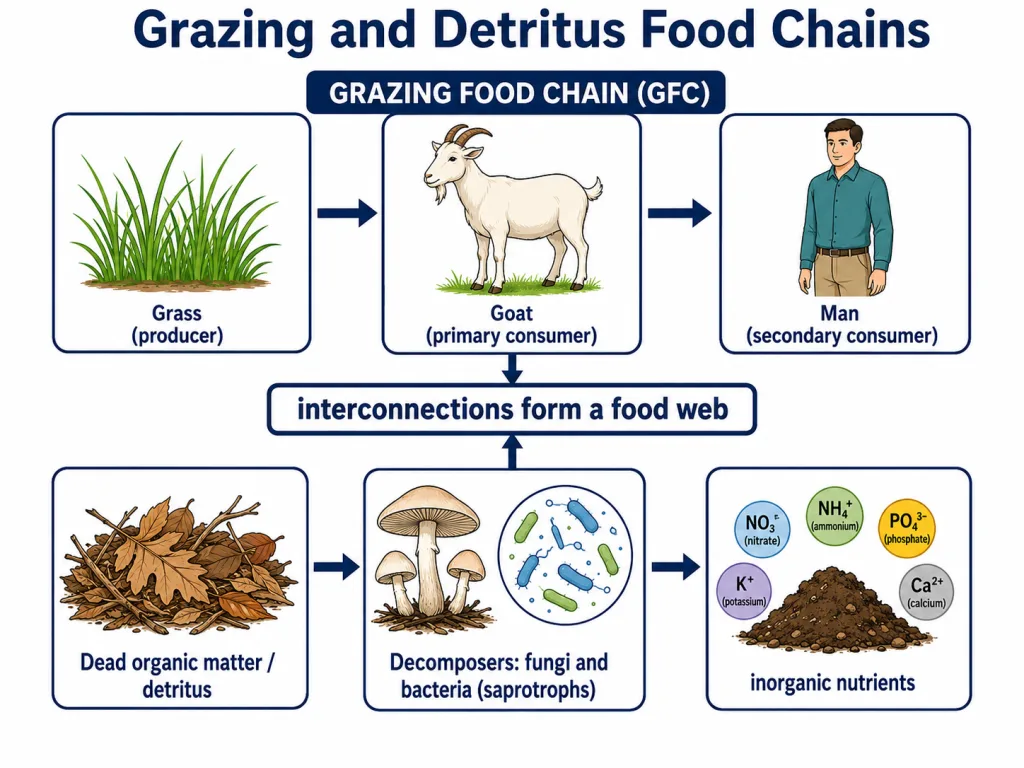
The first is the grazing food chain (GFC), which starts from the producers, the green plants. A herbivore eats the plant, a carnivore eats the herbivore, and so on. A simple example is:
Grass -> Goat -> Man
Here grass is the producer, the goat the primary consumer, and man the secondary consumer.
The Detritus Food Chain and Its Decomposers
The second kind is the detritus food chain (DFC), which does not begin with a living plant at all. It begins with dead organic matter, the detritus. This chain is made up of decomposers — heterotrophic organisms, mainly fungi and bacteria, that meet their energy and nutrient needs by breaking down dead organic matter.
Because they live on decaying material, these decomposers are also called saprotrophs (sapro meaning to decompose). They secrete digestive enzymes that break down dead and waste material into simple inorganic substances, which they then absorb.
Which Chain Carries More Energy
The relative importance of the two chains depends on the ecosystem. In an aquatic ecosystem, the grazing food chain is the major conduit for energy flow. In a terrestrial ecosystem, the picture is reversed — a much larger fraction of energy flows through the detritus food chain than through the grazing food chain.
So the fallen leaves, dead wood and animal remains of a forest floor are not a dead end at all; they feed the busiest energy pathway of the whole system.
From Chains to Webs
The two chains are not sealed off from one another. The detritus food chain may be connected with the grazing food chain at several points — some organisms of the DFC are prey to animals of the GFC, and some animals, such as cockroaches and crows, are omnivores that draw on both. These natural interconnections turn simple chains into a branching food web.
The number of trophic levels a grazing food chain can support is restricted, and the reason is energetic. Transfer of energy follows the ten per cent law — only about 10 per cent of the energy at one trophic level is passed on to the next level above it. So little energy survives after a few transfers that the chain cannot extend indefinitely, which is why food chains in nature are short.
Quick Recap
- A food chain links organisms by who eats whom; all depend on producers directly or indirectly.
- The grazing food chain (GFC) starts from producers (green plants) — e.g. Grass -> Goat -> Man.
- The detritus food chain (DFC) starts from dead organic matter (detritus) and is made of decomposers — mainly fungi and bacteria, also called saprotrophs; they secrete enzymes that break dead matter into simple inorganic substances and absorb them.
- In aquatic ecosystems the GFC carries most energy; in terrestrial ecosystems the DFC carries a much larger fraction.
- The two chains interconnect (shared prey, omnivores like cockroaches and crows) to form a food web.
- Energy transfer follows the ten per cent law — only about 10 per cent passes to each higher level — so the number of trophic levels is limited.
Solved Examples — Section 7
Q1. Name the two types of food chain and state where each begins.
Answer: The grazing food chain begins with producers (green plants); the detritus food chain begins with dead organic matter (detritus).
Q2. Identify the trophic role of each organism in Grass -> Goat -> Man.
Answer: Grass is the producer, the goat is the primary consumer, and man is the secondary consumer.
Q3. What are saprotrophs, and what does the name mean?
Answer: Saprotrophs are the decomposers (mainly fungi and bacteria) of the detritus food chain; sapro means to decompose. They break down dead and waste material.
Q4. In which ecosystem does the detritus food chain carry a larger fraction of energy?
Answer: In a terrestrial ecosystem, where much more energy flows through the DFC than through the grazing food chain.
Q5. How do simple food chains become a food web?
Answer: Through natural interconnections — some DFC organisms are prey to GFC animals, and omnivores like cockroaches and crows feed at more than one point, linking the chains into a web.
Q6. State the ten per cent law and one of its consequences.
Answer: Only about 10 per cent of the energy at a trophic level is transferred to the next higher level; because so little energy remains, the number of trophic levels in a food chain is restricted.