
What an Ecological Pyramid Shows
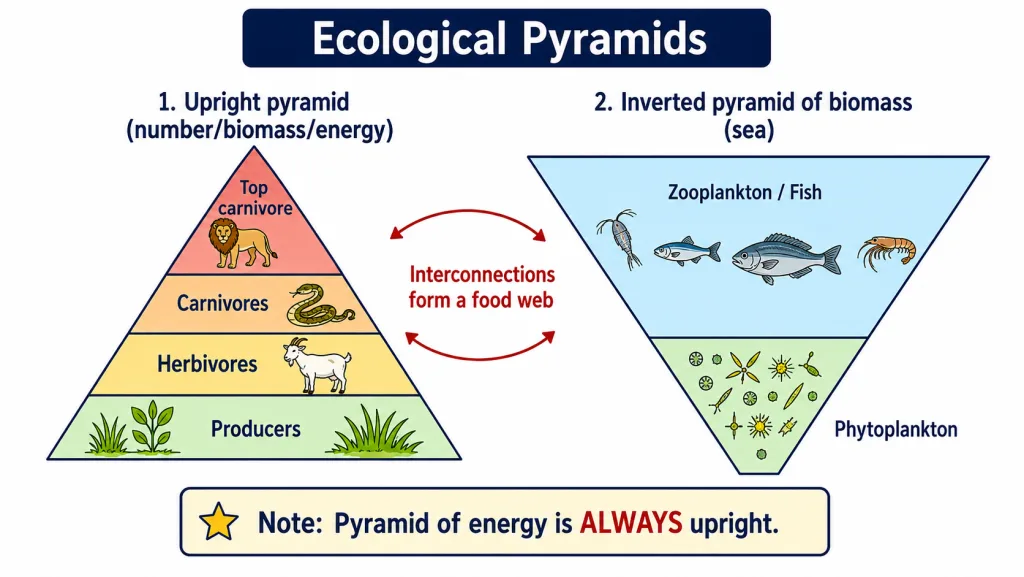
Think of the shape of a pyramid — a broad base narrowing towards the apex. An ecological pyramid captures the feeding relationship between organisms at different trophic levels in exactly that shape. The relationship can be expressed in terms of number, biomass or energy.
In every such pyramid the base represents the producers, the first trophic level, while the apex represents the top-level, or tertiary, consumer. The three types usually studied are the pyramid of number, the pyramid of biomass and the pyramid of energy.
A Trophic Level Is a Function, Not a Species
Any calculation of number, biomass or energy must include all the organisms at a given trophic level. If we count only a few individuals, no generalisation we make will hold.
There is a subtler point too. A trophic level is a functional level, not a species. The same species can occupy more than one trophic level at the same time. A sparrow, for instance, is a primary consumer when it eats seeds but a secondary consumer when it eats insects. So we place organisms by what they are doing in the food chain, not simply by their name.
Upright Pyramids and Their Exceptions
In most ecosystems all three pyramids are upright. Producers are more numerous and carry more biomass than the herbivores, and herbivores in turn exceed the carnivores. Energy at a lower trophic level is always more than at a higher one.
But the pyramids of number and biomass have striking exceptions. The pyramid of numbers can be inverted — think of the many insects feeding on a single big tree, where one producer supports a huge number of consumers. The pyramid of biomass in the sea is generally inverted, because the biomass of the fishes far exceeds that of the tiny phytoplankton that support them.
The pyramid of energy, however, is always upright and can never be inverted. At every transfer from one trophic level to the next, some energy is always lost as heat, so a higher level can never hold more energy than the level below it.
Where Pyramids Fall Short
Useful as they are, ecological pyramids have real limitations. They do not account for a species that belongs to two or more trophic levels at once. They assume a simple food chain, something that almost never exists in nature, and so they cannot accommodate a food web. And they give no place to the saprophytes, the decomposers, even though these organisms play a vital role in the ecosystem.
So a pyramid is a neat summary of trophic structure, but it is a simplification — the real network of feeding relationships is richer than any single triangle can show.
Quick Recap
- An ecological pyramid expresses the relationship between trophic levels in terms of number, biomass or energy; the base is the producers (first trophic level) and the apex the top (tertiary) consumer.
- The three types are the pyramid of number, pyramid of biomass and pyramid of energy.
- Calculations must include all organisms at a level; a trophic level is a functional level, not a species (one species can occupy several).
- Most pyramids are upright, but the pyramid of numbers can be inverted (insects on a big tree) and the pyramid of biomass in the sea is generally inverted (fish biomass exceeds phytoplankton).
- The pyramid of energy is always upright, never inverted, because energy is always lost as heat at each transfer.
- Limitations: they ignore species in two or more levels, assume a simple food chain (no food web) and give no place to decomposers/saprophytes.
Solved Examples — Section 8
Q1. In terms of what three things can an ecological pyramid be expressed?
Answer: In terms of number, biomass or energy.
Q2. What do the base and the apex of an ecological pyramid represent?
Answer: The base represents the producers (first trophic level) and the apex the top-level, or tertiary, consumer.
Q3. Why is a trophic level called a functional level rather than a species?
Answer: Because the same species can occupy more than one trophic level at the same time; e.g. a sparrow is a primary consumer eating seeds and a secondary consumer eating insects.
Q4. Give one example each of an inverted pyramid of numbers and an inverted pyramid of biomass.
Answer: Many insects feeding on a single big tree give an inverted pyramid of numbers; in the sea the biomass of fishes exceeding that of phytoplankton gives an inverted pyramid of biomass.
Q5. Why is the pyramid of energy always upright?
Answer: Because some energy is always lost as heat at each transfer between trophic levels, so a higher level can never hold more energy than the one below it.
Q6. State two limitations of ecological pyramids.
Answer: They assume a simple food chain and cannot accommodate a food web, and they give no place to the decomposers (saprophytes) despite their vital role.