
Growth When Resources Are Unlimited
Availability of resources — mainly food and space — is essential for the unimpeded growth of a population. Ideally, when resources in a habitat are unlimited, each species has the ability to realise fully its innate potential to grow in number, exactly as Darwin observed while developing his theory of natural selection — he famously calculated that even a slow-breeding animal like the elephant would reach enormous numbers if unchecked. Under such conditions the population grows in an exponential (or geometric) fashion.
This kind of runaway growth is only possible while nothing checks it — as soon as food or space begins to run short, the pattern changes. But it is worth understanding the ideal case first, because it reveals the raw growth potential built into every species.
The Exponential Growth Equation
Consider a population of size in which the per-capita birth rate is and the per-capita death rate is . The increase or decrease in during a unit time period is then
If we let , the equation takes the compact form
The term is a single number that captures how fast the population tends to grow, folding the birth and death rates together into one growth parameter.
The Intrinsic Rate of Natural Increase
The in these equations is called the intrinsic rate of natural increase. It is a very important parameter, widely chosen for assessing the impact of any biotic or abiotic factor on population growth — the higher the , the greater a population's inherent capacity to grow.
A few real values give a sense of its magnitude. For the Norway rat is about 0.015, while for the flour beetle it is 0.12. For the human population in India in 1981, the value was 0.0205. To work out such a value for any population you need to know its birth rates and death rates.
The J-Shaped Curve and the Integral Form
When the population size is plotted against time, exponential growth produces a characteristic J-shaped curve that climbs ever more steeply.
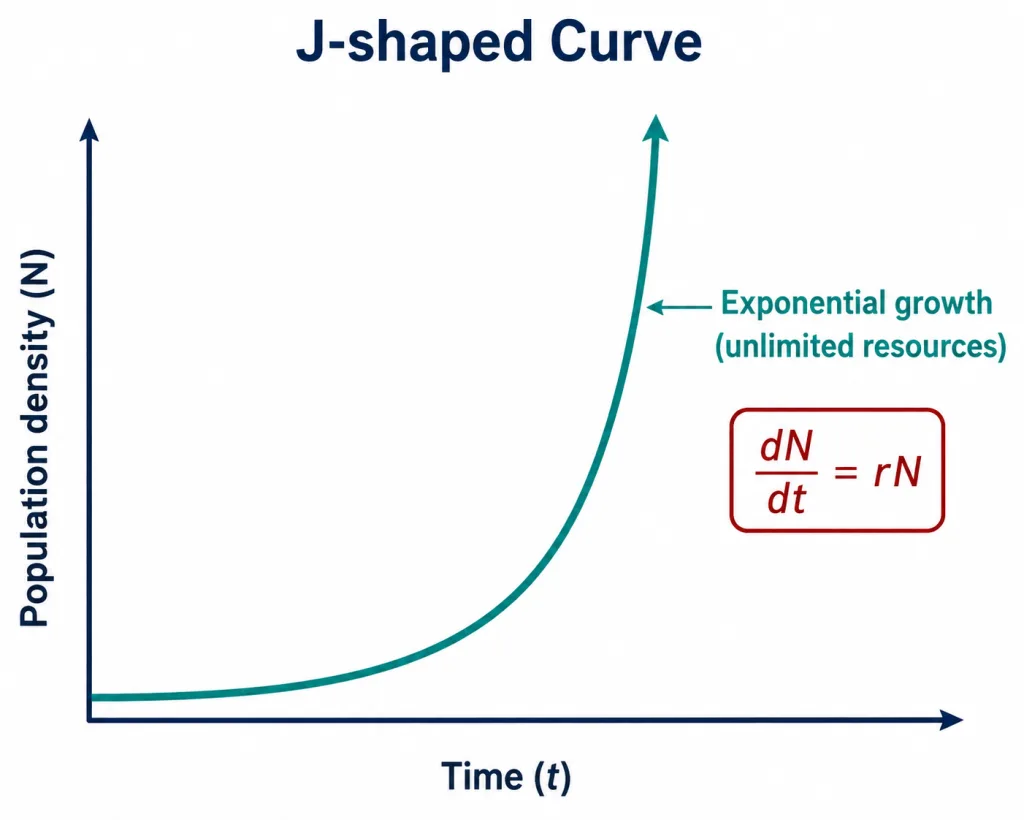
Using basic calculus, the growth equation can be written in its integral form as
where = population density after time , = population density at time zero, = intrinsic rate of natural increase, and = the base of natural logarithms (about 2.71828).
Any species growing exponentially under unlimited resources can reach enormous densities in a very short time. The classic chess-and-wheat anecdote captures this: placing one grain on the first square and doubling the number on each of the 64 squares soon outstrips all the wheat in an entire kingdom. In the same way, a single Paramecium dividing by binary fission and doubling every day would build up a mind-boggling population in just a couple of months (a beyond-NCERT illustration — NCERT's own examples are Darwin's elephant and the chessboard story).
Quick Recap
- When resources (food and space) are unlimited, a population grows exponentially (geometrically), realising its full innate potential, as Darwin noted.
- With per-capita birth rate and death rate : ; letting gives .
- is the intrinsic rate of natural increase, a key parameter for assessing effects on growth (Norway rat , flour beetle , India 1981 ).
- The integral form is , where is the starting density, the density after time , and is about 2.71828.
- Plotting against time gives a J-shaped curve.
- Exponential growth can reach enormous densities fast — as in the chess-and-wheat anecdote and a Paramecium doubling daily.
Solved Examples — Section 5
Q1. Under what conditions does a population grow exponentially?
Answer: When resources — food and space — are unlimited, so each species realises its full innate potential to grow.
Q2. Write the differential form of exponential growth in terms of per-capita birth rate b and death rate d.
Answer: .
Q3. What is r, and what is it called?
Answer: , and it is called the intrinsic rate of natural increase.
Q4. Give the r value for the flour beetle.
Answer: About 0.12.
Q5. Write the integral form of the exponential growth equation and state what means.
Answer: , where is the population density at time zero.
Q6. What shape is the curve when N is plotted against time under exponential growth?
Answer: A J-shaped curve.