
Predation — Nature's Conduit for Energy
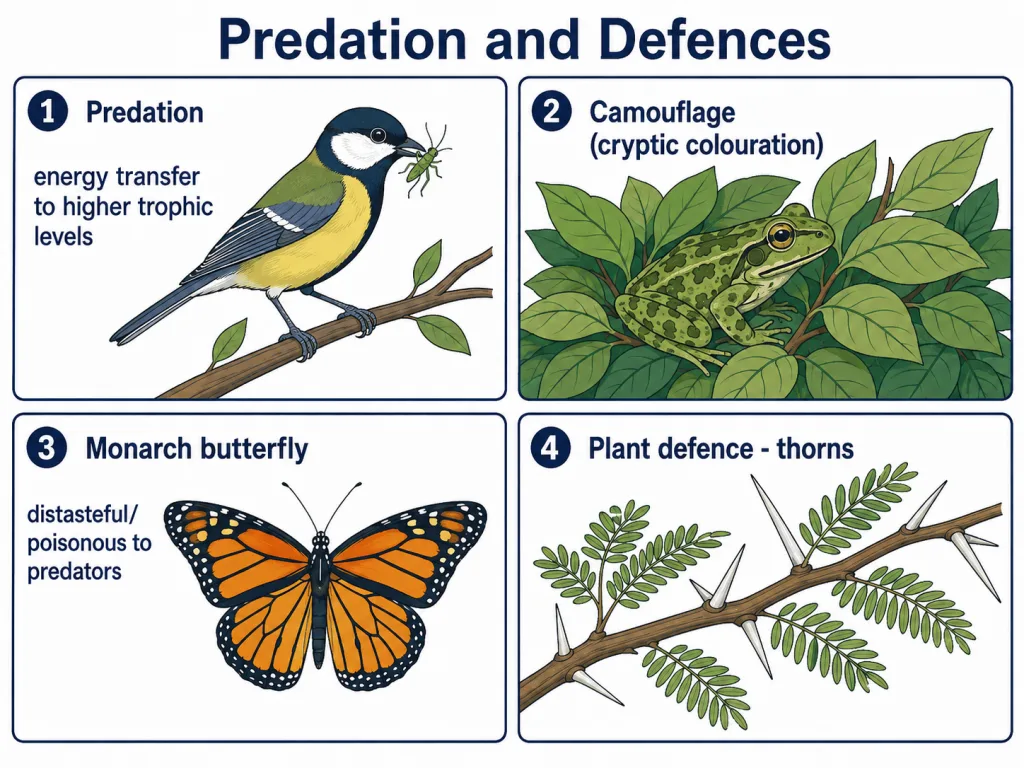
What would happen to all the energy fixed by plants if there were no animals to eat them? Predation is nature's way of transferring the energy fixed by autotrophs up to higher trophic levels. In this sense a predator acts as a 'conduit' for energy flow through a community.
When we picture a predator and its prey, the tiger and the deer come to mind, but the idea is much wider. A sparrow eating a seed is a predator too. And although plant-eating animals are grouped separately as herbivores, in a broad ecological sense they are predators on plants — herbivores are, ecologically, predators.
Why Predators Matter
Beyond moving energy across trophic levels, predators play two other important roles.
They keep prey populations under control. Without predators, prey species could reach very high densities and destabilise the ecosystem. This is exactly what happens when an exotic species is introduced into a new area without its natural predators — it turns invasive. The prickly pear cactus introduced into Australia in the early 1920s spread over millions of hectares of rangeland and was brought under control only after a cactus-feeding moth — a predator from the cactus's natural habitat — was introduced. This is the principle behind biological control of agricultural pests.
Predators also help maintain species diversity by reducing the intensity of competition among prey. On the American Pacific coast the starfish Pisaster is a keystone predator in rocky intertidal communities. In a famous field experiment, when all the Pisaster were removed from an enclosed intertidal area, more than 10 species of invertebrates went extinct within a year because of unchecked interspecific competition.
Prudent Predators and Prey Defences
A predator that is too efficient and overexploits its prey drives the prey to extinction — and, left with no food, the predator then goes extinct too. This is why predators in nature are said to be 'prudent'; unchecked greed is self-defeating.
Prey species, for their part, have evolved a range of defences to lessen the impact of predation. Some insects and frogs are cryptically coloured (camouflaged) so that predators do not detect them easily. Others are simply poisonous and are therefore avoided. The Monarch butterfly is highly distasteful to its bird predator because of a special chemical in its body — and, interestingly, it acquires this chemical during its caterpillar stage by feeding on a poisonous weed.
Plant Defences Against Herbivores
For a plant, the herbivore is the predator, and the problem is severe because a plant cannot run away. About 25 per cent of all insects are phytophagous — they feed on plant sap and other parts. In response, plants have evolved an astonishing range of morphological and chemical defences.
The commonest morphological defence is thorns, as seen in Acacia and Cactus. Many plants also deploy chemical defences — substances that make herbivores sick, inhibit their feeding or digestion, disrupt reproduction, or even kill them. The weed Calotropis that grows in abandoned fields produces highly poisonous cardiac glycosides, which is why cattle and goats never browse on it. Strikingly, several chemicals we extract commercially — nicotine, caffeine, quinine, strychnine and opium — are produced by plants as defences against grazers and browsers.
Quick Recap
- Predation transfers plant-fixed energy to higher trophic levels; a predator is a 'conduit' for energy.
- A sparrow eating a seed is a predator, and herbivores are ecologically predators on plants.
- Predators control prey populations and maintain species diversity (basis of biological control).
- Prickly pear cactus in Australia (early 1920s) was controlled by an introduced cactus-feeding moth; removing the starfish Pisaster caused >10 invertebrate species to go extinct within a year.
- Predators are 'prudent'; prey defences include camouflage and being poisonous (the Monarch butterfly, distasteful due to a chemical acquired as a caterpillar).
- Plant defences: thorns (Acacia, Cactus); cardiac glycosides in Calotropis; nicotine, caffeine, quinine, strychnine, opium are anti-herbivore chemicals; about 25% of insects are phytophagous.
Solved Examples — Section 9
Q1. In ecological terms, what is predation's role in energy flow?
Answer: It transfers the energy fixed by plants to higher trophic levels; the predator acts as a 'conduit' for energy transfer.
Q2. Why is a herbivore considered a predator?
Answer: Because a herbivore feeds on plants (its prey); ecologically, plant-eaters are not very different from predators.
Q3. How was the prickly pear cactus controlled in Australia?
Answer: By introducing a cactus-feeding moth — a predator from the cactus's natural habitat — which is an example of biological control.
Q4. What happened when the starfish Pisaster was removed from an intertidal area?
Answer: More than 10 species of invertebrates became extinct within a year due to interspecific competition, showing that predators maintain species diversity.
Q5. Why is the Monarch butterfly avoided by its bird predator?
Answer: It is highly distasteful because of a special chemical it acquires as a caterpillar by feeding on a poisonous weed.
Q6. Name the commonest morphological plant defence and one chemical defence with its plant.
Answer: Thorns (as in Acacia and Cactus) are the commonest morphological defence; Calotropis produces poisonous cardiac glycosides as a chemical defence.