
Parasitism — Free Lodging and Meals
Because the parasitic way of life offers free lodging and food, it is no surprise that parasitism has evolved in group after group, from plants to higher vertebrates. Many parasites are host-specific, able to parasitise only a single host species, and as a result host and parasite tend to co-evolve: if the host evolves ways to resist the parasite, the parasite must evolve counter-mechanisms to remain successful.
A parasitic lifestyle brings striking adaptations — loss of unnecessary sense organs, adhesive organs or suckers to cling to the host, loss of the digestive system, and a very high reproductive capacity. Life cycles are often complex, involving one or two intermediate hosts or vectors. The human liver fluke depends on two intermediate hosts — a snail and a fish — to complete its cycle, while the malarial parasite needs the mosquito as a vector. Most parasites reduce the host's survival, growth and reproduction and can make it more vulnerable to predation.
Ectoparasites, Endoparasites and Brood Parasitism
Ectoparasites feed on the external surface of the host. Familiar examples are lice on humans and ticks on dogs, while many marine fish carry ectoparasitic copepods. The parasitic plant Cuscuta, seen growing on hedge plants, has lost its chlorophyll and leaves during evolution and draws all its nutrition from the host.
Endoparasites live inside the host at various sites — liver, kidney, lungs, red blood cells. Their life cycles are more complex due to extreme specialisation; their morphology is greatly simplified while their reproductive potential is emphasised.
Brood parasitism in birds is a fascinating case: the parasitic bird — the cuckoo (koel) — lays its eggs in the nest of its host, the crow, and lets the host incubate them. Over evolutionary time the parasite's eggs have come to resemble the host's eggs in size and colour, so the host is less likely to detect and eject them.
Commensalism — One Benefits, the Other Unaffected
In commensalism, one species benefits while the other is neither harmed nor benefited.
An orchid growing as an epiphyte on a mango branch gains support and position while the mango tree is unaffected. Barnacles growing on the back of a whale are carried through nutrient-rich waters while the whale derives no apparent benefit or harm. The cattle egret and grazing cattle make a classic sight: the egrets forage close to the cattle because the moving cattle stir up and flush out insects that the egrets then catch, while the cattle are unaffected. Similarly, the clownfish living among the stinging tentacles of the sea anemone gains protection from predators, while the anemone appears to derive no benefit.
Mutualism — Both Partners Benefit
Mutualism confers benefits on both interacting species.
Lichens are an intimate mutualism between a fungus and photosynthesising algae or cyanobacteria. Mycorrhizae are associations between fungi and the roots of higher plants — the fungus helps the plant absorb essential nutrients from the soil, and the plant supplies the fungus with energy-yielding carbohydrates.
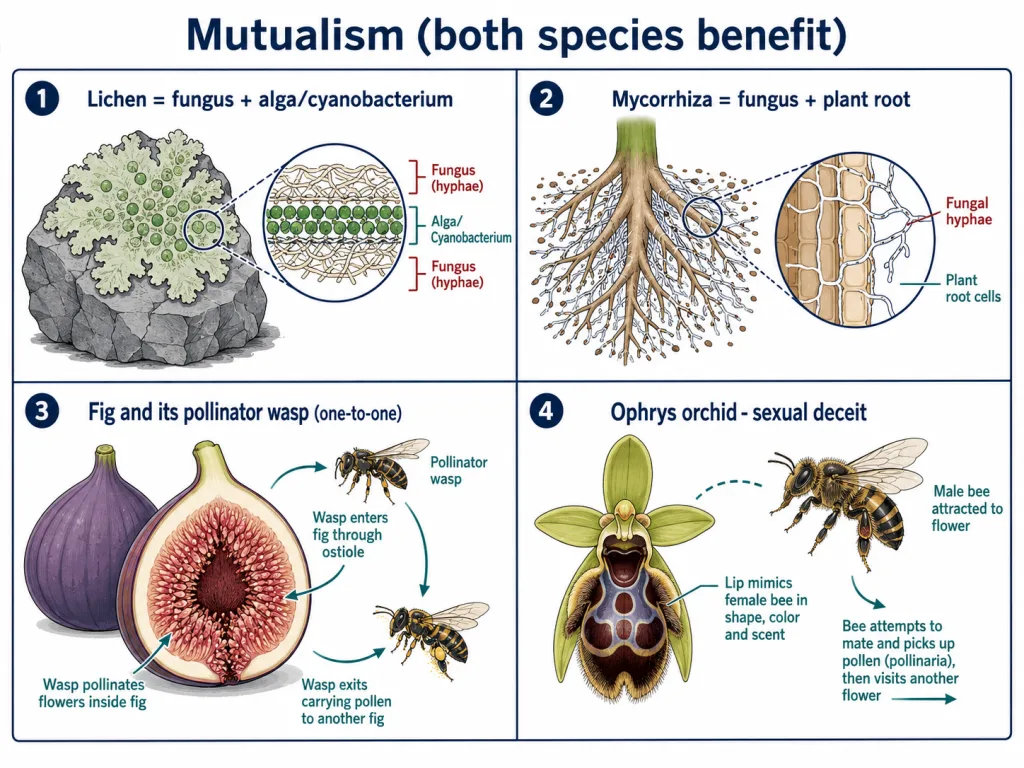
The most spectacular examples come from plant-animal relationships, which often involve co-evolution of flower and pollinator. Many fig species share a tight one-to-one relationship with a partner wasp: a given fig can be pollinated only by its own wasp species, and the female wasp uses the fig's developing seeds to nourish its larvae while pollinating the fig. The Mediterranean orchid Ophrys goes further, using 'sexual deceit' — one petal resembles a female bee in size, colour and markings, so a male bee 'pseudocopulates' with the flower and carries pollen to the next, a vivid illustration of co-evolution between flower and pollinator.
Quick Recap
- Parasitism: parasites get free food and lodging; many are host-specific and co-evolve with the host; adaptations include suckers, loss of digestive system and high reproductive capacity.
- The human liver fluke needs two intermediate hosts (snail and fish); the malarial parasite needs the mosquito vector.
- Ectoparasites (lice, ticks, copepods; Cuscuta on hedges) live outside; endoparasites live inside with simplified morphology but high reproductive potential.
- Brood parasitism: the cuckoo (koel) lays eggs in the crow's nest; parasite eggs resemble the host's.
- Commensalism (one benefits, other unaffected): orchid on mango, barnacles on whale, cattle egret and cattle, clownfish and sea anemone.
- Mutualism (both benefit): lichens (fungus + alga/cyanobacteria), mycorrhizae (fungus + plant roots), the fig-wasp partnership, and the Ophrys orchid's sexual deceit showing co-evolution.
Solved Examples — Section 11
Q1. How many intermediate hosts does the human liver fluke need, and what are they?
Answer: Two intermediate hosts — a snail and a fish.
Q2. What are ectoparasites? Give two examples.
Answer: Parasites that feed on the external surface of the host, such as lice on humans and ticks on dogs (also the plant Cuscuta).
Q3. What is brood parasitism, with an example?
Answer: A bird laying its eggs in another species' nest to be incubated by the host; the cuckoo (koel) lays eggs in the crow's nest, and its eggs resemble the host's.
Q4. An orchid grows as an epiphyte on a mango branch. Name and define this interaction.
Answer: Commensalism — one species (the orchid) benefits while the other (the mango) is neither harmed nor benefited.
Q5. What is mutualism? Give two examples.
Answer: An interaction that benefits both species, such as lichens (fungus with alga/cyanobacteria) and mycorrhizae (fungus with plant roots).
Q6. How does the orchid Ophrys achieve pollination?
Answer: By 'sexual deceit' — one petal resembles a female bee, so a male bee pseudocopulates with the flower and transfers pollen, showing co-evolution of flower and pollinator.