
Why Exponential Growth Cannot Last
No population of any species in nature has unlimited resources at its disposal, so exponential growth cannot continue forever. Food and space run short, and this shortage leads to competition between individuals of the same population. Out of that struggle, the 'fittest' individuals are the ones that survive and reproduce.
Every habitat can support only a maximum number of individuals of a species, beyond which no further growth is possible. This ceiling is nature's carrying capacity, written as K for that species in that habitat.
The Sigmoid Curve and Its Phases
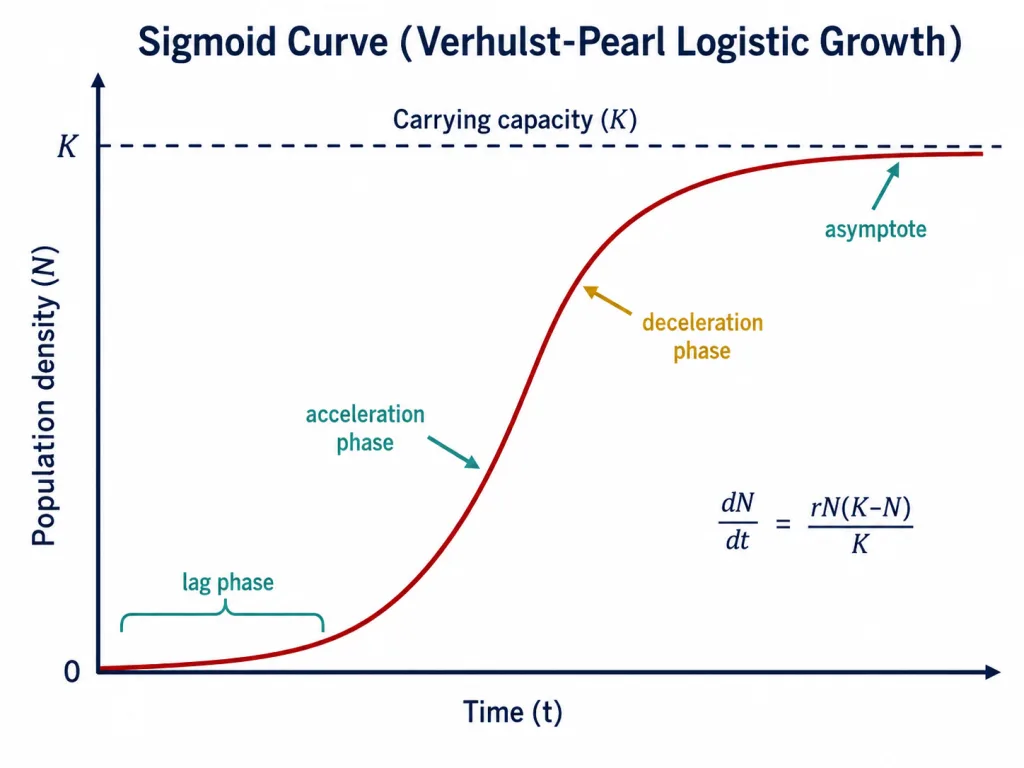
A population growing in a habitat with limited resources does not shoot up in a smooth J-shape. Instead it passes through a sequence of phases: first a slow lag phase, then a phase of acceleration as numbers pick up, followed by a phase of deceleration as resources start to bite, and finally an asymptote when the density levels off at the carrying capacity K.
When density (N) is plotted against time (t), these phases together trace a sigmoid, or S-shaped, curve.
The Verhulst-Pearl Logistic Equation
This pattern of growth is called Verhulst-Pearl Logistic Growth, and it is described by the equation:
Here is the population density at time t, is the intrinsic rate of natural increase, and is the carrying capacity.
The key is the term . When is small, this term is close to 1 and growth is nearly exponential. As climbs towards , the term shrinks towards 0, slowing growth down. When finally equals , the term becomes 0 and growth stops altogether. (And if ever overshoots , the term turns negative — the population declines back towards the carrying capacity.)
Why the Logistic Model Is More Realistic
Resources for growth for most populations are finite and become limiting sooner or later. Because of this, the logistic growth model is considered a more realistic description of how real populations behave than the exponential model, which assumes resources never run out.
In short, the exponential model tells us what a population could do with endless resources, while the logistic model tells us what it actually does once the environment pushes back.
Quick Recap
- No population has unlimited resources, so exponential growth cannot continue; limited resources cause competition, and the fittest survive and reproduce.
- A habitat supports only a maximum number of individuals, the carrying capacity (K), beyond which no growth occurs.
- In a resource-limited habitat a population shows a lag phase, then acceleration, deceleration, and finally an asymptote at K, tracing a sigmoid (S-shaped) curve.
- This is Verhulst-Pearl Logistic Growth, described by , where = density at time t, = intrinsic rate of natural increase, = carrying capacity.
- Because resources become limiting, the logistic model is more realistic than the exponential model.
Solved Examples — Section 6
Q1. Why can exponential growth not continue indefinitely in nature?
Answer: Because no population has unlimited resources; food and space become limiting, leading to competition and a check on growth.
Q2. What is carrying capacity (K)?
Answer: The maximum number of individuals of a species that a given habitat can support, beyond which no further growth is possible.
Q3. Name, in order, the phases of logistic growth.
Answer: Lag phase, then acceleration, then deceleration, and finally an asymptote at the carrying capacity.
Q4. What is the shape of the curve obtained when N is plotted against time in logistic growth?
Answer: A sigmoid, or S-shaped, curve.
Q5. Write the Verhulst-Pearl logistic growth equation and name its terms.
Answer: , where = population density at time t, = intrinsic rate of natural increase, and = carrying capacity.
Q6. Why is the logistic model considered more realistic than the exponential model?
Answer: Because resources for most populations are finite and become limiting sooner or later, so real populations level off rather than growing without bound.