
No Species Lives Alone
Can you think of any natural habitat on earth inhabited by just a single species? There is no such place — the very idea is inconceivable. Every species needs at least one more species to survive.
Even a plant, which makes its own food, cannot live in isolation. It needs soil microbes to break down organic matter and return inorganic nutrients for absorption, and it needs an animal agent to manage pollination. So in nature, animals, plants and microbes do not and cannot live alone; they interact in various ways to form a biological community.
Interspecific Interactions and Their Signs
Interspecific interactions arise from the interaction of populations of two different species. The outcome for each species can be beneficial, detrimental, or neutral — neither harmful nor helpful.
Ecologists capture this compactly with signs: a '+' for a beneficial outcome, a '-' for a detrimental one, and a '0' for a neutral one. Writing the pair of signs for the two species lets us name every possible type of interaction at a glance.
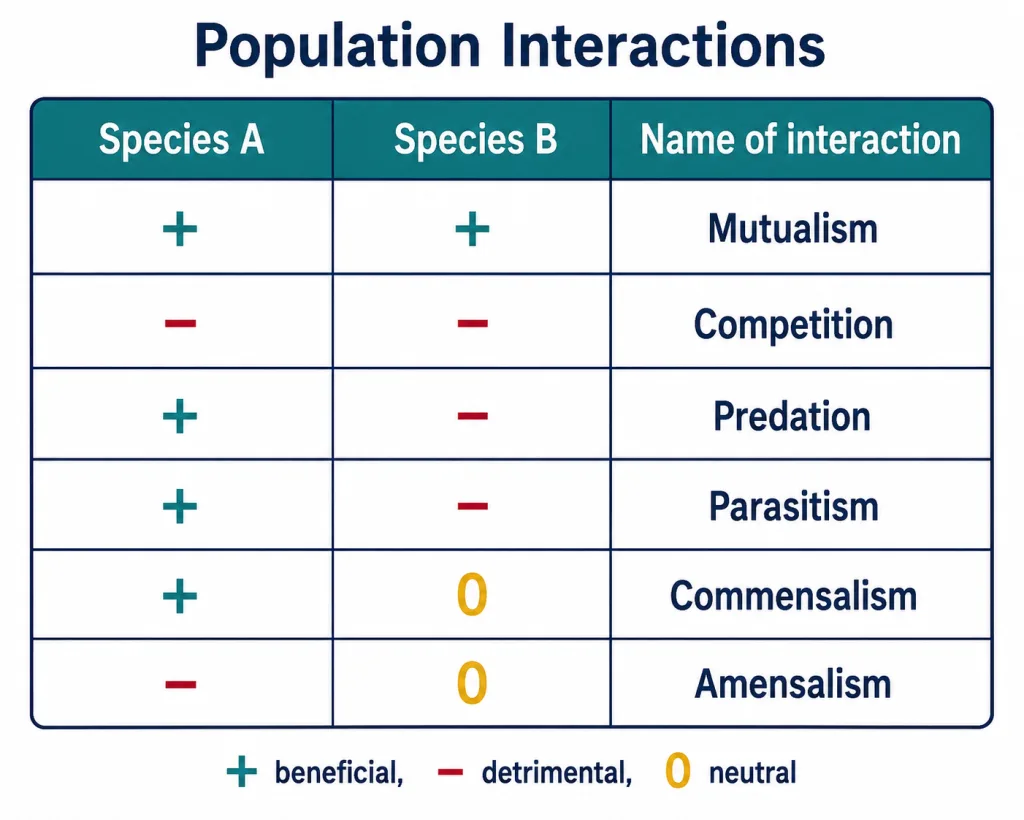
The Six Types of Interaction
Each interaction is defined by its pair of signs:
- Mutualism (+ / +) — both species benefit.
- Competition (- / -) — both species are harmed.
- Predation (+ / -) — the predator benefits, the prey is harmed.
- Parasitism (+ / -) — the parasite benefits, the host is harmed.
- Commensalism (+ / 0) — one species benefits, the other is unaffected.
- Amensalism (- / 0) — one species is harmed, the other is unaffected.
Notice that both predation and parasitism carry the pair (+ / -); they differ in the way the benefiting species obtains its food, not in the sign pattern.
A Shared Feature of Some Interactions
Among these six, three interactions share a common characteristic worth remembering: in predation, parasitism and commensalism, the two interacting species live closely together.
This intimacy of living is one useful way to group the interactions in your mind — the predator and its prey, the parasite and its host, and the commensal and its partner all share close physical association, even though the balance of benefit and harm differs from case to case.
Quick Recap
- In nature, populations of different species never live in isolation; even a plant needs soil microbes and pollinators.
- Interspecific interactions occur between populations of two species and can be beneficial (+), detrimental (-) or neutral (0) to each.
- The types by sign pair: Mutualism (+ / +), Competition (- / -), Predation (+ / -), Parasitism (+ / -), Commensalism (+ / 0), Amensalism (- / 0).
- Predation, parasitism and commensalism share the feature that the interacting species live closely together.
Solved Examples — Section 8
Q1. What are interspecific interactions?
Answer: Interactions that arise between the populations of two different species; the outcome may be beneficial (+), detrimental (-) or neutral (0) to each.
Q2. Give the sign pair for mutualism and state what it means.
Answer: (+ / +); both interacting species benefit.
Q3. Which interaction is denoted by (- / -), and what does it mean?
Answer: Competition; both interacting species are harmed.
Q4. How do the sign patterns of predation and parasitism compare?
Answer: Both are (+ / -) — one species benefits (predator or parasite) while the other is harmed (prey or host).
Q5. Distinguish commensalism from amensalism by their signs.
Answer: Commensalism is (+ / 0) — one benefits, the other is unaffected; amensalism is (- / 0) — one is harmed, the other is unaffected.
Q6. Which three interactions share the feature that the species live closely together?
Answer: Predation, parasitism and commensalism.