
Continuity and Differentiability — The Foundations
Continuity at : — left hand limit, right hand limit and value all present and equal. Piecewise functions can only misbehave at their joints; check LHL, RHL and value at each joint separately. Sums, products, quotients (denominator nonzero) and composites of continuous functions stay continuous; polynomials, rational functions, , , , and are continuous throughout their domains, while jumps at every integer.
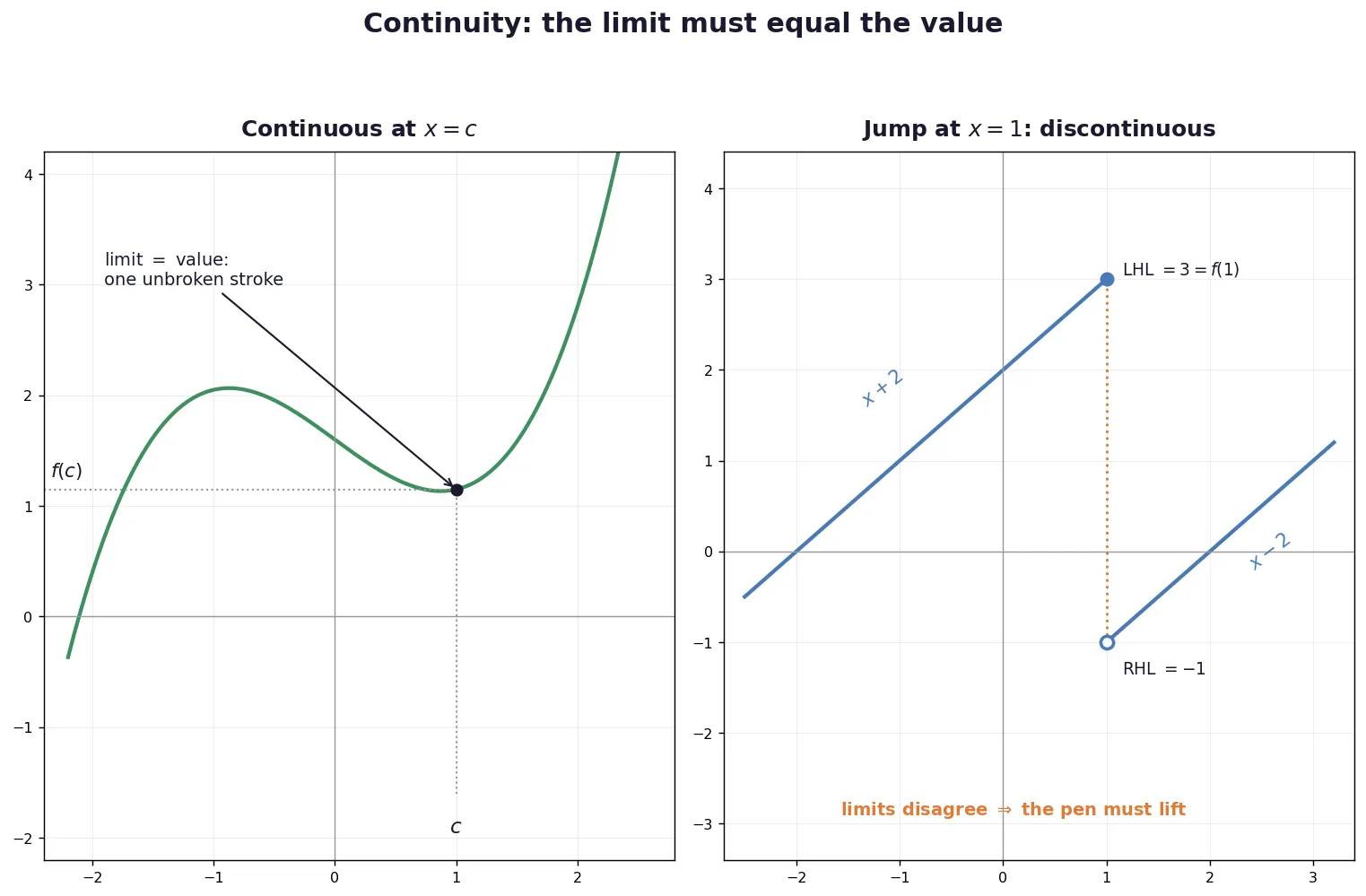
Continuity-constant questions (find ): equate the two sides at the joint. When the piece is a limit form, use the standard limits , , .
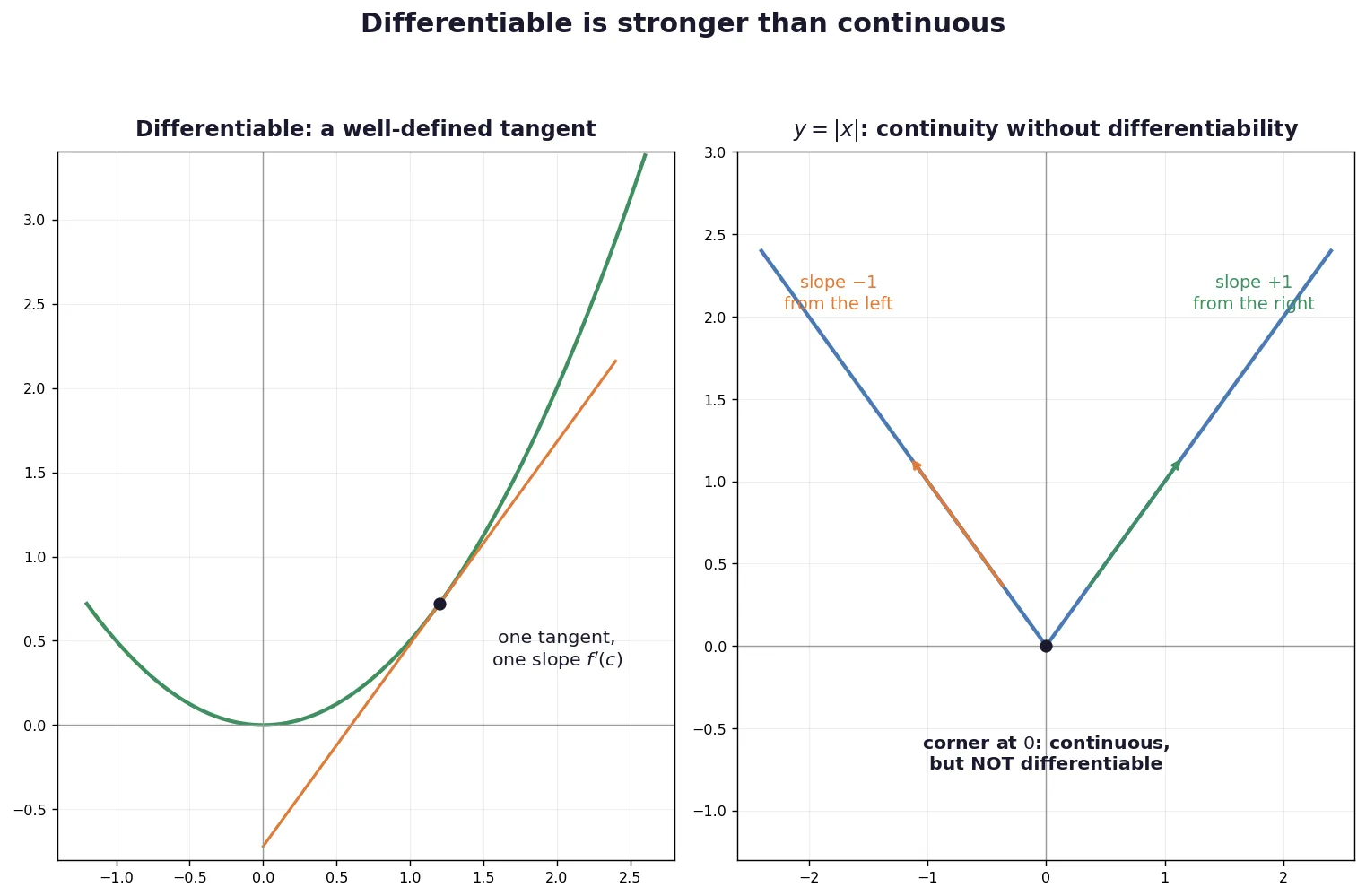
Differentiability: , when the limit exists. Every differentiable function is continuous, but not conversely — is continuous at yet has LHD and RHD : a corner. Every carries one corner at , and fails at integers by failing continuity first.
The Differentiation Toolkit
The table: ; ; ; ; ; ; ; ; ; .
Chain rule — the engine of everything: , one factor per layer, and forgetting the inner factor is the most common error in the chapter.
Implicit differentiation: differentiate the relation as it stands; every appearance of triggers a by the chain rule; collect and solve — the answer may contain both and .
Inverse-trig simplification first: arguments like collapse under to ; differentiating the collapsed form saves a page.
Logarithmic differentiation — for variable-to-variable powers (both positive where needed): take , differentiate, multiply back by . Classify before differentiating: power rule, exponential rule, logarithmic differentiation, constant.
Parametric forms: (with ) — 's rate on top. Standard collapses: and .
Second order: . For relation proofs — the flagship 5-marker — use the clear-then-differentiate trick: after the first derivative, clear radicals or denominators, then differentiate the cleaned equation implicitly and substitute back.
Worked Examples — Continuity and Differentiability
Example 1 — A joint that fails
Find all points of discontinuity of .
Step 1 — away from the joint: each piece is a polynomial — continuous.
Step 2 — at : LHL , RHL — unequal.
Answer: discontinuous only at — piecewise functions are innocent except at their joints.
Example 2 — A continuity constant
Find so that is continuous at .
Step 1 — equate the sides: LHL must equal RHL (and then agrees automatically).
Answer: .
Example 3 — Continuous but not differentiable
Show that is continuous but not differentiable at .
Step 1 — continuity: LHL RHL . ✓
Step 2 — one-sided derivatives: LHD , RHD — unequal.
Answer: continuous with a corner — the standing counterexample to "continuous implies differentiable".
Example 4 — Chain rule, twice over
Differentiate (i) , (ii) .
Step 1 — (i): outer , inner : derivative .
Step 2 — (ii): power rule outside, inner derivative : .
Answer: as computed — every chain-rule answer carries the inner derivative as a visible factor.
Worked Examples — Implicit, Inverse-Trig, Logarithmic
Example 5 — Implicit with a chain inside
Find if .
Step 1 — differentiate through: .
Step 2 — factor and solve:
Answer: as displayed — the exclusion keeps the denominator alive, and answers in and are perfectly acceptable.
Example 6 — Collapse before differentiating
Differentiate for .
Step 1 — substitute : the argument becomes , so on this interval.
Step 2 — differentiate the collapsed form: .
Answer: — three lines instead of a quotient-rule page.
Example 7 — The classification table in action
Differentiate , , and state the derivative of for constant .
Step 1 — log the variable-variable power: , so .
Step 2 — multiply back: .
Step 3 — the constant-base cousin: .
Answer: as displayed — and takes the plain power rule: three shapes, three different tools.
Example 8 — Full logarithmic differentiation
Differentiate , , w.r.t. .
Step 1 — log: .
Step 2 — product rule: .
Answer: — the original function always rides out front.
Example 9 — Exponential and logarithm composites
Differentiate (i) , (ii) for .
Step 1 — (i): the exponential reproduces itself, times the inner derivative: .
Step 2 — (ii): two chain links: .
Answer: as computed — the derivative pair , plus the chain rule covers the whole family.
Worked Examples — Parametric and Second Order
Example 10 — The parabola
Find if , .
Step 1 — differentiate each w.r.t. and divide: .
Answer: — answers in terms of the parameter are complete answers.
Example 11 — The cycloid with the half-angle finish
Find if , .
Step 1 — divide the rates: .
Step 2 — half-angle collapse: .
Answer: — the unsimplified quotient loses the presentation mark.
Example 12 — The sine-cosine relation
If , prove .
Step 1 — differentiate twice: .
Answer: for every choice of constants. ∎
Example 13 — The exponential relation
If , prove .
Step 1 — the two derivatives: , .
Step 2 — substitute: coefficients of : ; of : .
Answer: proved. ∎ (Pattern: passes through as , zero at the exponents present.)
Example 14 — Clear-then-differentiate
If , show that .
Step 1 — first derivative, then clear the radical: , so .
Step 2 — differentiate the cleaned equation: .
Step 3 — multiply by : . ∎
Answer: proved — the clean-up before the second differentiation is the whole trick, and it recurs in every relation proof of this type.