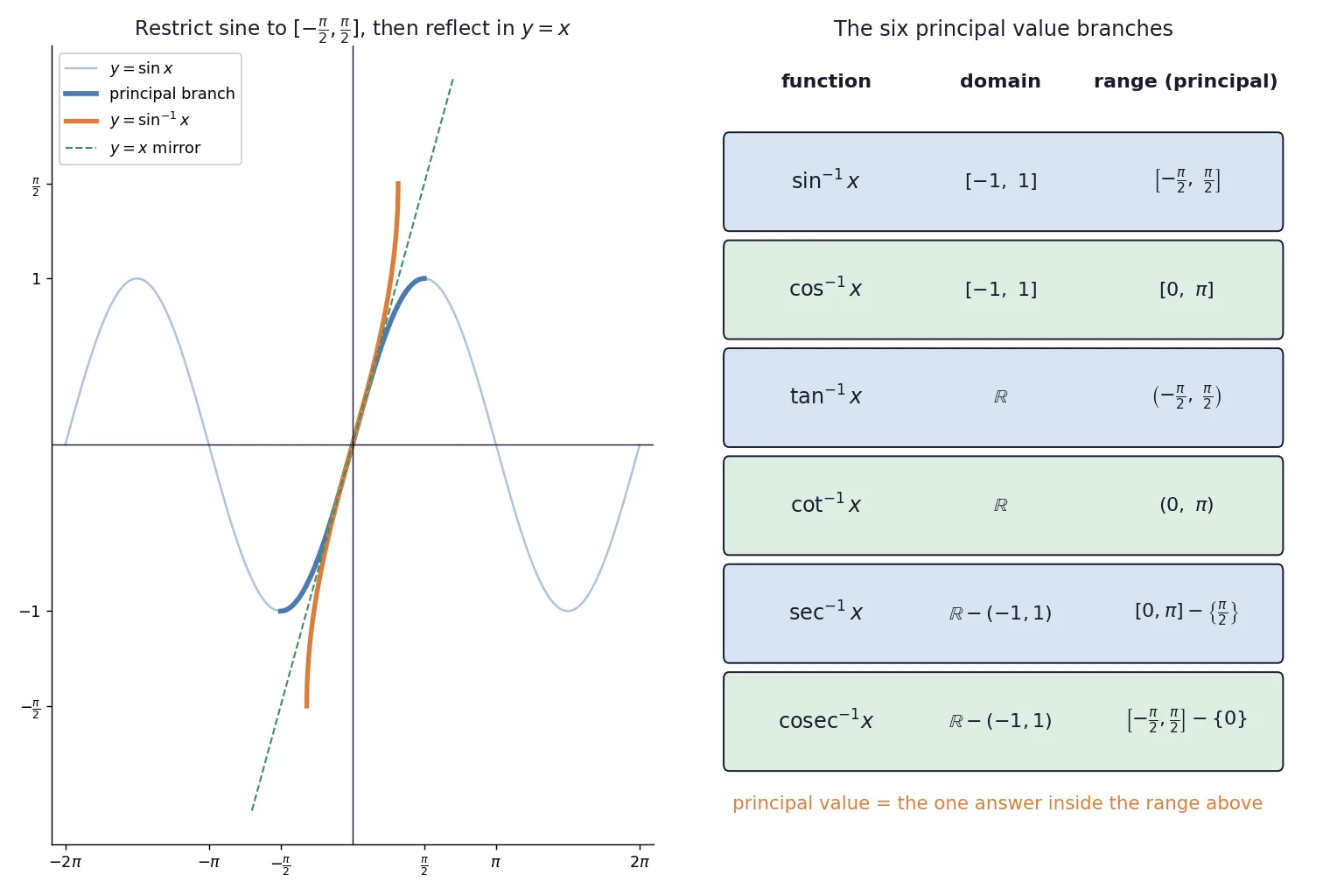
The Six Inverse Functions and Their Principal Branches
Trigonometric functions are many-one on their natural domains, so none of them has an inverse until the domain is restricted. Each restriction chosen is the principal value branch, and the whole chapter lives inside these branches:
Function
Domain
Principal value branch (range)
sin−1x
[−1,1]
[−2π,2π]
cos−1x
[−1,1]
[0,π]
tan−1x
R
(−2π,2π)
cot−1x
R
(0,π)
sec−1x
∣x∣≥1
[0,π]−{2π}
cosec−1x
∣x∣≥1
[−2π,2π]−{0}
The memory pattern:sin−1, tan−1, cosec−1 live in the symmetric interval around 0 (fourth-and-first quadrant); cos−1, cot−1, sec−1 live in [0,π] territory (first-and-second quadrant). Also: sin−1x means the inverse function, never sinx1 — the reciprocal is written (sinx)−1.
Evaluating principal values
To evaluate cos−1(−21): ask which angle in [0,π] has cosine −21? — answer 32π. The branch decides everything: −32π and 34π also have cosine −21, but they are outside [0,π] and therefore wrong answers.
Negative-argument shortcuts (valid on the whole domain):
sin−1(−x)=−sin−1x,tan−1(−x)=−tan−1x,cos−1(−x)=π−cos−1x
Odd behaviour for the symmetric-branch trio; the π-minus flip for the [0,π] trio.
The wrap-around technique
sin−1(sinθ)=θonly whenθ already lies in the principal branch. Otherwise, first replace θ by the branch angle with the same sine:
sin−1(sin53π): since 53π>2π, use sinθ=sin(π−θ): answer π−53π=52π.
cos−1(cos67π): since 67π>π, use cosθ=cos(2π−θ): answer 2π−67π=65π.
tan−1(tan43π): use tanθ=tan(θ−π): answer 43π−π=−4π.
Answering 53π, 67π or 43π to these is the classic error of the chapter — always check the branch before cancelling.
Worked Examples — Principal Values and Wrap-Arounds
Example 1 — Direct principal values
Evaluate (i) sin−1(21), (ii) cos−1(−21), (iii) tan−1(−1).
Step 1 — (i): which angle in [−2π,2π] has sine 21? — 4π.
Step 2 — (ii): which angle in [0,π] has cosine −21? — π−3π=32π.
Answer:4π, 32π, −4π — each pinned by its own branch.
Example 2 — A negative argument in the reciprocal family
Find the principal value of cosec−1(−2).
Step 1 — odd function:cosec−1(−x)=−cosec−1x.
Step 2 — the positive value:cosec−1(2) asks for the branch angle with cosecant 2, i.e. sine 21: that is 4π.
Answer:−4π — inside the branch [−2π,2π]−{0}. ✓
Example 3 — Wrap-around with sine
Evaluate sin−1(sin53π).
Step 1 — check the branch:53π exceeds 2π — direct cancellation is illegal.
Step 2 — same sine, right branch:sin53π=sin(π−53π)=sin52π, and 52πis in the branch.
Answer:52π — never 53π.
Example 4 — Wrap-around with cosine and tangent
Evaluate (i) cos−1(cos67π), (ii) tan−1(tan43π).
Step 1 — (i):67π∈/[0,π]; same cosine at 2π−67π=65π, which is in the branch.
Step 2 — (ii):43π∈/(−2π,2π); tangent has period π, so subtract: 43π−π=−4π.
Answer:65π and −4π — the correction rule depends on the function (π−θ for sine, 2π−θ for cosine, θ−π for tangent).
Example 5 — A three-term principal-value sum
Evaluate tan−1(1)+cos−1(−21)+sin−1(−21).
Step 1 — each term by its branch:tan−1(1)=4π; cos−1(−21)=32π; sin−1(−21)=−6π.
Step 2 — add with a common denominator:123π+128π−122π=129π.
Answer:43π — note how the negative-argument rules do all the sign work.
Properties — Cancellation, Complements and Simplest Forms
The cancellation laws, with their fine print
sin(sin−1x)=x(−1≤x≤1),sin−1(sinθ)=θ(−2π≤θ≤2π)
The first law is unconditional on the domain; the second demands the branch — that asymmetry is the source of every wrap-around question. The same pattern holds for all six functions.
(each on the appropriate domain). These convert mixed sums instantly — any expression containing sin−1x+cos−1x is hiding a constant 2π.
Reciprocal conversions
sin−1x1=cosec−1x,cos−1x1=sec−1x,(∣x∣≥1)
so sec−1(2)=cos−121=3π — always convert the reciprocal family to sine/cosine/tangent before computing.
Simplest forms — the substitution dictionary
"Write in simplest form" questions all yield to one idea: substitute a trig function for x so the expression collapses to a single angle.
Expression contains
Substitute
Typical collapse
a2−x2
x=asinθ
tan−1a2−x2x=sin−1ax
1−cosx, 1+cosx
half-angle
tan−11+cosx1−cosx=2x
1±sinxcosx
half-angle split
tan−11−sinxcosx=4π+2x
a2+x2
x=atanθ
radical becomes asecθ
Presentation for full marks: name the substitution, show the collapse to tan−1(tan(⋅)) or sin−1(sin(⋅)), state the interval that keeps the angle inside the principal branch, and only then cancel. The interval sentence is a genuine mark on the board scheme, not decoration.
Evaluating trig-of-inverse-trig: for tan(sin−153), set θ=sin−153, draw the 3-4-5 right triangle (opposite 3, hypotenuse 5, adjacent 4), and read off tanθ=43. The triangle method turns every such evaluation into arithmetic.
Worked Examples — Properties and Simplest Forms
Example 6 — Complementary pair in action
Evaluate sin−1(72)+cos−1(72).
Step 1 — recognise the pair: the two arguments are identical and lie in [−1,1].
Answer:2π, with no computation — the complementary identity does not care what the common argument is.
Example 7 — Reciprocal conversion
Find the principal value of sec−1(2).
Step 1 — convert:sec−1(2)=cos−121.
Step 2 — evaluate in [0,π]:cos−121=3π.
Answer:3π — the reciprocal family always routes through its partner function.
Example 8 — The triangle method
Evaluate tan(sin−153) and cos(sin−153).
Step 1 — set the angle:θ=sin−153, so sinθ=53 with θ in the first quadrant.
Step 2 — build the triangle: opposite 3, hypotenuse 5, so adjacent =25−9=4.
Step 3 — read off:tanθ=43 and cosθ=54.
Answer:43 and 54 — one triangle answers every ratio question about the same angle.
Example 9 — Simplest form with half-angles
Write tan−1(1+cosx1−cosx), 0<x<π, in simplest form.
Step 1 — half-angle identities:1−cosx=2sin22x and 1+cosx=2cos22x.
Step 2 — collapse the quotient: on 0<x<π both half-angle values are positive, so the roots strip cleanly:
tan−1(cos2xsin2x)=tan−1(tan2x)
Step 3 — cancel inside the branch:0<2x<2π, safely inside (−2π,2π).
Answer:2x — with the interval check written, which is where the last mark lives.
Example 10 — The quarter-turn form
Write tan−1(1−sinxcosx), −2π<x<2π, in simplest form.
Step 1 — half-angle split:cosx=cos22x−sin22x and 1−sinx=(cos2x−sin2x)2.
Step 2 — factor and cancel:(cos2x−sin2x)2(cos2x+sin2x)(cos2x−sin2x)=cos2x−sin2xcos2x+sin2x=1−tan2x1+tan2x=tan(4π+2x)
Step 3 — cancel inside the branch: for the given interval, 4π+2x stays in (0,2π).
Answer:4π+2x.
Example 11 — Substitution with a radical
Write tan−1(a2−x2x), ∣x∣<a, in simplest form.
Step 1 — substitute x=asinθ: then a2−x2=acosθ and the fraction is tanθ.
Step 2 — collapse:tan−1(tanθ)=θ, valid since θ=sin−1ax lies in the tangent branch.
Answer:sin−1ax — the a2−x2 shape always calls the sine substitution.
Example 12 — Solving a simple inverse-trig equation
Find x if tan−1x+2cot−1x=32π.
Step 1 — trade cot−1 for tan−1: write 2cot−1x=2(2π−tan−1x)=π−2tan−1x.
Step 2 — substitute and solve:tan−1x+π−2tan−1x=32π gives tan−1x=π−32π=3π.