Every square matrix A carries one number, detA=∣A∣. Two warnings first: ∣A∣ is not a modulus (determinants can be negative), and only square matrices have determinants. For order 1, ∣[a]∣=a; for order 2,
a11a21a12a22=a11a22−a12a21
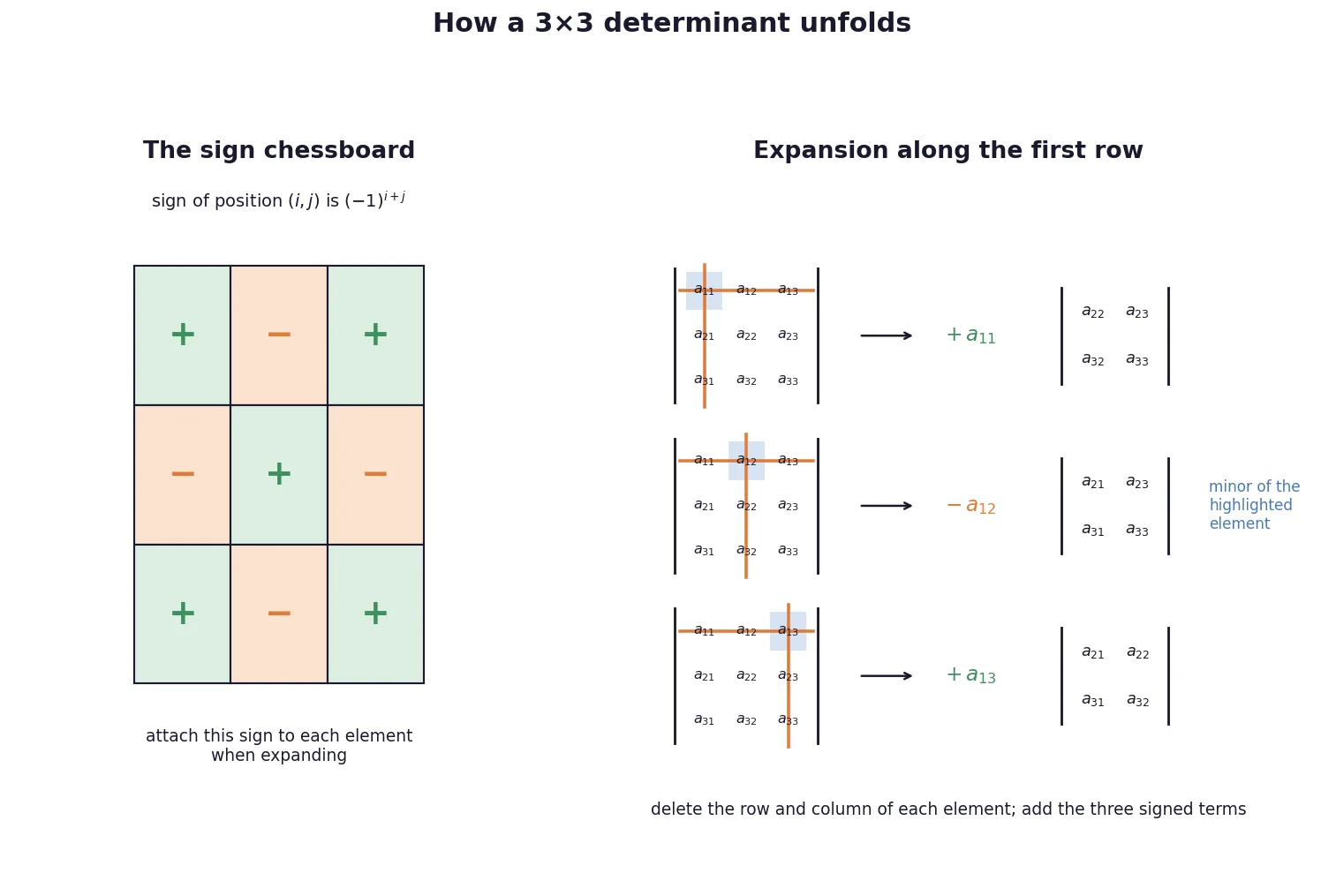
For order 3, expand along any row or column: each element is multiplied by its sign (−1)i+j and by the 2×2 determinant left after deleting its row and column, and the three signed terms are added. All six expansions agree, so pick the line with the most zeros — every zero kills a whole term.
The scaling law:∣kA∣=kn∣A∣ for order n — one factor of k per row, so writing ∣kA∣=k∣A∣ is the chapter's classic error. A triangular matrix's determinant is just the product of its diagonal entries.
Area of a Triangle and Collinearity
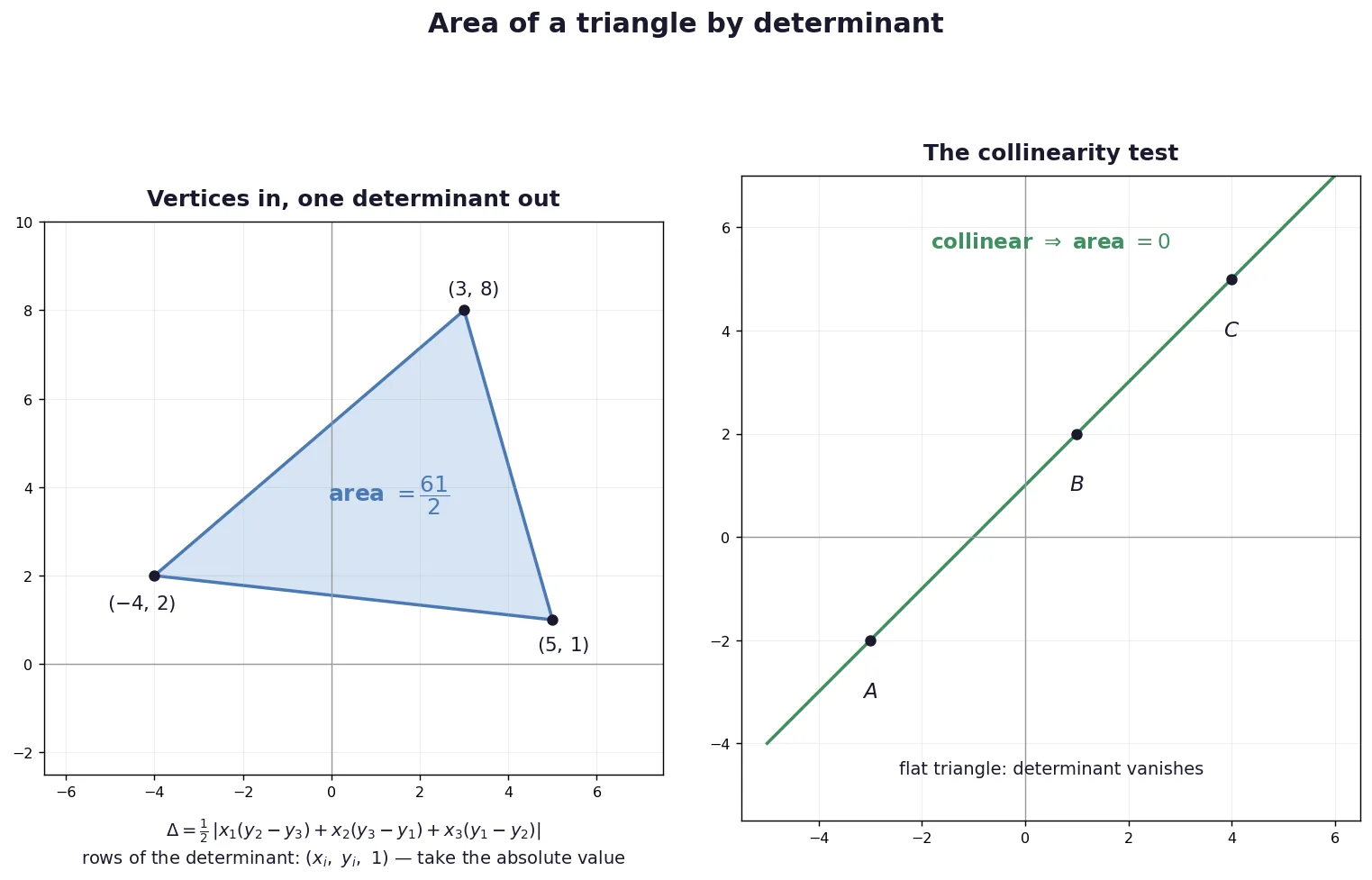
Δ=21x1x2x3y1y2y3111
Three remarks carry the marks: take the absolute value (area is positive); when the area is given, equate the half-determinant to ± the area and solve both signs; and collinear points give determinant zero — which doubles as a way to find the equation of a line through two points (set the flat-triangle determinant with (x,y) to zero).
Minors, Cofactors, Adjoint and Inverse
MinorMij: delete row i and column j. CofactorAij=(−1)i+jMij — the chessboard sign attached. Then elements times their own cofactors sum to Δ (along any line), while elements times another row's cofactors sum to 0 — the own/alien dichotomy.
AdjointadjA = transpose of the cofactor matrix. For 2×2: swap the diagonal, negate the off-diagonal. The master identity and its consequences:
A(adjA)=(adjA)A=∣A∣I,A−1=∣A∣1adjA(∣A∣=0)
Singular means ∣A∣=0 (no inverse); nonsingular means ∣A∣=0 (invertible). The supporting formulas: ∣AB∣=∣A∣∣B∣, det(A−1)=detA1, and ∣adjA∣=∣A∣n−1 (so ∣A∣2 at order 3).
Solving Systems — the Matrix Method
Write the system as AX=B (coefficients, unknowns, constants). If ∣A∣=0: unique solution
X=A−1B
(premultiply — never BA−1). If ∣A∣=0: compute (adjA)B — nonzero means inconsistent (no solution); zero means infinitely many solutions or none, to be examined directly. Board presentation: state ∣A∣before inverting, show adjA, and end by substituting the solution back into one equation.
Worked Examples — Evaluation and Area
Example 1 — A 2×2 with signs
Evaluate 2−54−1.
Step 1 — diagonal rule:2(−1)−4(−5)=−2+20.
Answer:18 — the second product is subtracted, so its minus becomes a plus.
Example 2 — The zeros shortcut
Evaluate Δ=1−14231400.
Step 1 — pick the third column (two zeros): only one term survives, with chessboard sign + at position (1,3):
Δ=4−1431−0+0
Step 2 — finish:4(−1−12)=−52.
Answer:−52 — one 2×2 instead of three, because the column was chosen well.
Example 3 — Solving for an unknown entry
Find x if 2x64x=2541.
Step 1 — expand both sides:2x2−24=2−20=−18.
Step 2 — solve:2x2=6, so x2=3.
Answer:x=±3 — a quadratic gives both roots; dropping the negative one is the standard mark-loser.
Example 4 — Area of a triangle
Find the area of the triangle with vertices (3,8), (−4,2), (5,1).
Step 1 — set up and expand:Δ=21[3(2−1)−8(−4−5)+1(−4−10)]=21(3+72−14)
Answer:261 square units — and had the bracket come out negative, the absolute value would fix the sign, not a recalculation.
Example 5 — Given area, two answers
Find k if the triangle with vertices (k,0), (4,0), (0,2) has area 4 square units.
Step 1 — half-determinant with both signs: the determinant simplifies (base on the x-axis, height 2) to give 4−k=±4.
Step 2 — solve both:k=0 or k=8.
Answer:k=0 or 8 — one triangle on each side; a single answer is half the marks.
Worked Examples — Cofactors, Adjoint, Inverse
Example 6 — A cofactor table with the alien check
For Δ=261−30554−7, find the first-row cofactors and the value of Δ.
Step 1 — the three cofactors:A11=+054−7=−20,A12=−614−7=46,A13=+6105=30
Answer:x=3, y=−1; check in the second equation: 9−2=7. ✓
Example 12 — Matrix method, three variables
Solve 3x−2y+3z=8, 2x+y−z=1, 4x−3y+2z=4.
Step 1 — determinant: expanding along R1: 3(2−3)+2(4+4)+3(−6−4)=−3+16−30=−17=0.
Step 2 — adjoint, inverse, multiply: computing the cofactor matrix, transposing, dividing by −17 and multiplying into B=(8,1,4)′ gives
X=123
Answer:x=1, y=2, z=3; check the first equation: 3−4+9=8. ✓ This full pipeline — determinant, adjoint, inverse, product, verification — is the standard 5-mark question of the chapter.
Example 13 — Detecting inconsistency
Examine the consistency of x+3y=5, 2x+6y=8.
Step 1 — determinant:∣A∣=6−6=0 — the matrix method stops; move to the adjoint test.
Step 2 — the test product:(adjA)B=(6−2−31)(58)=(6−2)=O
Answer: inconsistent — no solution; geometrically the two lines are parallel (doubling the first equation demands 2x+6y=10=8).
Ready to test your knowledge?
Take a quick interactive quiz on this topic —
free, works without login.