
Relations — The Three Properties and Equivalence
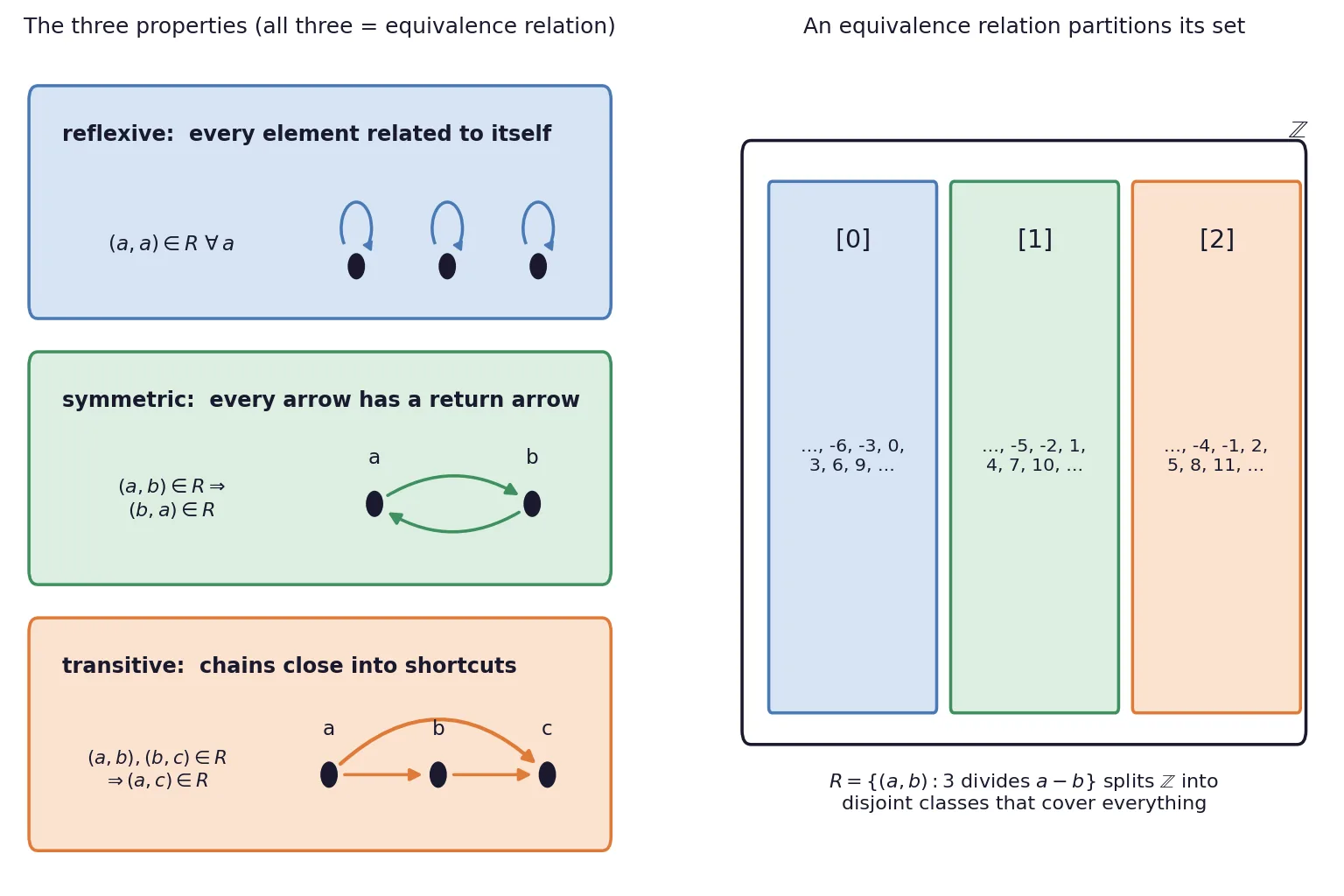
A relation from a set to itself is any subset of ; is written . On a set with elements there are possible relations — the two extremes being the empty relation (no pair related) and the universal relation (every pair related). Everything the board asks about relations comes down to three properties, each with a precise test:
- Reflexive: for every . One missing diagonal pair breaks it.
- Symmetric: whenever , also . Test every pair; one one-way pair breaks it.
- Transitive: whenever and , also . The chains must close.
A relation with all three properties is an equivalence relation — the chapter's central definition, and the single most-asked proof in board papers.
How to write the proof for full marks: take arbitrary elements, verify each property from the defining condition (never from a few examples), and state the conclusion. For "divisible by" conditions the three checks almost write themselves: is divisible by anything (reflexive); if divides it divides (symmetric); if divides and it divides their sum (transitive).
Equivalence classes
An equivalence relation slices into disjoint equivalence classes: , the set of everything related to . Two facts carry the marks:
- Classes are either identical or disjoint — they partition the set.
- exactly when .
Standard specimen: on , iff divides gives exactly three classes — the possible remainders. With " is even", the two classes are the odds and the evens: all odd numbers are related to each other, all evens to each other, and never across.
Frequent one-mark traps: symmetric-and-transitive does not force reflexive (the element might relate to nothing at all); the smallest equivalence relation containing a given pair on needs exactly the diagonal plus and — five pairs; and a relation can be reflexive and transitive without being symmetric ( is the standing example).
Worked Examples — Relations
Example 1 — A relation with none of the properties
Check the three properties for on .
Step 1 — reflexive? would need — false. Not reflexive.
Step 2 — symmetric? but would need — false. Not symmetric.
Step 3 — transitive? and are in , but would need — false. Not transitive.
Answer: neither reflexive, nor symmetric, nor transitive — one concrete failing pair is a complete disproof for each property.
Example 2 — The divisibility template, in full
Show that on , defined by iff divides , is an equivalence relation, and find its equivalence classes.
Step 1 — reflexive: , divisible by . ✓
Step 2 — symmetric: if then , still divisible. ✓
Step 3 — transitive: if and , then . ✓
Step 4 — the classes: (evens) and (odds).
Answer: an equivalence relation with exactly two classes — evens and odds. This add-the-differences trick is the whole transitivity proof for every divisibility relation.
Example 3 — Counting classes for mod 3
For on with iff divides , list the equivalence classes.
Step 1 — the proof pattern: identical to Example 2 with in place of — equivalence confirmed.
Step 2 — classes by remainder: every integer leaves remainder , or on division by , and two integers are related exactly when their remainders match.
Answer: three classes — , , . In general, mod gives exactly classes.
Example 4 — Reflexive and transitive but not symmetric
Check the properties of on .
Step 1 — reflexive: always. ✓
Step 2 — symmetric? but is false. ✗
Step 3 — transitive: and chain to . ✓
Answer: reflexive and transitive, not symmetric — the standard counterexample showing the three properties are genuinely independent.
Example 5 — The smallest equivalence relation containing a pair
Find the smallest equivalence relation on containing .
Step 1 — what is forced: reflexivity demands ; symmetry demands to partner the given .
Step 2 — check nothing more is forced: transitivity on requires and — already present. The element stays in its own class.
Answer: — exactly pairs. Adding any pair involving would be a larger equivalence relation, not the smallest.
Functions — One-One, Onto, Bijective
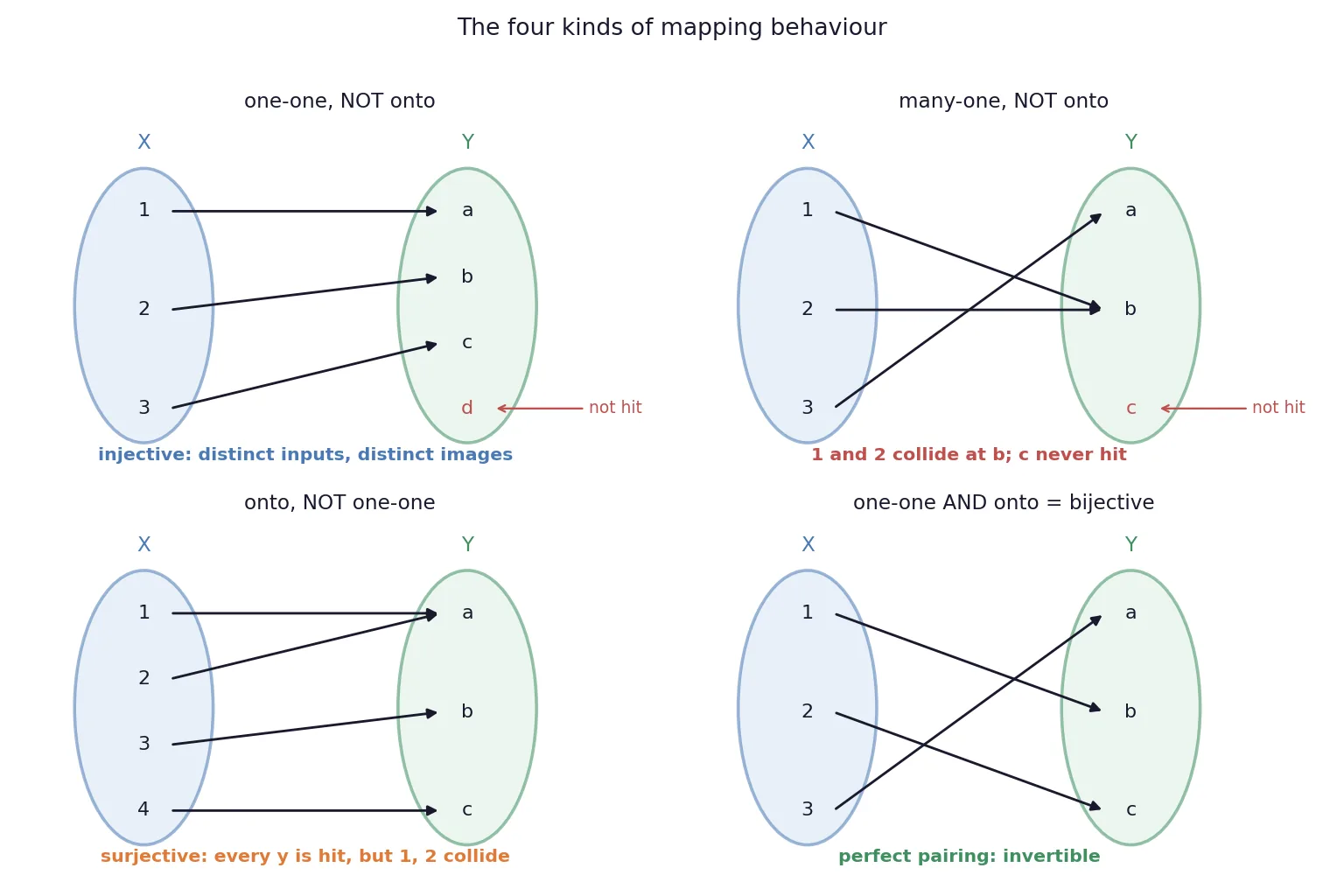
A function assigns exactly one output in to each input in . The chapter classifies functions by two independent questions:
One-one (injective): different inputs give different outputs. Working test: assume and derive by algebra. Disproof: exhibit two distinct inputs with equal outputs — one pair is enough.
Onto (surjective): every element of the codomain is hit. Working test: take an arbitrary , solve for , and check the solution lies in . Disproof: name one element of with no preimage.
Bijective = one-one and onto — the gold standard, because bijective is exactly what makes a function invertible.
The domain matters as much as the formula. is not one-one on (since ) but is one-one on ; it is not onto (no negative value is hit) but is onto if the codomain says so. Every injectivity/surjectivity verdict must quote the domain and codomain — answers that ignore them lose marks even when the algebra is right.
Composition and Invertibility
Composition: — apply first, then . Order matters: in general , and showing this with a concrete pair is itself a board question. Composition is associative, and composing with the identity function changes nothing.
Invertible function: is invertible if there is a with and ; then , and it is unique.
Finding , the three-line routine: set , solve for in terms of , and declare to be that expression. Always finish by verifying one composition — — because the verification line is where the presentation mark lives.
Useful closing facts: the composition of two bijections is a bijection, (order reverses, exactly like matrix inverses), and if the function is its own inverse — a pattern the board likes to hide inside rational functions.
Worked Examples — Functions
Example 6 — A full bijectivity proof
Show that , , is bijective.
Step 1 — one-one: suppose : then , so and . ✓
Step 2 — onto: take any and solve : , which is a real number, and . ✓
Answer: bijective. Every non-constant linear function () passes both tests by exactly this algebra.
Example 7 — When the domain changes the verdict
Discuss whether is one-one and onto (i) as , (ii) as .
Step 1 — case (i), one-one? with — not one-one.
Step 2 — case (i), onto? has no preimage (squares are never negative) — not onto.
Step 3 — case (ii), one-one? for natural numbers, forces (both positive) — one-one. ✓
Step 4 — case (ii), onto? is not a perfect square, so no natural has — not onto.
Answer: (i) neither; (ii) one-one but not onto. Same formula, different verdicts — the domain and codomain are part of the function.
Example 8 — One-one but not onto
Show that , , is one-one but not onto.
Step 1 — one-one: gives . ✓
Step 2 — onto? the element of the codomain would need , i.e. — not a natural number. ✗
Answer: one-one, not onto — the shift leaves uncovered. (The same map on is onto: infinite sets behave differently from finite ones.)
Example 9 — A cubic bijection
Show that , , is bijective.
Step 1 — one-one: gives ; the second factor is positive unless both are zero, so . ✓
Step 2 — onto: for any real , is real and . ✓
Answer: bijective, with — contrast with , where the even power destroys injectivity.
Worked Examples — Composition and Inverse
Example 10 — Order matters in composition
For and , find and and show they differ.
Step 1 — : .
Step 2 — : .
Step 3 — one test value: at : while .
Answer: — a single differing value is a complete proof.
Example 11 — Find the inverse and verify
Show that , , is invertible and find .
Step 1 — bijective: linear with nonzero slope — one-one and onto by the Example 6 algebra.
Step 2 — solve : , so .
Step 3 — verify: ✓ and ✓.
Answer: — always close with the verification line.
Example 12 — A function that is its own inverse
Let , . Show that . What is ?
Step 1 — compute :
Step 2 — conclude: is the identity, so is invertible with
Answer: the function is its own inverse — multiply through by the common denominator and the collapse is three lines.
Example 13 — Composition, numerically
For and , evaluate and .
Step 1 — : , then .
Step 2 — : , then .
Answer: and — read compositions inside-out, always applying the nearer function to the input first.