
What Is a Differential Equation?
Ordinary equations like or involve only variables. An equation like
involves a derivative of the dependent variable — and that changes everything. In general:
Definition: An equation involving derivatives of the dependent variable with respect to the independent variable is called a differential equation.
Such equations arise wherever change is modelled — physics, chemistry, biology, economics — because nature usually specifies rates, and solving the differential equation recovers the quantity itself.
Ordinary versus partial
- A differential equation involving derivatives with respect to only one independent variable is an ordinary differential equation (ODE) — e.g. .
- Equations with derivatives with respect to several independent variables are partial differential equations — beyond this course. From here, "differential equation" means an ordinary one.
Notation
The dash notation keeps long equations readable; avoids a forest of dashes for higher orders.
Key Point: A differential equation is a relationship between a function and its rates of change. "Solving" it will mean finding every function that makes the relationship true — a function-valued answer, not a number-valued one.
Order and Degree
Order
Definition: The order of a differential equation is the order of the highest order derivative of the dependent variable appearing in it.
- — highest derivative : order 1.
- — highest derivative : order 2.
- — highest derivative : order 3 (the power on is irrelevant to order).
Degree — check the polynomial condition first
Definition: When the equation is a polynomial equation in its derivatives , the degree is the highest power (a positive integer) of the highest order derivative.
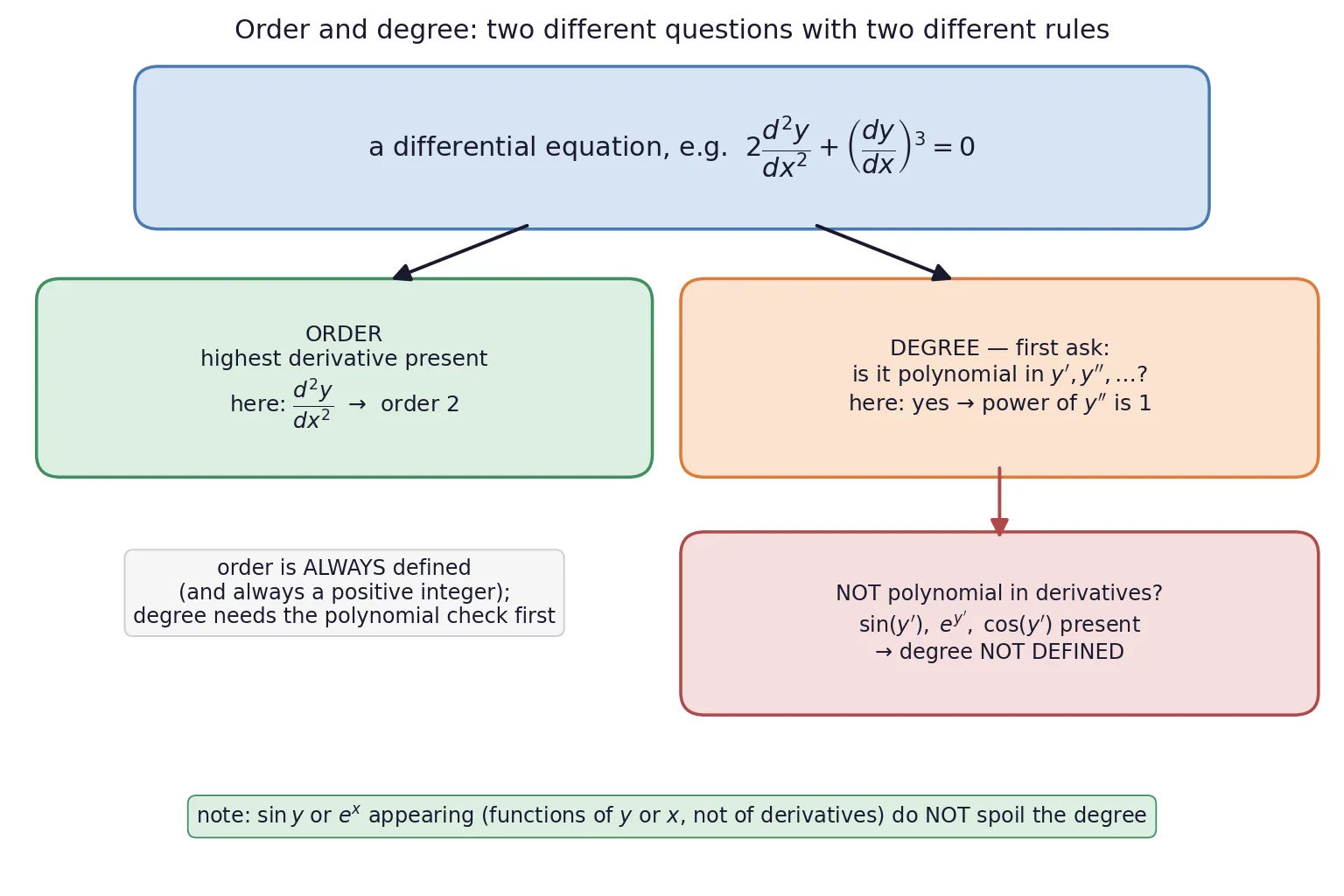
The three NCERT touchstones:
- — polynomial in : degree (power of ).
- — polynomial in (the involves , not a derivative — harmless): degree .
- — of a derivative: not a polynomial in , so the degree is not defined.
The rules in brief
- Order is always defined; degree only when the polynomial condition holds.
- Order and degree (when defined) are always positive integers.
- Functions of or of alone (, , ) never spoil the degree — only functions of derivatives (, , ) do.
Key Point: Two separate questions, two separate scans. First scan for the highest derivative (order — always answerable). Then ask "polynomial in the derivatives?" — if yes, read off the power of the highest derivative; if no, write "degree not defined", which is itself a full-credit answer.
[JEE Tip] JEE and boards both bait with equations needing clearing first: must be squared to before reading degree . Clear roots and fractions of derivatives first, then apply the definitions — but never try to "clear" a ; that stays undefined.
Solved Examples
Example 1: A clean first-order equation
Find the order and degree, if defined, of .
Solution:
- Order: highest derivative is — order .
- Degree: polynomial in ( involves only ); power of is .
Final Answer: order , degree .
Example 2: Products of derivatives
Find the order and degree, if defined, of .
Solution:
- Order: highest derivative is — order .
- Degree: the equation is polynomial in and ; the highest power of is (the square sits on , which doesn't count).
Final Answer: order , degree .
Example 3: A derivative inside an exponential
Find the order and degree, if defined, of .
Solution:
- Order: highest derivative — order .
- Degree: is an exponential of a derivative — the equation is not polynomial in its derivatives.
Final Answer: order , degree not defined. (The term is irrelevant — powers of itself never matter.)
Example 4: Sine of a third derivative
Find the order and degree, if defined, of .
Solution:
- Order: highest derivative — order .
- Degree: breaks the polynomial condition.
Final Answer: order , degree not defined.
Example 5: Watch which derivative carries the power
Find the order and degree, if defined, of .
Solution:
- Order: highest derivative is — order .
- Degree: polynomial in both derivatives; the power of the highest derivative is — the fourth power on the lower-order does not set the degree.
Final Answer: order , degree .
Takeaway: Degree reads the exponent on the highest-order derivative only. A big power on a lower derivative is a decoy — the single most common order/degree error.
Example 6: Both order and degree above 1
Find the order and degree, if defined, of .
Solution:
- Order: highest derivative — order .
- Degree: polynomial in all derivatives; power of is .
Final Answer: order , degree .