
The Chapter in One Sweep
A differential equation relates a function to its derivatives. This chapter teaches you to do exactly two things: read such an equation (order, degree, what counts as a solution) and solve the three first-order types that boards and JEE actually ask.
Reading an equation
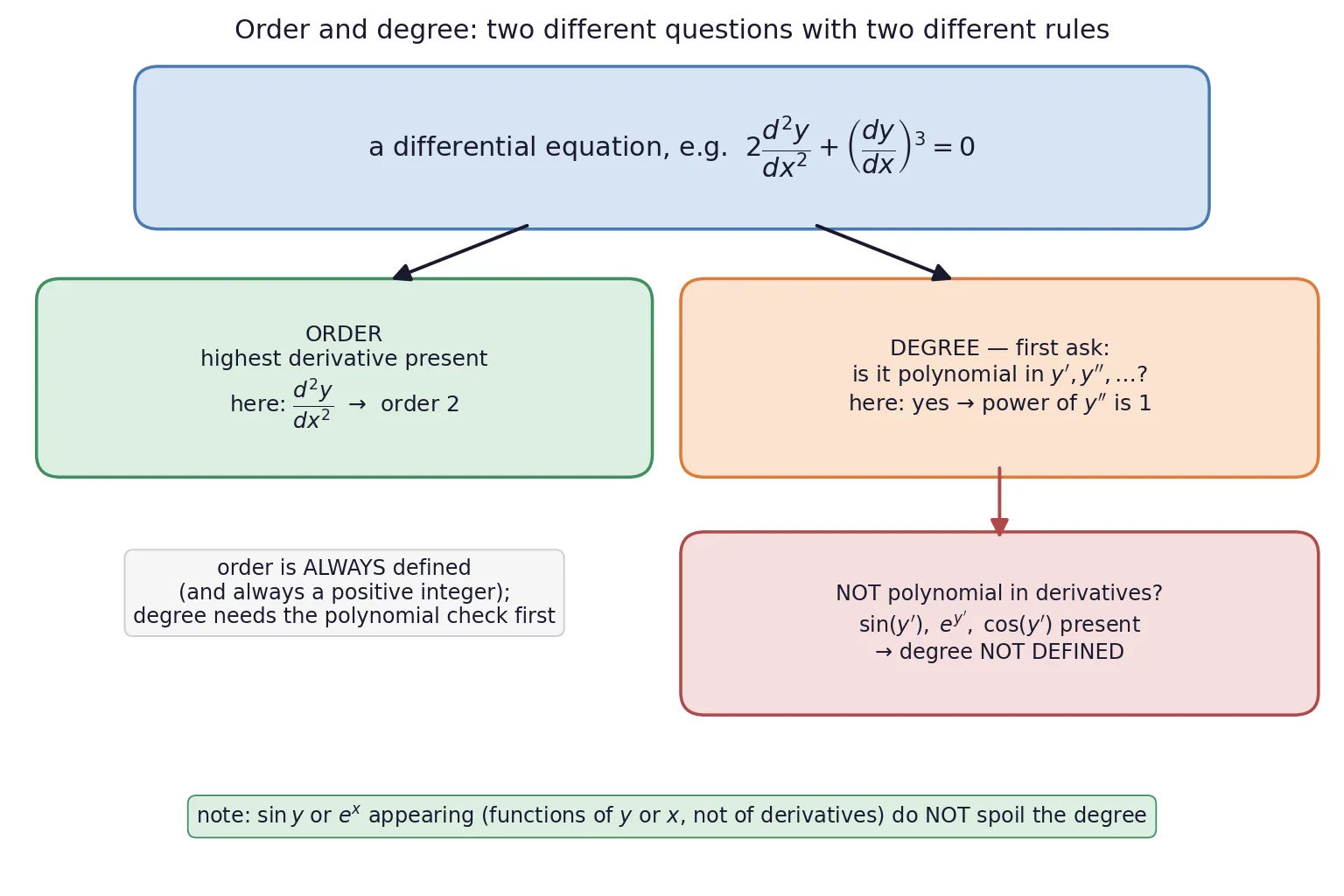
- Order = the order of the highest derivative present.
- Degree = the power of that highest-order derivative, but only after the equation is polynomial in its derivatives — clear roots and fractions first; if a derivative sits inside , , , the degree is not defined. (A function like wrapping the variable is harmless.)
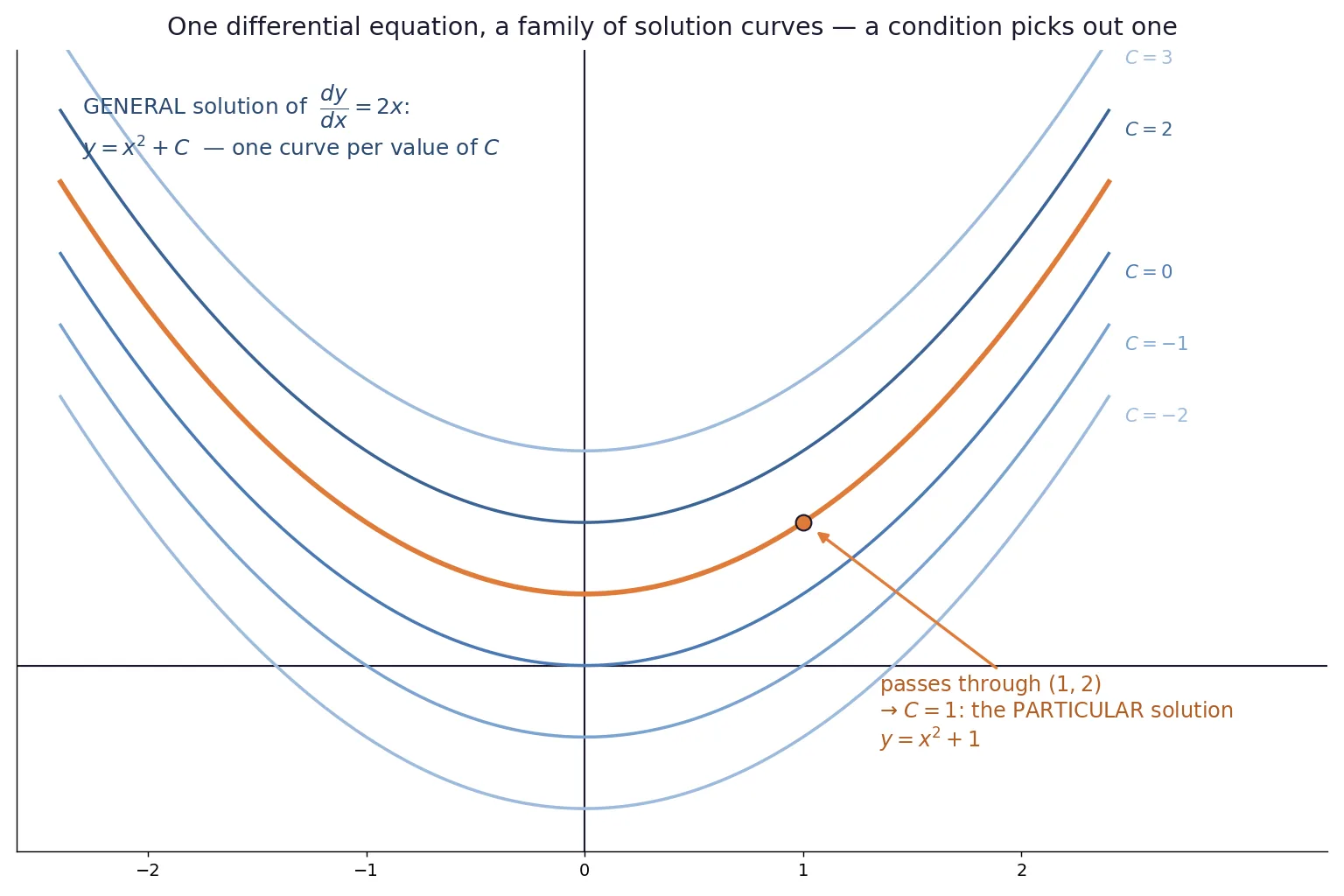
- General vs particular: the general solution of an order- equation carries exactly arbitrary constants; a particular solution carries none — the constants are fixed by given conditions. To verify a claimed solution, differentiate it and substitute; never try to re-solve.
The three-method decision tree
Ask in this order:
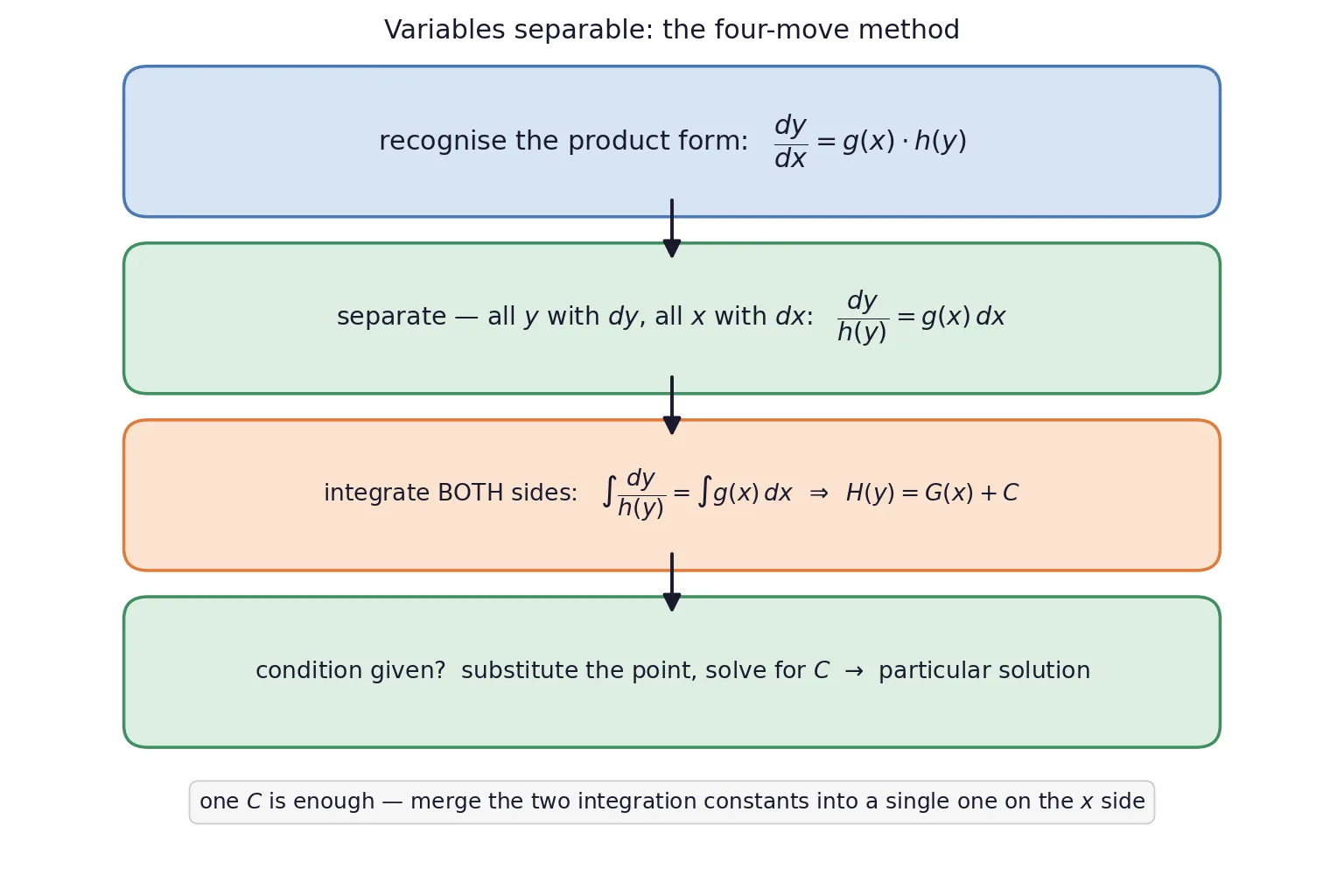
- Does the right side factor as ? → Variables separable. Move all to , all to , integrate both sides, one constant.
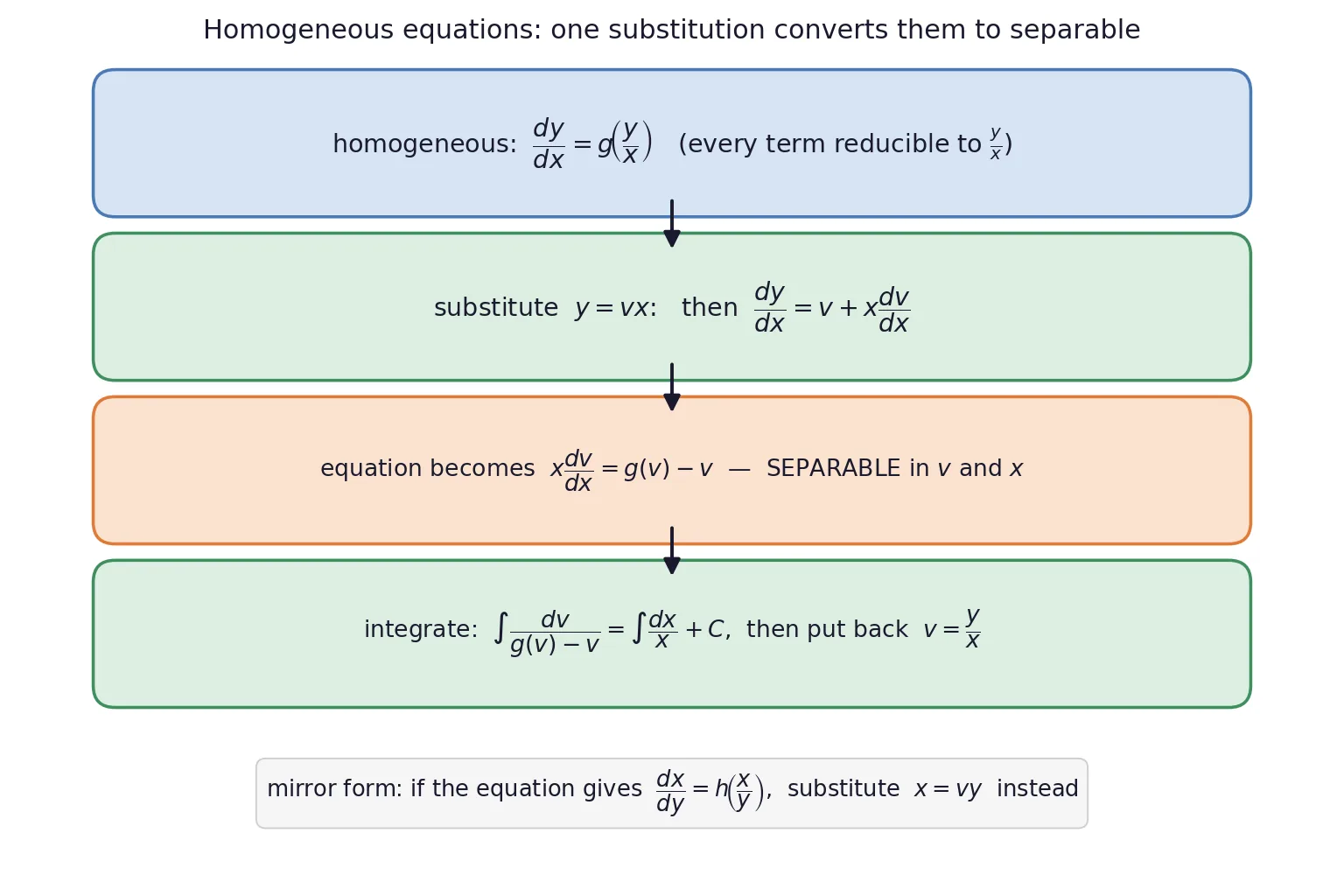
- Is every term the same total degree — is a function of alone? → Homogeneous. Substitute , so ; the equation in separates. (Mirror: for use .)
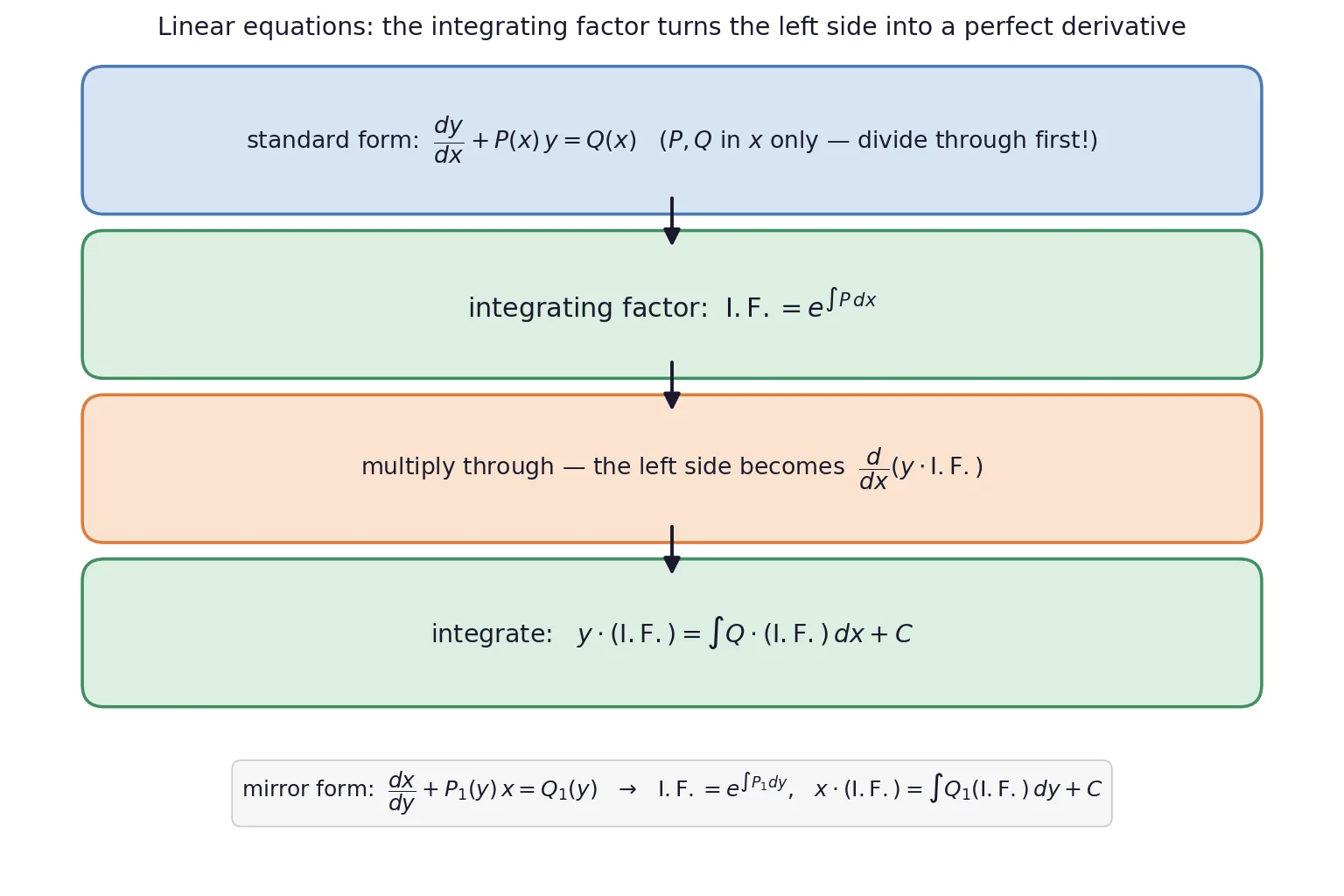
- Is it shaped with functions of ? → Linear. Compute I.F. , then . (Mirror: gives .)
Tables and the Mistake Checklist
Integrating-factor speed table
| I.F. | |
|---|---|
| (in ) |
Exact differentials worth recognising
| Combination | Equals |
|---|---|
Growth and decay in one line
— doubling time ; each equal time interval multiplies by the same factor.
The mistake checklist — run it before submitting
- Degree read before clearing radicals? Square away fractional powers first; degree must be a positive integer or "not defined".
- Constant added at the moment of integration? One , on the side, immediately — not appended at the end.
- Logs merged before naming ? should become by exponentiating properly — a dangling un-merged constant changes the family.
- I.F. multiplied into as well? The solution line is — forgetting the I.F. inside the integral is the top linear-equation error.
- Returned from to (or in Bernoulli)? The answer must be in and ; and when multiplying back through, the constant picks up factors too.
- Particular solution actually particular? Substitute the condition, solve for , and state the final constant-free equation.
- Verified by substitution? Thirty seconds: differentiate your answer and push it through the original equation.
Where each skill was built
Order and degree — Section 1. Verification and families — Section 2. Separable equations and growth models — Section 3. Homogeneous equations — Section 4. Linear equations — Section 5. Graded worked examples — Section 6. Board-pattern practice — Section 7. JEE tools (shift substitution, Bernoulli, exact differentials, orthogonal trajectories) — Section 8. Full JEE drill — Section 9.