F3(x,y)=cosxy: the λ's cancel — λ0F3, degree 0.
F4(x,y)=sinx+cosy: scales by no power of λ — not homogeneous.
Definition:F(x,y) is a homogeneous function of degree n if F(λx,λy)=λnF(x,y) for every nonzero constant λ. Equivalently, F(x,y)=xng(xy) or ynh(yx).
Homogeneous differential equations
Definition:dxdy=F(x,y) is a homogeneous differential equation if F is homogeneous of degree zero — i.e. the right side can be written entirely in terms of the ratio xy.
The quick recognition test: in a quotient like x−yx+2y, every term in numerator and denominator has the same total degree (here 1) — divide top and bottom by x and only xy remains: homogeneous. In 2xyx3+2y2, the degrees mix (3 versus 2) — not homogeneous.
Key Point: Degree-zero homogeneity means the slope field looks the same along every ray through the origin — which is exactly why the ratio v=xy is the natural variable, and why the substitution y=vx (next block) untangles the equation.
[JEE Tip] Terms with constants added — like (4x+6y+5) — break homogeneity instantly (the 5 has degree 0 while x,y have degree 1). Scan for stray constants first; it eliminates options in recognition MCQs in seconds.
The Substitution y=vx
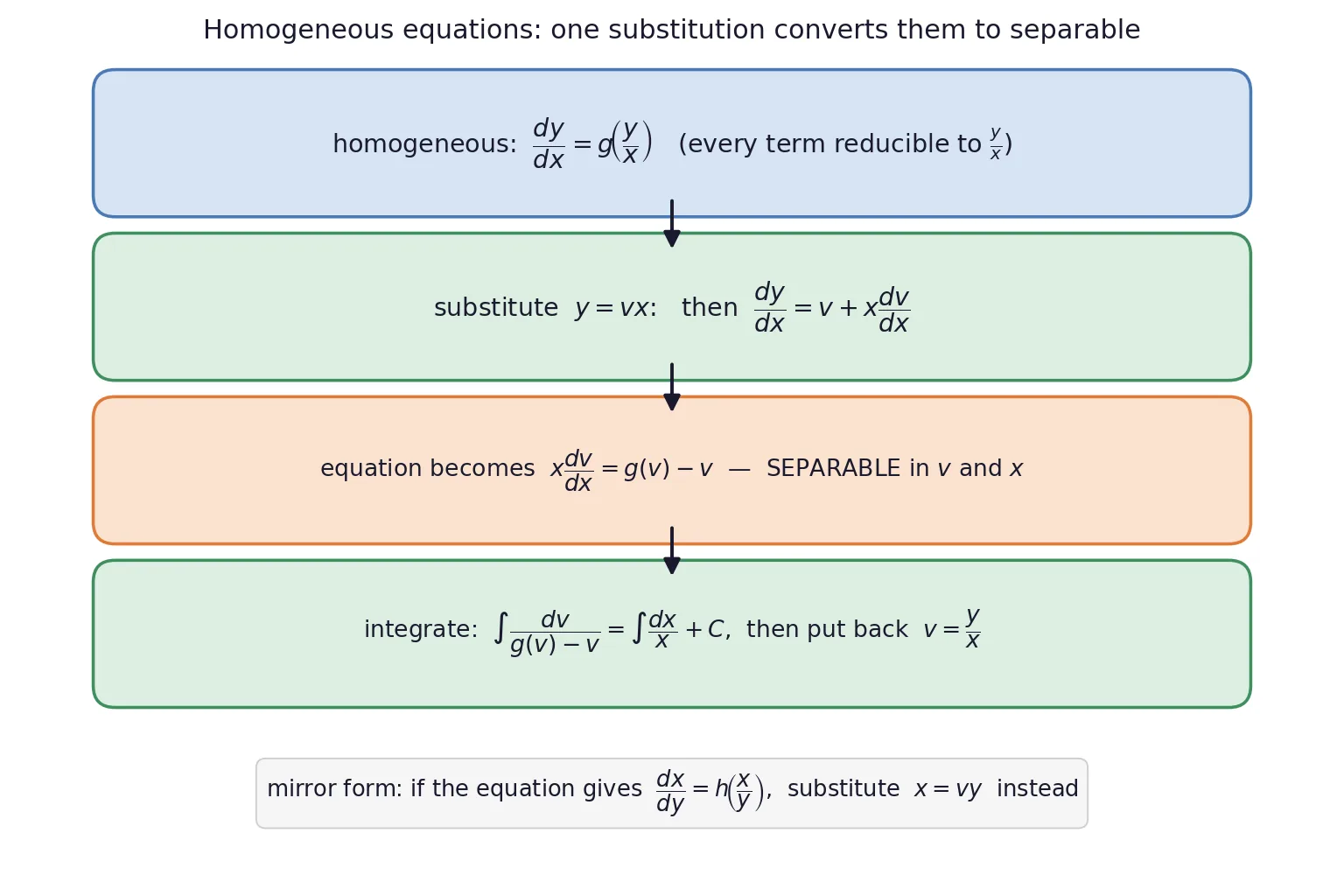
To solve dxdy=g(xy):
Substitutey=vx (where v is a function of x). Differentiating: dxdy=v+xdxdv.
The equation becomesv+xdxdv=g(v), i.e.
xdxdv=g(v)−v
Separate (the whole point — v and x now separate): g(v)−vdv=xdx.
Integrate and back-substitutev=xy:
∫g(v)−vdv=log∣x∣+C
The mirror form x=vy
If the equation arrives as dydx=h(yx) — degree-zero in the other orientation — substitute x=vy, so dydx=v+ydydv, and proceed identically. Equations written in differentials (2yex/ydx+(y−2xex/y)dy=0) often signal this form: solve for dydx and check for yx.
Working habits
Show homogeneity first (the exam asks for it): verify F(λx,λy)=λ0F(x,y), or rewrite the right side as a function of xy.
Don't forget −v: the separable form is g(v)−vdv, not g(v)dv — omitting the −v is the classic slip.
Back-substitute at the end, and simplify constants (log-merging, ±C→C) exactly as in Section 3.
Key Point: The substitution machine has one purpose: convert to separable. After step 2 you are back in Section 3 territory — every homogeneous problem is a separable problem wearing a disguise.
[JEE Tip] The v-integral ∫g(v)−vdv is where Chapter 7 skills return: expect partial fractions (v2−12v), standard forms (v2+v+1v−1 needs completing the square), or a plain ff′. Identify the integral type before grinding.
Solved Examples
Example 1: The full showcase
Show that (x−y)dxdy=x+2y is homogeneous and solve it.
Solution:
Homogeneity:dxdy=x−yx+2y; replacing (x,y) by (λx,λy) leaves it unchanged (λ0) — homogeneous.
Substitute y=vx:v+xdxdv=1−v1+2v, so xdxdv=1−vv2+v+1.
Separate:v2+v+1v−1dv=−xdx.
Integrate (split the numerator along the derivative 2v+1, complete the square for the remainder): 21log(v2+v+1)−3tan−132v+1=−log∣x∣+C1.
Back-substitute v=xy and tidy:
Final Answer:log(x2+xy+y2)=23tan−1(3xx+2y)+C.
Takeaway: The v-integral used both Chapter 7 power-moves: numerator = A(derivative) + B, then the completed-square tan−1 form. Homogeneous problems are integration problems in disguise.
Example 2: A trig ratio
Show that xcos(xy)dxdy=ycos(xy)+x is homogeneous and solve it.
Rearrange:dxdy=−x2xy+y2=−(v+v2) with v=xy — homogeneous.
Substitute:xdxdv=−v2−2v.
Separate and split:v(v+2)dv=−xdx; partial fractions: 21logv+2v=−log∣x∣+C1.
Exponentiate and back-substitute:v+2v=x2C gives y+2xy=x2C, i.e. x2y=C(y+2x).
Apply (1,1):1=3C, so C=31.
Final Answer:3x2y=y+2x, i.e. y+2x=3x2y.
Takeaway: Steps 1-2 are always the same three lines; all the variety lives in the v-integral. Bring your Chapter 7 toolkit — here, a two-factor partial fraction decomposition.
Ready to test your knowledge?
Take a quick interactive quiz on this topic —
free, works without login.