The First Solving Engine
A first order, first degree differential equation has the shape dxdy=F(x,y). When F factors as a product of a pure-x function and a pure-y function,
dxdy=g(x)⋅h(y)
the equation is of variables separable type — and it solves in four moves.
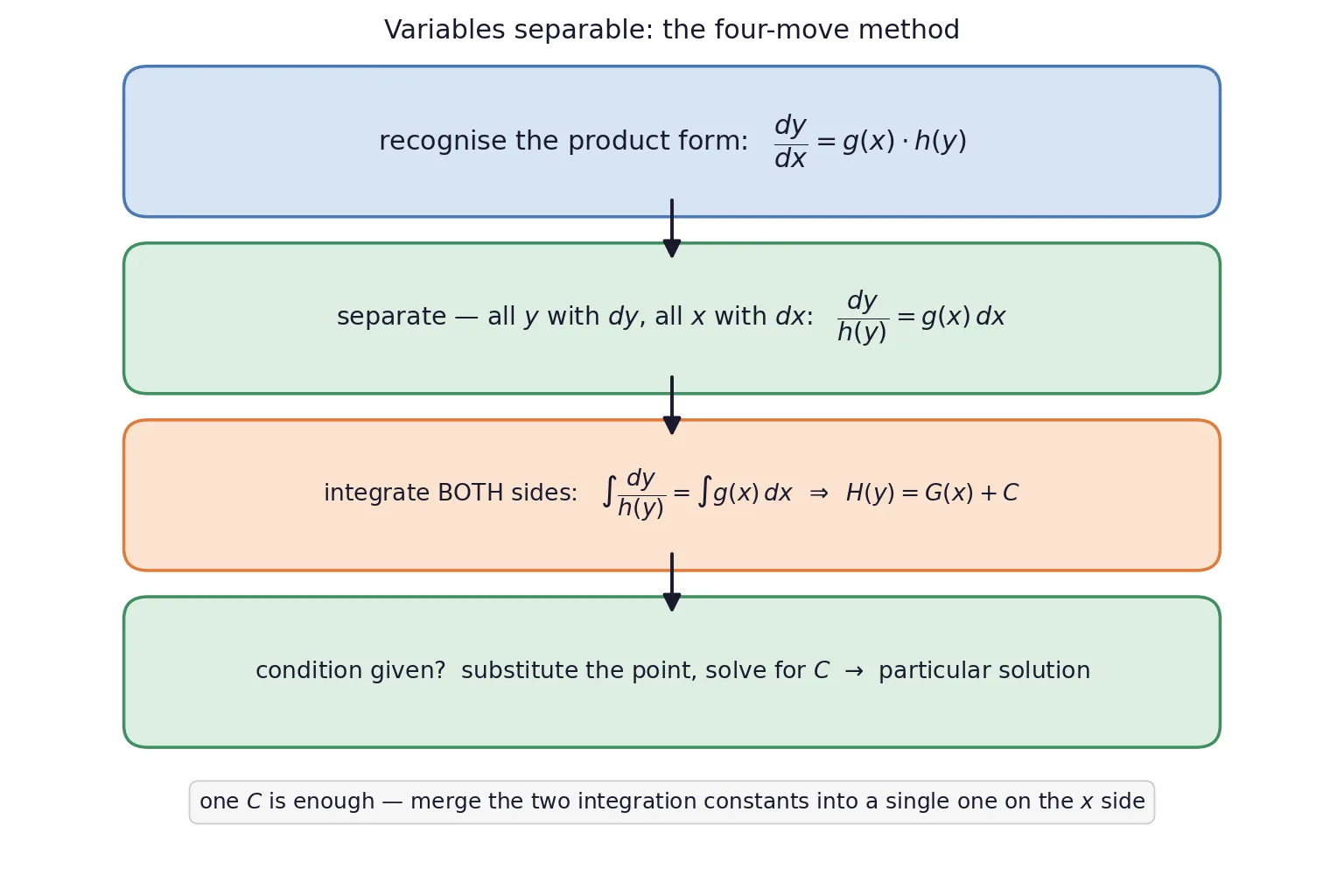
The method
- Recognise the product form g(x)h(y).
- Separate (for h(y)=0): h(y)dy=g(x)dx — every y travels with dy, every x with dx.
- Integrate both sides: ∫h(y)dy=∫g(x)dx, giving H(y)=G(x)+C — the general solution, usually left implicit.
- Apply the condition (if given) to find C — the particular solution.
Worked template
dxdy=2−yx+1 (with y=2): separate to (2−y)dy=(x+1)dx, integrate:
2y−2y2=2x2+x+C1⇒x2+y2+2x−4y+C=0
(where C=2C1 absorbed the doubling — constants merge freely).
Housekeeping rules
- One constant is enough: write +C on the x-side only; two constants merge into one.
- Constants can be reshaped: 2C1→C, eC1→C, ±C→C — any invertible renaming is legal and keeps answers tidy.
- Implicit answers are complete answers: tan−1y=tan−1x+C need not be solved for y unless asked.
- Note excluded values: the separation divided by h(y), so cases like y=2 above are excluded by hypothesis (the problem states them).
Key Point: Separability is a structural property — spot the product g(x)h(y). Sums like dxdy=x+y do NOT separate (that one is linear, Section 5); products, quotients and exponentials like ex+y=exey do.
[JEE Tip] ex+y splitting into ex⋅ey is the most-recycled separable disguise in MCQs: dxdy=ex+y separates to e−ydy=exdx, giving −e−y=ex−C, i.e. ex+e−y=C. Recognise the family.
Curves and Growth — Separable Equations at Work
Curve problems
"The slope of the tangent at (x,y) is …" translates directly to dxdy=… — then the routine is: solve generally, substitute the given point, extract C.
Template: the curve through (−2,3) with slope y22x: separate y2dy=2xdx, integrate 3y3=x2+C; the point gives 9=4+C, so C=5 and the curve is 3y3=x2+5.
The exponential growth model
"Principal increases continuously at the rate of 5% per year" means the rate of change is proportional to the current amount:
dtdP=1005P=20P
Separate and integrate: logP=20t+C1, so P=Cet/20 (with C=eC1). An initial value pins down C: starting from ₹1000, P=1000et/20, and doubling (P=2000) gives et/20=2, i.e.
t=20loge2 years
The same skeleton handles every "proportional growth" model — bacteria counts, populations, radioactive decay (with a minus sign): dtdN=kN⇒N=N0ekt.
Key Point: In growth problems the answer usually stays in exact log/exponential form (20log2, not a decimal). Two data points determine the two unknowns N0 and k; a question for "when does N reach …" then solves an exponential equation by taking logs.
[JEE Tip] Boards love the bank/bacteria stories; JEE prefers the same mathematics stripped bare ("if y′=ky and y(0)=A…"). Either way, jump straight to y=(initial value)ekt — deriving it costs a minute, quoting it costs nothing, and the mark scheme accepts both.
Solved Examples
Example 1: The model separation
Find the general solution of dxdy=2−yx+1 (where y=2).
Solution:
- Separate: (2−y)dy=(x+1)dx.
- Integrate: 2y−2y2=2x2+x+C1.
- Tidy (multiply by 2, absorb constants): x2+y2+2x−4y+C=0.
Final Answer: x2+y2+2x−4y+C=0.
Example 2: Symmetric inverse-tangent pair
Find the general solution of dxdy=1+x21+y2.
Solution:
- Separate (safe: 1+y2=0 always): 1+y2dy=1+x2dx.
- Integrate: tan−1y=tan−1x+C.
Final Answer: tan−1y=tan−1x+C — a perfectly complete implicit answer.
Example 3: A particular solution
Find the particular solution of dxdy=−4xy2 given y=1 when x=0.
Solution:
- Separate (for y=0): y2dy=−4xdx.
- Integrate: −y1=−2x2+C, so y=2x2−C1.
- Apply the condition: 1=−C1 gives C=−1.
Final Answer: y=2x2+11.
Example 4: Curve through a point
Find the equation of the curve through (1,1) whose differential equation is xdy=(2x2+1)dx (with x=0).
Solution:
- Separate: dy=(2x+x1)dx.
- Integrate: y=x2+log∣x∣+C.
- Apply the point (1,1): 1=1+0+C, so C=0.
Final Answer: y=x2+log∣x∣.
Example 5: Slope condition through a point
Find the equation of the curve through (−2,3), given that the slope of the tangent at any point (x,y) is y22x.
Solution:
- Translate: dxdy=y22x; separate: y2dy=2xdx.
- Integrate: 3y3=x2+C.
- Apply (−2,3): 9=4+C, so C=5.
Final Answer: 3y3=x2+5, i.e. y=(3x2+15)1/3.
Example 6: Continuous compounding
In a bank, principal increases continuously at the rate of 5% per year. In how many years will ₹1000 double itself?
Solution:
- Model: dtdP=1005P=20P.
- Separate and integrate: logP=20t+C1, so P=Cet/20.
- Initial value: P=1000 at t=0 gives C=1000; so P=1000et/20.
- Doubling: 2000=1000et/20 gives et/20=2, so t=20loge2.
Final Answer: t=20loge2 years (about 13.86 years).
Example 7: Trig products
Solve sec2xtanydx+sec2ytanxdy=0.
Solution:
- Separate (divide by tanxtany): tanxsec2xdx=−tanysec2ydy.
- Integrate (each side is ff′): log∣tanx∣=−log∣tany∣+C1.
- Combine the logs: log∣tanxtany∣=C1.
Final Answer: tanxtany=C — the exponentiated constant eC1 renamed C.
Example 8: A trig-integrating condition
Find the particular solution of dxdy=ytanx, given y=1 when x=0.
Solution:
- Separate: ydy=tanxdx.
- Integrate: log∣y∣=log∣secx∣+C1, so y=Csecx.
- Apply the condition: 1=Csec0=C.
Final Answer: y=secx.
Takeaway: When both integrals produce logs, exponentiate and merge: logy=log(secx)+C1 becomes y=Csecx in one step — cleaner than carrying the log form to the end.
