
What Does It Mean to Solve a Differential Equation?
For an ordinary equation like or , a solution is a number that satisfies it. For a differential equation like
a solution is a function : substituting and its derivatives for makes L.H.S. R.H.S. for every . The graph is called the solution curve (or integral curve) of the equation.
General versus particular
Consider , with . Substituting into gives L.H.S. R.H.S. — a solution for every choice of and . This two-parameter family is the general solution (also called the primitive).
Now fix the parameters — say , — to get : still a solution, but with no arbitrary constants. That is a particular solution.
Definitions: The solution containing arbitrary constants is the general solution. A solution free from arbitrary constants — obtained by giving the constants particular values — is a particular solution.
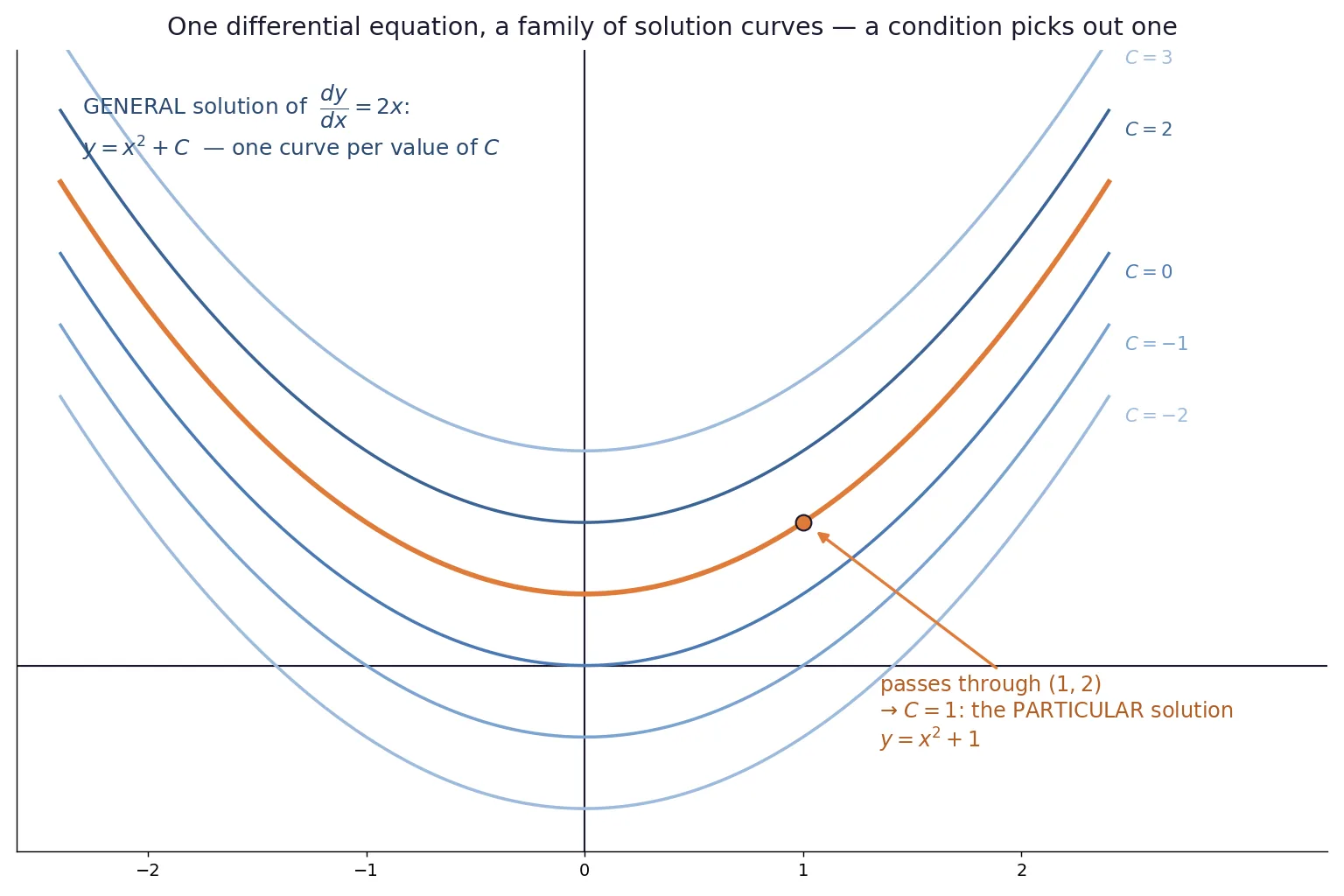
Counting the constants
The general solution of an th order differential equation contains exactly arbitrary constants — one integration per order. So a fourth-order equation's general solution carries constants, while any particular solution carries (that is what "particular" means).
Key Point: One differential equation ↔ one family of curves. Extra information — "the curve passes through " — pins down the constants and selects one member of the family. This is exactly how the solving methods of the next three sections will be used in exams: general solution first, then apply the condition.
[JEE Tip] Constant-counting is a free-marks MCQ: general solution of order → constants; particular solution of any order → constants. No computation, just the definitions.
Verifying a Solution — the Substitution Recipe
Verification questions hand you a function and an equation and ask you to check the fit. No solving techniques needed — just careful differentiation.
The recipe:
- Differentiate the given function as many times as the order of the equation demands.
- Substitute the function and its derivatives into the L.H.S.
- Simplify and confirm L.H.S. R.H.S. identically (for all in the domain, not just at one point).
Worked template
Verify that solves :
- , and differentiating again, .
- Substitute: L.H.S. R.H.S. ✓
Implicit solutions
Solutions sometimes arrive as implicit relations, like . Differentiate the relation implicitly:
which is exactly the differential equation to be verified. Implicit verification = implicit differentiation + algebra to isolate .
Key Point: Verification is differentiation running forward — no integrals anywhere. If the check leaves a leftover term, either the differentiation slipped or the function genuinely isn't a solution; both are findable by redoing step 1 slowly.
[JEE Tip] When a verification involves square roots (like against ), the identity may hold only on a stated domain (here where ) — quote the domain restriction; both boards and JEE include it in the full-credit answer.
Solved Examples
Example 1: Second-order verification
Verify that is a solution of .
Solution:
- Differentiate twice: ; .
- Substitute: L.H.S. R.H.S.
Final Answer: Verified — is a solution.
Example 2: A two-parameter family
Verify that (with ) solves .
Solution:
- Differentiate twice: ; .
- Substitute: L.H.S. .
Final Answer: Verified for every and — and with two arbitrary constants matching the order , this is the general solution.
Example 3: A root function
Verify that is a solution of .
Solution:
- Differentiate: .
- Compute the R.H.S.: .
- Compare: L.H.S. R.H.S. ✓
Final Answer: Verified.
Takeaway: When both sides are computed independently and meet in the middle, the verification is airtight — rearranging one side into the other risks circular algebra.
Example 4: An implicit solution
Verify that is a solution of (where ).
Solution:
- Differentiate implicitly: gives .
- Collect : , so .
- Isolate: — exactly the given equation.
Final Answer: Verified.
Example 5: A domain-sensitive verification
Verify that is a solution of (for and or ).
Solution:
- Differentiate: , so .
- Compute the root: .
- Compare: on the stated domain (where ), , so R.H.S. L.H.S. ✓
Final Answer: Verified on the stated domain.
Takeaway: , not — the domain restriction in the problem statement is exactly what turns the modulus into a plain factor. Quote it.
Example 6: From general to particular
The general solution of is . Find the particular solution whose curve passes through .
Solution:
- Apply the condition: substitute , : .
- Solve for the constant: .
- Write the particular solution: .
Final Answer: — one curve selected from the one-parameter family.
Takeaway: This two-step move — solve generally, then impose the condition — is the closing move of nearly every solving problem in the rest of the chapter.