
The Question That Completed Electromagnetism
By Chapter 6 we knew two great facts: currents produce magnetic fields (Oersted, Ampere), and changing magnetic fields produce electric fields (Faraday). One question begged to be asked: does a changing ELECTRIC field produce a magnetic field?
James Clerk Maxwell (1831-1879) argued yes — and proved that the answer reorganises all of physics. While applying Ampere's circuital law to a charging capacitor, he noticed the law was inconsistent (next section's story), and repaired it by inventing the displacement current: a time-varying electric field acts as a source of magnetic field.
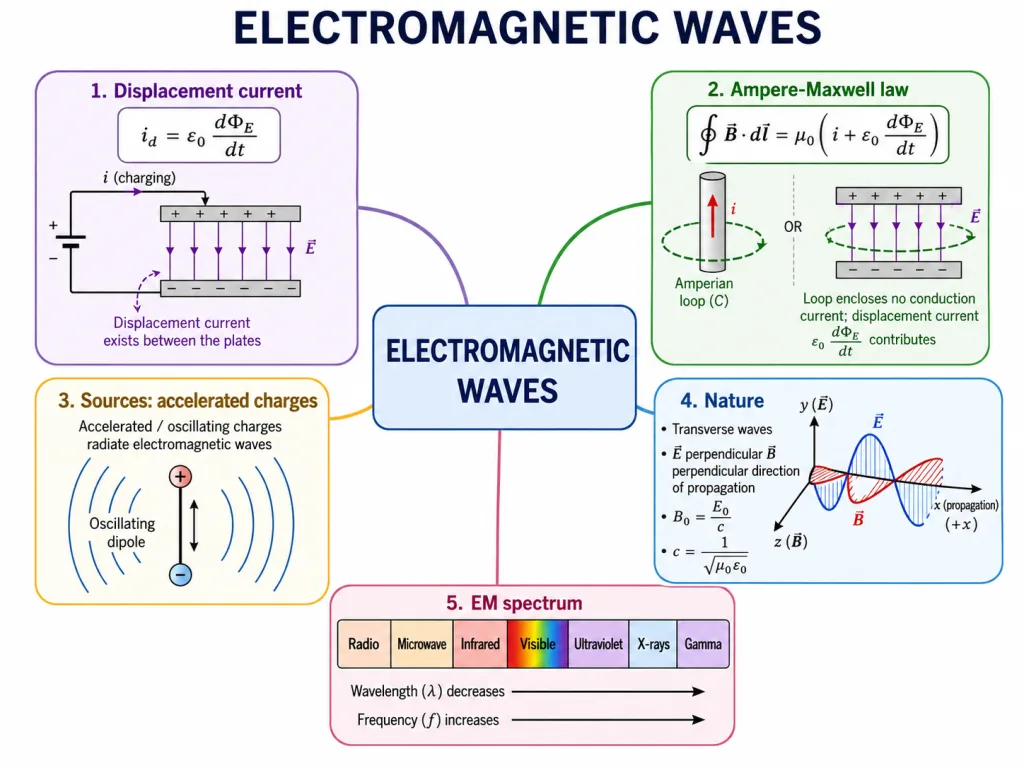
With the repair in place, Maxwell wrote down a set of equations — Maxwell's equations — involving the electric and magnetic fields and their sources (charges and currents). Together with the Lorentz force formula, they express all the basic laws of electromagnetism.
The Prediction That Changed Everything
Maxwell's equations made a staggering prediction: coupled, time-varying electric and magnetic fields can propagate through empty space as waves — electromagnetic waves — with speed
Putting in the measured constants gives about m/s — the measured speed of light! The inescapable conclusion: light is an electromagnetic wave. Maxwell had unified electricity, magnetism and optics in one stroke.
The experimental confirmations followed: Hertz demonstrated electromagnetic waves in the laboratory (1887); Jagdish Chandra Bose in Kolkata produced much shorter (millimetre) wavelengths; Marconi transmitted them across kilometres, founding modern communication.
Key Point: the chapter's storyline in one breath — Ampere's law has a gap → displacement current fills it → the repaired equations predict waves at speed → that's the speed of light → light is an EM wave → and a whole spectrum of such waves exists, from gamma rays ( m) to long radio waves ( m).
[NEET Important] Maxwell predicted EM waves theoretically; Hertz demonstrated them experimentally. Who-did-what is a recurring one-liner.
Solved Examples
Example 1: Computing c from the constants [JEE Numerical]
Compute using T m/A and C N m.
Solution:
- .
- s/m.
- m/s — electricity and magnetism conspire to give exactly the speed of light.
Example 2: Sunlight's commute [NEET Numerical]
The sun is m away. How long does its light take to reach us?
Solution:
- .
- s minutes. Every sunrise is eight minutes old news.
Example 3: The span of the spectrum [JEE Numerical]
NCERT quotes the spectrum from gamma rays ( m) to long radio waves ( m). How many orders of magnitude is that, and what is the corresponding frequency ratio?
Solution:
- Wavelength ratio: — eighteen orders of magnitude.
- Since , the frequency ratio is the same (inverted): gamma at Hz vs long radio at Hz.
- One physical phenomenon — oscillating E and B — spans it all.
Example 4: Frequency of yellow light [NEET Numerical]
Estimate the frequency of yellow light of wavelength 600 nm.
Solution:
- .
- Hz — the Hz scale NCERT quotes for visible light.
Example 5: Why circuits can't make light [JEE Numerical]
Visible light has frequency Hz while electronic circuits manage Hz. By what factor do circuits fall short, and what did this imply for testing Maxwell?
Solution:
- Shortfall factor .
- No oscillator could be built at optical frequencies — so Maxwell's theory had to be tested at low (radio) frequencies, exactly what Hertz did in 1887.
- The wave nature is identical across the spectrum; only the frequency differs.
Example 6: A radio wave's wavelength [NEET Numerical]
Find the wavelength of the 25 MHz wave.
Solution:
- .
- m — a short-wave radio wavelength, vastly longer than light's hundreds of nanometres.
Example 7: What did Maxwell actually unify?
State precisely what Maxwell's unification achieved.
Solution:
- The laws of electricity (Coulomb, Gauss) and magnetism (Oersted, Ampere, Faraday) were combined into one consistent set — Maxwell's equations.
- The equations predicted electromagnetic waves with speed , numerically the measured speed of light.
- Hence optics joined electromagnetism: light is an electromagnetic wave. Three sciences, one theory.
Example 8: Prediction vs demonstration
Distinguish the roles of Maxwell, Hertz, Bose and Marconi.
Solution:
- Maxwell: predicted EM waves theoretically from his equations.
- Hertz (1887): produced and detected them in the laboratory — wavelength, speed, reflection, refraction all matching light.
- Bose: generated much shorter wavelengths (25 mm down to 5 mm), still in the lab. Marconi: transmitted them over kilometres — the birth of radio communication.
Example 9: Whose current is it?
What inconsistency did Maxwell notice, and what did he add to fix it?
Solution:
- Applying Ampere's circuital law to find B outside a charging capacitor, different surfaces spanning the same loop gave different answers (current pierces one surface but not another).
- He added a new term — the displacement current — sourced by the changing electric field in the gap.
- With , every surface agrees. (Full story in Section 2.)
Example 10: Is light special among EM waves?
In what sense is visible light 'just another band' of the electromagnetic spectrum?
Solution:
- All EM waves are the same physical phenomenon — coupled oscillating and travelling at c in vacuum.
- Bands differ only in frequency/wavelength, and hence in how they are produced and detected — the basis of the spectrum's classification.
- Visible light is merely the narrow band (400-700 nm) our eyes happen to detect.