
The Charging-Capacitor Paradox
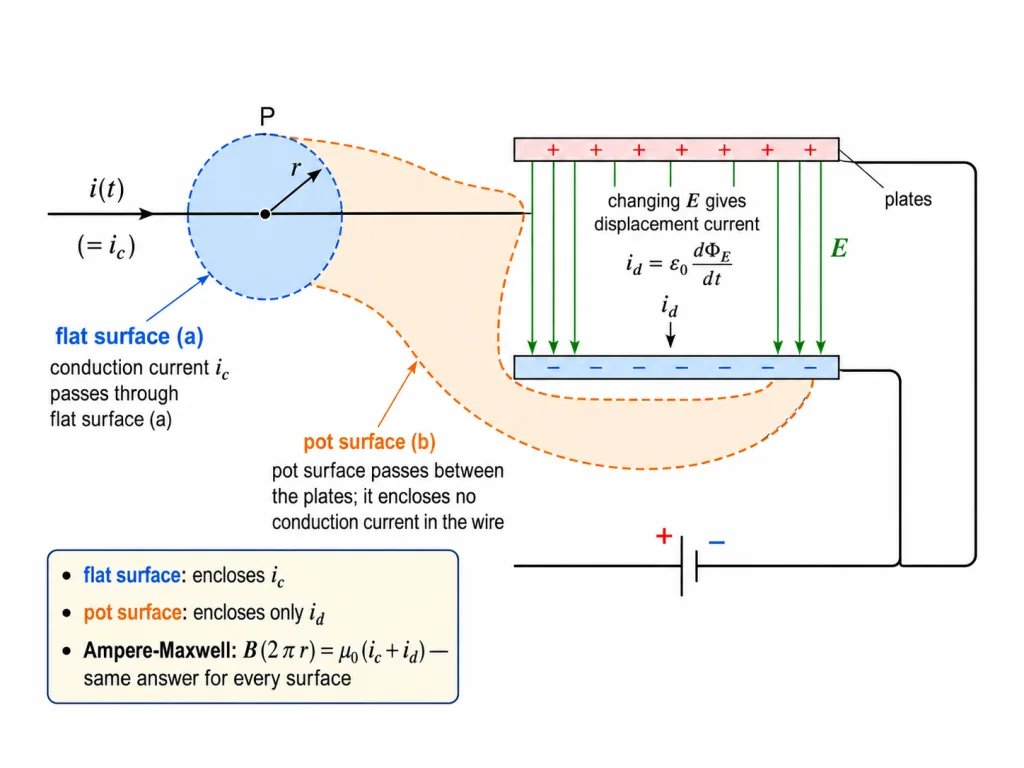
Take a parallel-plate capacitor being charged by a time-dependent current , and ask for the magnetic field at a point P just outside it, near the connecting wire. Apply Ampere's circuital law, , to a circular loop of radius r around the wire:
- Surface 1 — a flat disc spanning the loop, pierced by the wire: . Fine.
- Surface 2 — a pot-shaped surface with the same circular mouth, whose bottom passes between the capacitor plates, touching no wire: enclosed current zero, so the law says .
- A tiffin-box-shaped surface does the same.
Contradiction! The same point P has a field computed one way and zero computed another. Since Ampere's law produced it, Ampere's law must be incomplete — something must be added so that every surface with the same boundary gives the same answer.
Maxwell's Fix: The Displacement Current
Look at what does cross the gap-spanning surface: the electric field! Between plates of area A carrying charge Q, (perpendicular to the surface), so the electric flux is
As the capacitor charges, Q changes, and
— exactly the missing current! Maxwell's resolution: a changing electric flux acts as a current, the displacement current
The total current is (conduction + displacement), and the Ampere-Maxwell law reads
Bookkeeping for the capacitor: outside (in the wire) , ; inside the gap , . Every surface now reports the same total current — paradox dissolved.
Key Point: has all the physical effects of a real current — it produces magnetic fields. The field at a point M between the plates is measurably the same as at P just outside.
Consequences: A More Symmetric Electromagnetism
With the displacement current in place:
- Faraday's law: a time-varying magnetic field gives rise to an electric field.
- Ampere-Maxwell law: a time-varying electric field gives rise to a magnetic field.
Time-dependent electric and magnetic fields give rise to each other — the seed of electromagnetic waves (Section 3 onwards).
NCERT's careful footnote: the symmetry is still not perfect — there are no known magnetic monopoles (no magnetic analogue of charge as a source), which is why Gauss's law for magnetism keeps its zero.
[JEE Tip] For a parallel-plate capacitor, — three interchangeable forms (, E, or V version). Choose whichever the data offers.
[NEET Important] In a region with steady fields (e.g. a steady current in a wire), : displacement current exists only while the electric field is changing. And in general both and can coexist in the same region — no medium is perfectly conducting or perfectly insulating.
Solved Examples
Example 1: Displacement current equals conduction current [NEET Numerical]
A capacitor is charged by a steady conduction current of 0.15 A in its leads. What is the displacement current between its plates?
Solution:
- Between the plates, the changing Q gives .
- is precisely the charging current: A.
- Continuity restored: the 'current' is 0.15 A everywhere around the circuit — conduction in the wires, displacement in the gap.
Example 2: From dV/dt [JEE Numerical]
A 1.0 F parallel-plate capacitor has its potential difference rising at V/s. Find the displacement current.
Solution:
- (capacitor form of ).
- A.
- Half an ampere flows 'through' the gap — as a changing field, not as charge.
Example 3: From dE/dt [JEE Numerical]
The electric field between circular plates of area m changes at V m s. Find .
Solution:
- .
- A mA.
- Enormous dE/dt values are needed for modest currents — is tiny.
Example 4: The two-surface check
State the paradox the displacement current resolves, in two sentences.
Solution:
- For the same Amperian loop near a charging capacitor, a flat surface (pierced by the wire) gives , while a pot-shaped surface through the gap gives zero — Ampere's law contradicts itself.
- Adding (which lives exactly where the wire doesn't) makes the total current through every spanning surface identical.
Example 5: B between the plates [JEE Numerical]
Circular capacitor plates of radius R = 6.0 cm carry a displacement current of amplitude 6.9 A (uniformly distributed). Find the amplitude of B at r = 3.0 cm from the axis.
Solution:
- Inside the gap, Ampere-Maxwell on a circle of radius r encloses the fraction of : .
- .
- T.
- Tiny but real — and measurable, confirming the displacement current's physical reality.
Example 6: An oscillating capacitor [JEE Numerical]
A 100 pF capacitor is connected to a source V. Find the peak displacement current.
Solution:
- .
- Peak: A.
- The 6.9 A of Example 5 — these two examples are one circuit.
Example 7: Where is each current?
For the charging capacitor, fill in: in the connecting wires, , ; between the plates, , .
Solution:
- Wires: (real charge flow), (steady E inside a good conductor changes negligibly).
- Gap: (no charge crosses), (the changing E carries the baton).
- Their sum is the same through every cross-section — current continuity, rescued.
Example 8: When is zero?
Give a situation with a non-zero electric field but zero displacement current, and one with in empty space.
Solution:
- Zero : a steady electric field (e.g. inside a wire carrying steady DC, or a fully charged capacitor) — E exists but .
- Non-zero in vacuum: any region where E varies with time — e.g. between charging plates, or in a passing electromagnetic wave — produces a magnetic field with no conduction current anywhere nearby.
- That second case is precisely how EM waves sustain themselves.
Example 9: The symmetry argument
In what sense does the displacement current make electromagnetism 'more symmetrical' — and why not perfectly so?
Solution:
- Faraday: changing B E. Ampere-Maxwell: changing E B. Each field now sources the other — a beautiful reciprocity.
- The symmetry is imperfect because magnetic monopoles do not exist: electric fields have point sources (charges); magnetic fields do not.
- Hence Gauss's law for E has on the right; Gauss's law for B has zero.
Example 10: Reading the Ampere-Maxwell law
Identify each term of and when each dominates.
Solution:
- Left side: circulation of B around a closed loop.
- : conduction-current source — dominates in wires and circuits.
- : displacement-current source — the only term in charging-capacitor gaps and in electromagnetic waves; both can coexist in ordinary (imperfect) media.