
A Plane Wave, Anatomised
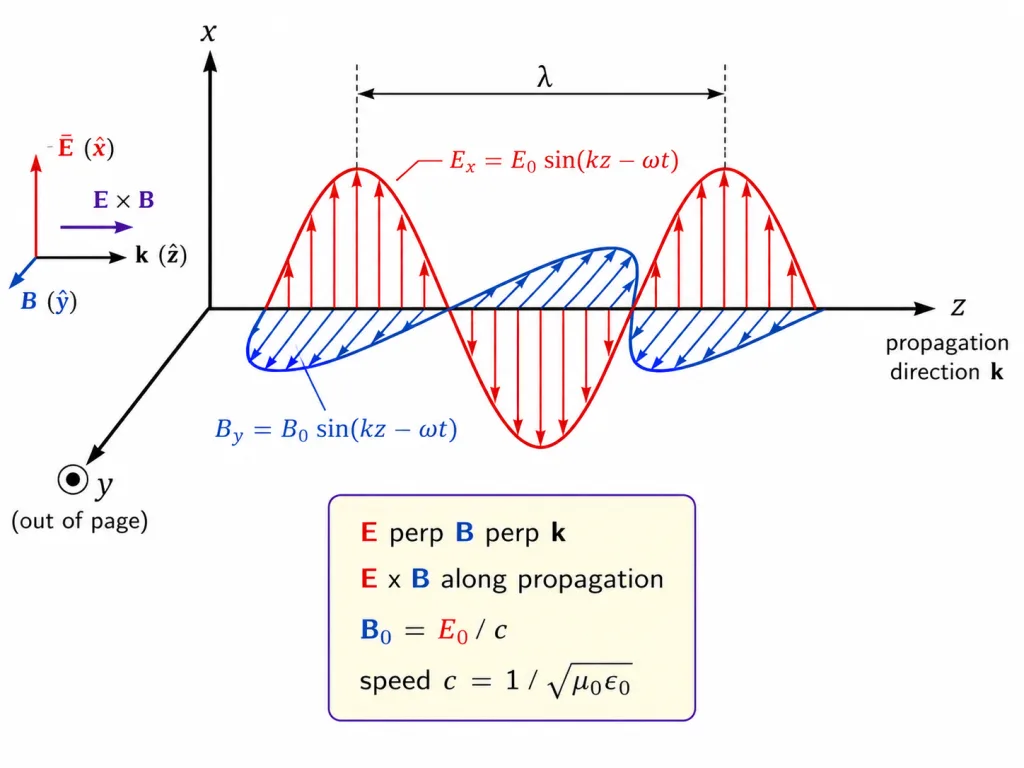
Maxwell's equations show that in an electromagnetic wave, and are perpendicular to each other AND to the direction of propagation — EM waves are transverse. (Plausible from the capacitor picture: E points between the plates, the B it generates circles parallel to them — perpendicular.)
The standard plane wave moving along z (NCERT Fig. 8.3):
- along x, along y, propagation along z — and : E cross B points along the propagation direction.
- — the magnitude of the wave vector , whose direction is the propagation direction.
- = angular frequency; speed .
- E and B oscillate in phase: they peak together, vanish together.
The Speed and the Ratio
Feeding the plane wave into Maxwell's equations yields two golden relations:
equivalently . And the field magnitudes are locked together:
In a material medium of permittivity and permeability , the speed becomes
— the velocity of light depends on the medium's electric and magnetic properties (this underlies the refractive index, next chapter: ).
Three more NCERT essentials:
- EM waves are self-sustaining oscillations of fields — no material medium is required (unlike sound).
- The vacuum speed c is the same for all wavelengths (to within experimental precision) — a fundamental constant, so well established that it defines the standard of length.
- EM waves carry energy — radio signals, sunlight powering life on earth. (Beyond NCERT, for JEE: they carry momentum too, exerting radiation pressure.)
[NEET Important] means the magnetic amplitude is times smaller in SI numbers — e.g. 300 V/m of E rides with just 1 T of B.
Reading and Writing Wave Equations (Exam Drill)
Given any wave like , extract everything:
- Wavelength: . Frequency: . Speed check: should be c (vacuum).
- Direction of travel: moves towards +z; towards .
- The partner field: magnitude from ; direction from propagation direction.
[JEE Tip] The direction-finding rule is a permanent JEE fixture: given E along and propagation along , B must satisfy , so . Work the cross product, never guess.
Key Point: E and B carry the same phase, the same frequency (the source's), and amplitudes locked by c. One field determines the other completely — an EM wave is a single entity, not two waves travelling together.
Solved Examples
Example 1: Finding B from E
A plane EM wave of frequency 25 MHz travels along x. At a point, V/m. Find there.
Solution:
- Magnitude: T.
- Direction: must point along propagation (). With E along : — so B is along z.
- T.
Example 2: Reading a full wave
The magnetic field of a wave is T. Find (a) wavelength and frequency, (b) the electric field expression.
Solution:
- (a) m: cm. rad/s: GHz (a microwave).
- (b) V/m.
- The form travels along ; with B along y, E must satisfy , giving E along z: V/m.
Example 3: Writing the partner field [JEE Numerical]
A wave travels along +z with V/m at 50 MHz. Write completely.
Solution:
- T.
- rad/s; rad/m.
- Same phase, perpendicular direction: T. ( — checks.)
Example 4: Speed in a medium [JEE Numerical]
Light enters a medium with and . Find its speed and the refractive index.
Solution:
- .
- m/s; .
- The medium's electric and magnetic properties set light's speed — Maxwell's Eq. (8.11) in action.
Example 5: From wavelength to everything [NEET Numerical]
A 6 m wavelength wave travels in vacuum. Find , and .
Solution:
- Hz MHz.
- rad/m.
- rad/s. (Check: m/s ✓.)
Example 6: The amplitude lock [NEET Numerical]
Sunlight at a point has electric amplitude 300 V/m. What is the magnetic amplitude?
Solution:
- .
- T = 1 T — about fifty times weaker than the earth's magnetic field, though the E field is sizeable.
- The ratio is always exactly c.
Example 7: Which way does it go? [JEE Numerical]
A wave has along and along at some instant. Find the propagation direction.
Solution:
- Propagation is along .
- .
- The wave travels along +z. (Cross products, not memory!)
Example 8: Are E and B in phase?
In a plane EM wave, when E is maximum at a point, what is B doing there — and why does it matter?
Solution:
- E and B share the factor : B is also maximum — they oscillate in phase.
- They vanish together too: the wave's energy arrives in synchronised pulses of both fields.
- (A common misconception puts them 90 degrees apart like an LC exchange — wrong for a travelling wave. In phase!)
Example 9: No medium needed
Sound cannot cross a vacuum but light can. Explain via the nature of EM waves.
Solution:
- Sound is a mechanical wave — oscillations OF a medium; no molecules, no wave.
- An EM wave is a self-sustaining oscillation of fields: changing E regenerates B (Ampere-Maxwell) and changing B regenerates E (Faraday).
- The fields need no carrier — so sunlight crosses m of vacuum to reach us.
Example 10: c as the metre's anchor
Why is the speed of light used to define the standard of length?
Solution:
- Experiments across wavelengths show c in vacuum is the same for all EM waves to within a few m/s out of m/s.
- Its constancy is so strongly supported, and its value so precisely known, that the metre is defined through c (distance light travels in a fixed fraction of a second).
- A fundamental constant became a ruler — physics at its most practical.