
The Spectrum's Long-Wavelength Half
The electromagnetic spectrum classifies EM waves by frequency — from gamma rays to long radio waves, with no sharp boundaries: the divisions follow roughly how the waves are produced and detected. This section covers the three long-wavelength bands, in order of decreasing wavelength.
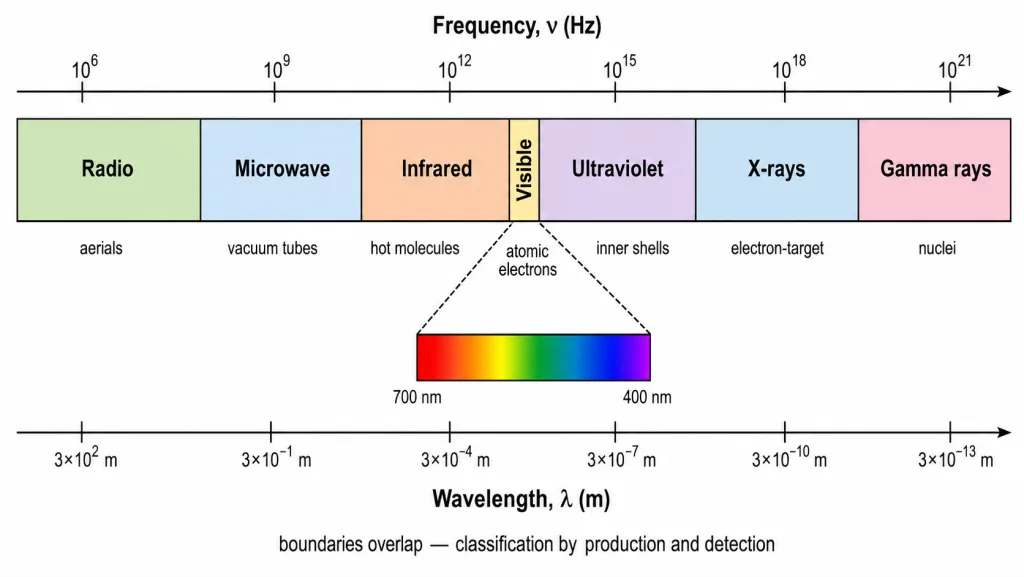
Radio waves ( 0.1 m)
Produced by the accelerated motion of charges in conducting wires (aerials). Used in radio and television communication. The frequency map (NCERT's numbers — exam favourites!):
| Service | Frequency range |
|---|---|
| General radio band | 500 kHz to about 1000 MHz |
| AM (amplitude modulated) | 530 kHz to 1710 kHz |
| Short wave | up to 54 MHz |
| TV | 54 MHz to 890 MHz |
| FM (frequency modulated) | 88 MHz to 108 MHz |
| Cellular phones | UHF (ultrahigh frequency) band |
Microwaves (GHz Frequencies)
Short-wavelength radio waves, frequencies in the gigahertz range. Produced by special vacuum tubes — klystrons, magnetrons and Gunn diodes.
Applications, each with its NCERT logic:
- Radar for aircraft navigation — short wavelengths make narrow, directed beams possible.
- Speed guns timing fast balls, tennis serves and automobiles — radar again.
- Microwave ovens: the frequency is chosen to match the resonant frequency of water molecules, so wave energy transfers efficiently to the molecules' kinetic energy, heating any food containing water. (Resonance, Chapter 7, now cooking dinner.)
[NEET Important] 'Why does a microwave oven heat food?' — frequency matched to water's resonant frequency; energy transfer by resonance. Word it exactly so.
Infrared Waves (1 mm to 700 nm)
Produced by hot bodies and molecules (vibrations of atoms and molecules); the band sits adjacent to the long-wavelength end of visible light. Called heat waves because water molecules (also CO, NH) readily absorb infrared, heat up, and warm their surroundings.
The NCERT application list:
- Greenhouse effect: incoming visible light passes through the atmosphere, is absorbed by the earth's surface, and is re-radiated as infrared; greenhouse gases (CO, water vapour) trap it, maintaining the earth's warmth.
- Physical therapy (infrared lamps).
- Earth satellites — military purposes and crop observation.
- Remote controls of TVs and electronic systems — semiconductor LEDs emit infrared.
- Snakes can see infrared — their prey glows in the dark.
Key Point: the three bands order as radio > microwave > infrared in wavelength — and the production ladder runs: aerial currents → vacuum tubes → molecular vibrations. Production frequency rises as wavelength falls.
Solved Examples
Example 1: The FM band in wavelengths [NEET Numerical]
Convert the FM band (88 MHz to 108 MHz) into wavelengths.
Solution:
- m.
- m.
- FM lives around 3 m — why FM aerials are metre-scale rods.
Example 2: AM band edges [JEE Numerical]
Find the wavelength range of the AM band (530 kHz to 1710 kHz).
Solution:
- At 530 kHz: m.
- At 1710 kHz: m.
- Hundreds of metres — hence the tall AM broadcast masts.
Example 3: The oven's frequency [NEET Numerical]
A microwave oven operates at 2450 MHz. Find the wavelength and explain the choice of frequency.
Solution:
- m cm.
- The frequency is selected to match the resonant frequency of water molecules: energy transfers efficiently to their kinetic energy.
- Result: anything containing water heats; the dry glass plate stays comparatively cool.
Example 4: Radar's choice [JEE Numerical]
A radar uses 10 GHz waves. Find the wavelength and state why microwaves suit radar.
Solution:
- cm.
- Such short wavelengths form narrow, well-directed beams that reflect cleanly off aircraft — ideal for navigation and speed guns.
- (Radio's hundreds of metres would smear around obstacles instead.)
Example 5: Classify by wavelength [NEET Numerical]
Name the band of EM waves with wavelengths (a) 600 m, (b) 3 cm, (c) 10 m.
Solution:
- (a) 600 m > 0.1 m: radio (medium-wave region, just beyond the AM band's 566 m edge).
- (b) 3 cm, between 0.1 m and 1 mm: microwave.
- (c) 10 m, between 1 mm and 700 nm: infrared.
Example 6: TV channel wavelength [JEE Numerical]
A TV station broadcasts at 600 MHz. Verify it lies in the NCERT TV band and find its wavelength.
Solution:
- NCERT's TV range: 54 MHz to 890 MHz — 600 MHz qualifies.
- m.
- Half-metre waves — between FM's 3 m and microwave's centimetres.
Example 7: Why 'heat waves'?
Justify infrared's nickname.
Solution:
- Water molecules present in most materials readily absorb infrared (so do CO, NH…).
- Absorption increases their thermal motion — the material heats up and warms its surroundings.
- Hence infrared lamps in physiotherapy, and your face feeling warmth from embers without touching them.
Example 8: The greenhouse chain
Trace how infrared maintains the earth's average temperature.
Solution:
- Visible sunlight passes relatively easily through the atmosphere and is absorbed by the earth's surface.
- The warm surface re-radiates at longer wavelengths — infrared.
- Greenhouse gases (CO, water vapour) trap this infrared, keeping the earth warm — the greenhouse effect.
Example 9: Your remote control
Which band does a TV remote use, what produces it, and what's a quick test?
Solution:
- Infrared, emitted by a semiconductor LED in the remote.
- NCERT lists remote switches of TVs, video recorders and hi-fi systems as standard IR applications.
- Test: many phone cameras show the remote's tip flashing (sensors see slightly beyond our red limit) — your eye sees nothing.
Example 10: Production line-up
Match the band to its NCERT production mechanism: radio, microwave, infrared.
Solution:
- Radio: rapid acceleration/deceleration of electrons in aerials.
- Microwave: special vacuum tubes — klystrons, magnetrons, Gunn diodes.
- Infrared: vibration of atoms and molecules (hot bodies). The production mechanism's energy scale climbs as wavelength shrinks — the spectrum's organising logic.