
The Four Equations of Everything (Electromagnetic)
Maxwell's equations in vacuum — the complete laws of the electromagnetic field:
| # | Equation | Name / content |
|---|---|---|
| 1 | Gauss's law (electricity): charges source E | |
| 2 | Gauss's law (magnetism): no monopoles | |
| 3 | Faraday's law: changing B makes E | |
| 4 | Ampere-Maxwell law: currents AND changing E make B |
Together with the Lorentz force , these govern every electromagnetic phenomenon you have studied — and predict one you haven't: waves.
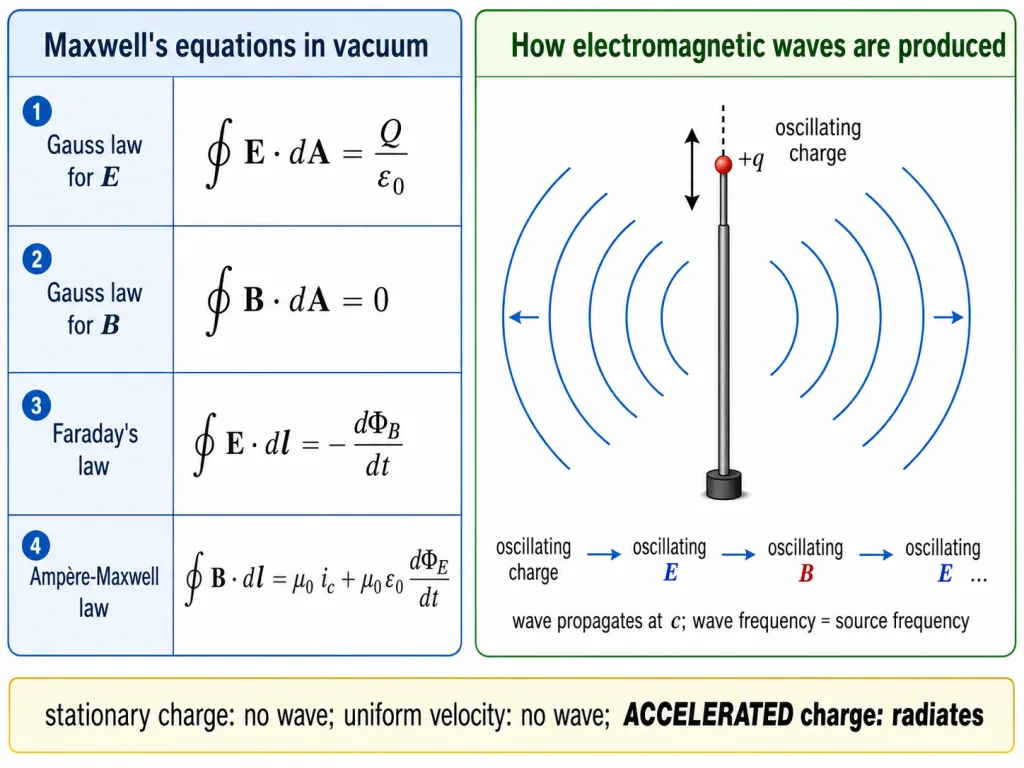
Who Can Radiate? Only Accelerated Charges
How are electromagnetic waves produced? Run through the candidates:
- A stationary charge: produces only an electrostatic field — nothing propagates.
- A charge in uniform motion (steady current): produces a magnetic field that does not change with time — still no radiation.
- An accelerated charge: radiates electromagnetic waves. This is the key result of Maxwell's theory (proof beyond our scope, but the logic is friendly):
An oscillating charge (one example of an accelerated charge) creates an oscillating electric field, which creates an oscillating magnetic field, which regenerates an oscillating electric field… the fields regenerate each other as the wave propagates outward.
Two facts to lock in:
- The wave's frequency equals the oscillation frequency of the charge.
- The wave's energy comes from the source — the energy of the accelerated charge.
Key Point (the one-mark classic): charges at rest → no wave; uniform velocity → no wave; acceleration → wave. No exceptions.
From Hertz to Bose to Marconi
Testing Maxwell looked simple: oscillate a current at the frequency of visible light. But yellow light oscillates at Hz, while even modern circuits manage only Hz. The test therefore had to happen at radio frequencies — and it did:
- Hertz (1887): produced and detected electromagnetic waves in the laboratory; measured their wavelength and speed; showed their vibration, reflection and refraction matched light's. Maxwell vindicated.
- Jagdish Chandra Bose (Kolkata, about seven years later): produced and observed EM waves of much shorter wavelength — 25 mm to 5 mm (the millimetre/microwave region). Lab-confined, like Hertz's.
- Guglielmo Marconi (Italy, around the same time): transmitted EM waves over many kilometres — the beginning of wireless communication.
[NEET Important] Match the name to the deed: Maxwell predicted; Hertz demonstrated; Bose miniaturised (mm waves); Marconi communicated (km range). All four appear as quick facts in NEET and Boards.
Solved Examples
Example 1: Radiate or not? [NEET pattern]
State whether each radiates EM waves: (a) an electron at rest, (b) an electron moving at constant 0.9c in a straight line, (c) an electron oscillating in an antenna, (d) an electron decelerating in a metal target.
Solution:
- (a) No — static charge, electrostatic field only.
- (b) No — uniform velocity, however large, is unaccelerated motion: a steady (non-radiating) field pattern.
- (c) Yes — oscillation is acceleration: radiates at the oscillation frequency.
- (d) Yes — deceleration is acceleration too (this is exactly how X-rays are made!).
Example 2: The antenna's frequency [NEET Numerical]
Charges in a transmitting antenna oscillate times per second. What are the frequency and wavelength of the radiated wave?
Solution:
- The wave frequency equals the charge's oscillation frequency: Hz MHz (an FM-band wave).
- m.
Example 3: Bose's wavelength range in frequencies [JEE Numerical]
Convert Bose's wavelength range (25 mm to 5 mm) into frequencies.
Solution:
- Hz GHz.
- Hz GHz.
- Bose was working in the microwave/millimetre-wave band — decades ahead of its technological time.
Example 4: Energy bookkeeping for a radiating charge
A charge oscillates and radiates. Where does the radiated energy come from?
Solution:
- The propagating wave carries energy through space.
- That energy comes at the expense of the source — the energy of the accelerated charge (whatever agency drives the oscillation keeps supplying it).
- No driver, no sustained radiation: antennas need transmitters.
Example 5: Why not visible-light circuits? [JEE Numerical]
To radiate yellow light ( Hz) directly from an LC oscillator with L = 1 nH, what C would be needed? Comment.
Solution:
- .
- ; F.
- A capacitance of F is hopelessly below anything buildable — which is why light comes from atomic transitions, not circuits, and why Hertz tested Maxwell with radio waves.
Example 6: An oscillating dipole's spectrum [NEET Numerical]
A dipole antenna driven at 500 kHz radiates a wave. In which spectrum band does it lie, and what is its wavelength?
Solution:
- 500 kHz sits at the lower edge of the radio band (NCERT: radio waves run from about 500 kHz to 1000 MHz).
- m — AM-broadcast territory.
Example 7: The four equations, one line each
State what each Maxwell equation says physically.
Solution:
- Gauss (E): electric field lines begin and end on charges; flux counts enclosed charge.
- Gauss (B): no magnetic monopoles; B-lines are closed loops, zero net flux.
- Faraday: a changing magnetic flux drives a circulating electric field (induced emf).
- Ampere-Maxwell: conduction currents and changing electric flux drive circulating magnetic fields.
Example 8: Self-sustaining fields
Using equations 3 and 4, explain how an EM wave keeps itself going in empty space.
Solution:
- In vacuum there are no charges or conduction currents — only the terms survive.
- The wave's changing E creates B (Ampere-Maxwell); that changing B recreates E (Faraday); and so on, leapfrogging through space.
- The mutual regeneration needs no medium — the fields are the medium. That is why light crosses the vacuum from the sun.
Example 9: Frequency is inherited [JEE Numerical]
An electron in an antenna oscillates with period 2 ns. Find the frequency and wavelength of the radiated wave, and name its band.
Solution:
- Hz MHz.
- m.
- 500 MHz lies in the TV/UHF radio region (NCERT: TV 54-890 MHz; cellular UHF).
Example 10: Hertz vs Marconi
Both Hertz and Marconi produced EM waves. What was the essential difference in their achievements?
Solution:
- Hertz created and detected the waves across a laboratory — a physics triumph: Maxwell's prediction made real and measured.
- Marconi sent them across kilometres — an engineering triumph: the birth of practical wireless communication.
- Between them sits Bose, who pushed the frequency frontier with millimetre waves.