
Visible Rays (700 nm to 400 nm)
The most familiar band — the part of the spectrum the human eye detects: roughly Hz to Hz, wavelengths 700 nm (red) down to 400 nm (violet). It is produced when electrons in atoms jump from higher to lower energy levels, and detected by the eye, photocells and photographic film.
Visible light reflected and emitted by objects is our window on the world — but the window's frame is species-specific: snakes detect infrared, and the 'visible' range of many insects extends into the ultraviolet.
Ultraviolet rays (400 nm to 0.6 nm)
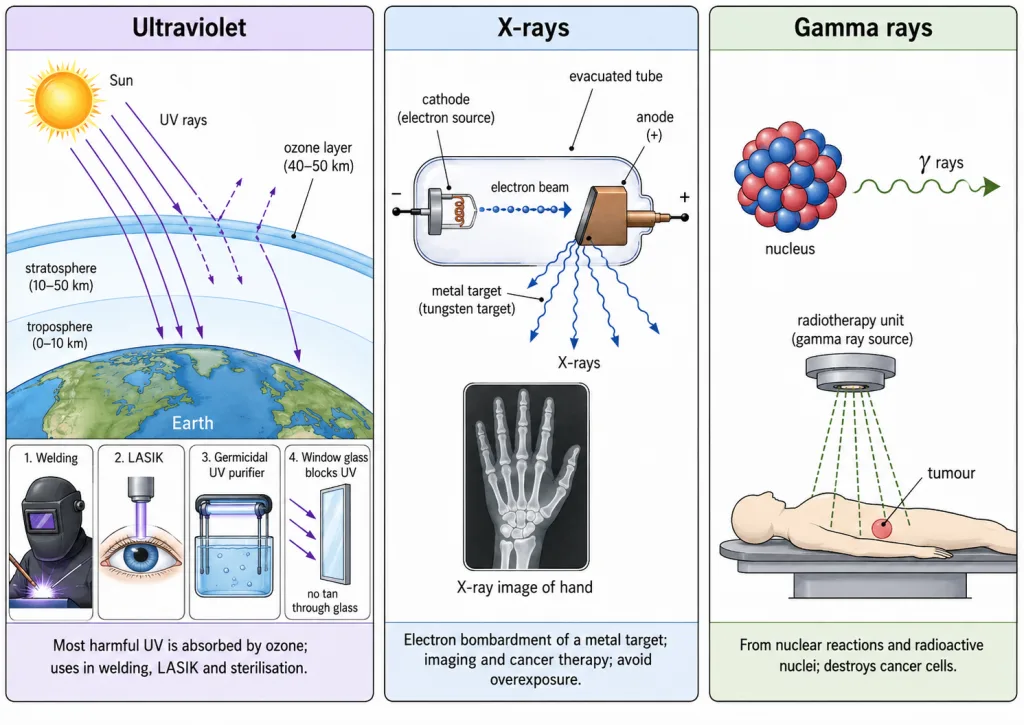
Produced by special lamps and very hot bodies; the sun is an important source. The NCERT facts that get asked:
- Most solar UV is absorbed by the ozone layer (altitude about 40-50 km) — whose depletion by CFCs (freon) is an international concern.
- UV induces melanin production — tanning; large doses are harmful.
- Ordinary glass absorbs UV — no tanning through a closed window!
- Welders' goggles block the copious UV of welding arcs.
- Short wavelengths focus into very narrow beams — LASIK eye surgery; UV lamps kill germs in water purifiers.
X-rays and Gamma Rays
X-rays (10 nm to nm)
Beyond UV. Produced by bombarding a metal target with high-energy electrons (sudden deceleration radiates — Section 3's rule at work). The classic medical band: diagnostic imaging and treatment of certain cancers. Because X-rays damage living tissue, unnecessary exposure must be avoided.
Gamma rays ( m to below m)
The top of the frequency ladder. Produced in nuclear reactions and emitted by radioactive nuclei. Used in medicine to destroy cancer cells.
Key Point — the overlap warning: the spectrum's divisions are not sharp; bands overlap (note UV reaching 0.6 nm while X-rays start at 10 nm!). Classification follows production/detection, not strict wavelength fences: a 1 nm wave from inner-shell transitions is 'UV/X-ray borderland'.
The Short-Wavelength Bands, Exam-Distilled
| Band | Wavelengths | Produced by | Star applications |
|---|---|---|---|
| Visible | 700-400 nm | electron transitions in atoms | sight, photography |
| UV | 400 nm-0.6 nm | special lamps, very hot bodies, the sun | LASIK, germicidal lamps, tanning (and its dangers) |
| X-rays | 10 nm- nm | high-energy electrons hitting metal targets | medical imaging, cancer treatment |
| Gamma | - m | nuclear reactions, radioactive nuclei | destroying cancer cells |
[NEET Important] Three guaranteed one-liners: ozone absorbs solar UV at 40-50 km; ordinary glass blocks UV (no sunburn indoors); X-rays from electron bombardment but gamma from nuclei. The X-vs-gamma production distinction is the single most-tested fact of this section.
[JEE Tip] Frequency order (increasing): radio < micro < IR < visible < UV < X < gamma. Energy and penetration climb the same ladder; wavelength runs opposite. Build one mental ladder and read every comparison off it.
Solved Examples
Example 1: Visible-band frequencies [NEET Numerical]
Verify NCERT's frequency range for visible light from its wavelength range (700-400 nm).
Solution:
- Red end: Hz.
- Violet end: Hz.
- Matching NCERT's 'about to Hz'.
Example 2: An X-ray's frequency [JEE Numerical]
Find the frequency of a 1 nm X-ray.
Solution:
- .
- Hz — a thousand times the visible band's frequency.
Example 3: Gamma at the extreme [JEE Numerical]
Find the frequency of a m gamma ray, and compare with visible light.
Solution:
- Hz.
- Versus visible's Hz: about times higher — eight orders of magnitude up the same ladder.
Example 4: Classify by wavelength [NEET Numerical]
Name the band for: (a) 550 nm, (b) 50 nm, (c) 0.05 nm, (d) m.
Solution:
- (a) 550 nm: visible (green region).
- (b) 50 nm: between 400 nm and 0.6 nm — ultraviolet.
- (c) 0.05 nm = m: X-ray range.
- (d) m: gamma ray territory (production decides borderline cases).
Example 5: No tan through the window
Why can't you get sunburnt behind an ordinary closed glass window?
Solution:
- Tanning/sunburn is caused by ultraviolet radiation inducing melanin production.
- Ordinary glass absorbs UV (NCERT states it directly).
- Visible light still streams through — brightness without burn.
Example 6: The ozone shield
State the role of the ozone layer and the threat to it.
Solution:
- The ozone layer (altitude about 40-50 km) absorbs most solar UV, protecting life from its harmful effects.
- Chlorofluorocarbons (CFCs, e.g. freon) deplete ozone — an international concern.
- One protective molecule layer between sunlight's useful glow and its harmful edge.
Example 7: X vs gamma — the production question
An unknown 0.01 nm radiation could be X-ray or gamma. What distinguishes them?
Solution:
- Wavelength alone cannot decide — the bands overlap here.
- Production is the criterion: X-rays come from high-energy electrons striking metal targets (atomic, inner-shell processes); gamma rays come from nuclear reactions and radioactive nuclei.
- Same wave physics, different birthplaces — exactly why NCERT classifies by production/detection.
Example 8: Why UV for LASIK? [JEE pattern]
Why is ultraviolet (not, say, infrared) used for high-precision eye surgery?
Solution:
- Precision of focusing improves as wavelength shrinks — UV's short wavelengths focus into very narrow beams (NCERT).
- A narrow beam removes tissue at fine scales without collateral spread.
- The same short-wavelength logic gives microwaves radar precision over radio — one principle, many bands.
Example 9: Medical double agent [NEET pattern]
X-rays both diagnose and endanger. Reconcile.
Solution:
- X-rays penetrate soft tissue but are absorbed differently by bone — perfect for diagnostic imaging; targeted doses also treat certain cancers.
- The same penetrating energy damages or destroys living tissue generally.
- Hence NCERT's warning: avoid unnecessary or over-exposure. Dose makes the difference between tool and hazard.
Example 10: Welders' goggles
Why must welders wear special glass goggles or masks?
Solution:
- Welding arcs emit large amounts of ultraviolet (they are very hot sources — a UV production route).
- UV in large quantity harms eyes and skin.
- The goggles' glass absorbs the UV, passing only safe visible light — everyday protection by selective absorption.