
Setting the Scene: A Pinhead in a Classroom
Chapter 12 established that every atom hides a nucleus — positive charge and mass densely packed at the centre. How packed? The nuclear radius is smaller than the atomic radius by a factor of about , so the nuclear volume is about of the atomic volume. If an atom were enlarged to the size of a classroom, the nucleus would be a pinhead — yet that pinhead holds more than 99.9% of the atom's mass.
This chapter asks the next questions: does the nucleus have structure? What are its constituents? What holds them together? The answers lead through nuclear sizes, masses, binding energy, the nuclear force, radioactivity, fission and fusion.
The atomic mass unit
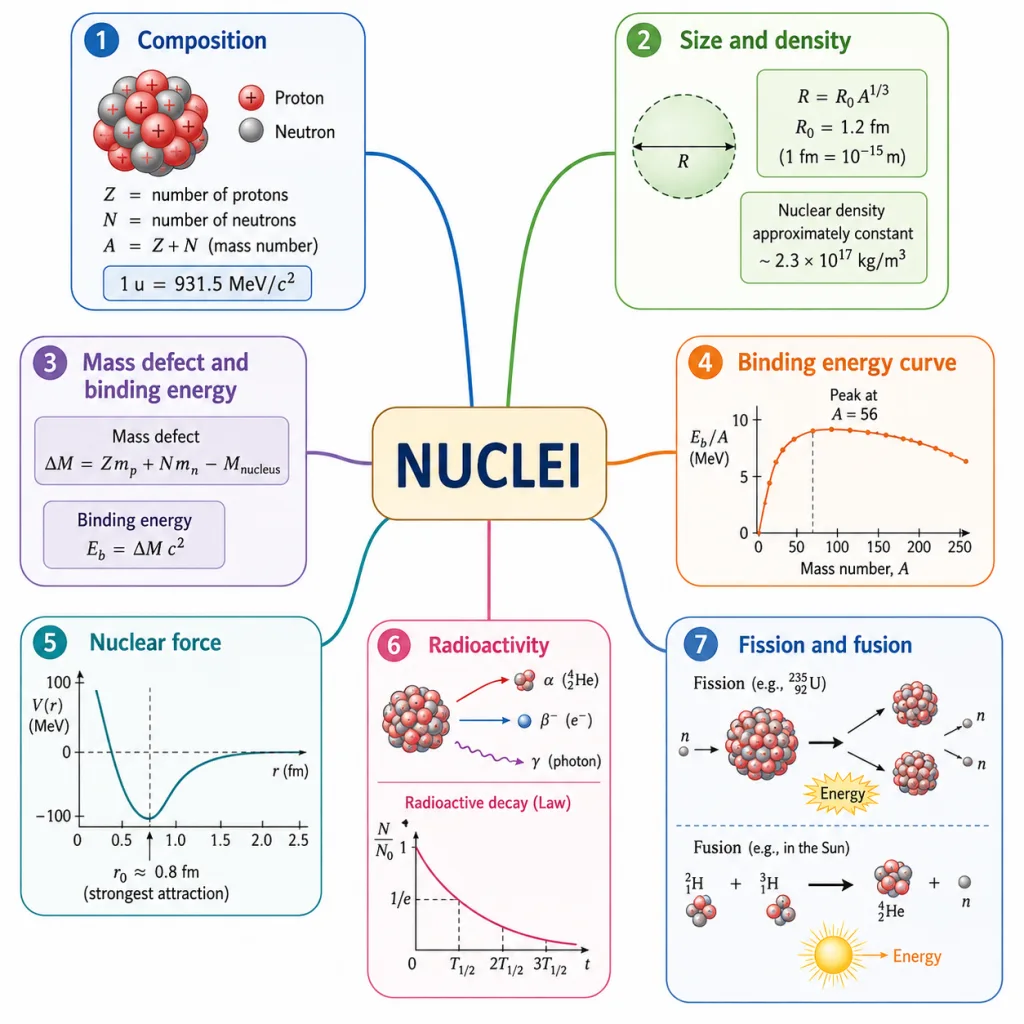
Kilograms are hopeless for atoms (a carbon-12 atom weighs kg). The working currency is the atomic mass unit (u) — defined as 1/12 of the mass of one carbon-12 atom:
Atomic masses in u are close to integers (multiples of hydrogen's mass) — with striking exceptions like chlorine's 35.46 u, whose explanation is coming right up. Accurate masses come from the mass spectrometer.
Isotopes and the Weighted Average
Mass spectrometry revealed that atoms of the same element can have different masses while sharing identical chemical properties. These are isotopes (Greek: same place — same slot in the periodic table). Practically every element is a mixture of isotopes.
The chlorine mystery solved
Chlorine has two isotopes, masses 34.98 u and 36.98 u (both near-integers!), with relative abundances 75.4% and 24.6%. The measured atomic mass is their weighted average:
— exactly the odd 35.46 u on the periodic table. Fractional atomic masses are bookkeeping artefacts of isotope mixing, not fractional nucleons.
Hydrogen's trio and the proton
Even hydrogen has three isotopes: masses 1.0078 u, 2.0141 u, 3.0160 u. The lightest (99.985% abundance) has a nucleus called the proton:
(equal to the hydrogen atom's mass minus one electron's = 0.00055 u). The proton carries one unit of fundamental positive charge and is stable. The other two isotopes are deuterium and tritium — tritium's nucleus is unstable and must be made artificially.
Since the atom is neutral with Z electrons outside the nucleus (total charge ), the nuclear charge is exactly : the nucleus contains exactly Z protons. (Early ideas of electrons inside the nucleus were ruled out by quantum-theory arguments.)
Chadwick's Neutron (1932)
A puzzle: deuterium and tritium are hydrogen isotopes, so each has one proton — yet the H : D : T nuclear masses run 1 : 2 : 3. The extra mass must be neutral matter, in multiples of roughly one proton mass: one unit in deuterium, two in tritium.
James Chadwick verified the hypothesis in 1932. Bombarding beryllium with alpha particles produced a neutral radiation that could knock protons out of light nuclei (helium, carbon, nitrogen). Could it be photons — the only neutral radiation then known? No: applying conservation of energy and momentum, photon energies would have had to be far higher than the bombardment could supply. Chadwick's resolution: a new neutral particle — the neutron — with mass 'very nearly the same as the mass of the proton'. He won the 1935 Nobel Prize.
Key Point: A free neutron is unstable — it decays into a proton, an electron and an antineutrino with a mean life of about 1000 s. Inside a nucleus, however, the neutron is stable.
The vocabulary of nuclides
- Z — atomic number = number of protons
- N — neutron number = number of neutrons
- A — mass number = Z + N = total nucleons (nucleon = proton or neutron)
- Notation: — e.g. Au has 197 nucleons: 79 protons, 118 neutrons.
| Term | Same | Different | Example |
|---|---|---|---|
| Isotopes | Z | N (hence A) | H, H, H |
| Isobars | A | Z | H and He |
| Isotones | N | Z (hence A) | Hg and Au (both N = 118) |
Isotopes share electronic structure → identical chemical behaviour, same periodic-table slot. Gold alone has 32 isotopes (A = 173 to 204).
[NEET Important] The isotope/isobar/isotone triple with the NCERT examples is a guaranteed one-marker. Memory hook: isoTope — same Type (element/Z); isoBar — same Bulk (A); isoTONe — same neuTON… i.e. neutron count.
Solved Examples
Example 1: The mass of 1 u in kilograms
Starting from the definition, compute 1 u in kg.
Solution:
- Definition: 1 u = × (mass of one C atom).
- Substitute: 1 u = kg.
- Answer: 1 u = kg.
- Takeaway: carbon-12 is the ruler; every atomic and nuclear mass in this chapter is measured against it.
Example 2: Chlorine's weighted average (NCERT's worked case)
Chlorine's isotopes have masses 34.98 u (75.4%) and 36.98 u (24.6%). Find the mean atomic mass.
Solution:
- Weighted average: .
- Compute: u.
- Conclusion: matches the periodic-table value 35.46 u — fractional masses come from isotope mixtures, each isotope being near-integral.
Example 3: Counting nucleons [Board Rapid]
For Au and U, state Z, N and A.
Solution:
- Gold: Z = 79 protons, A = 197 nucleons, N = 197 - 79 = 118 neutrons.
- Uranium: Z = 92, A = 235, N = 235 - 92 = 143 neutrons.
- Takeaway: N = A - Z; the subscript is the proton count, the superscript counts everything.
Example 4: Classify the pairs [NEET Pattern]
Classify: (a) H and He; (b) H and H; (c) Hg and Au.
Solution:
- (a) Same A = 3, different Z → isobars.
- (b) Same Z = 1, different N → isotopes (deuterium and tritium).
- (c) N: 198 - 80 = 118 and 197 - 79 = 118 — same N, different Z → isotones.
- Takeaway: compute N explicitly for isotone checks; the eye can't spot equal neutron counts from the symbols.
Example 5: Why the neutral radiation wasn't photons [Board Conceptual]
Outline Chadwick's argument that the beryllium radiation had to be a new particle.
Solution:
- The radiation was neutral (undeflected) and could knock protons out of light nuclei — a job needing serious energy and momentum.
- If photons: conservation of energy and momentum demanded photon energies far larger than the alpha-beryllium bombardment could possibly supply.
- Resolution: a neutral particle with mass ≈ proton mass transfers momentum efficiently in collisions (like billiard balls) — modest energies suffice.
- From the conservation laws, Chadwick pinned its mass at nearly the proton's — the neutron.
Example 6: The deuterium-tritium mass ladder
Using the 1 : 2 : 3 mass ratio of H : D : T nuclei, deduce their neutron contents.
Solution:
- All three are hydrogen isotopes → each has exactly 1 proton.
- Masses ≈ 1, 2, 3 proton masses → neutral extra matter ≈ 0, 1, 2 proton-mass units.
- Conclusion: H has 0 neutrons, D has 1, T has 2 — precisely the ladder that pointed to the neutron before Chadwick caught it.
Example 7: Free vs bound neutrons [NEET Conceptual]
Compare the stability of a free neutron and a neutron inside a nucleus.
Solution:
- Free neutron: unstable — decays to proton + electron + antineutrino, mean life ≈ 1000 s.
- Inside a nucleus: stable — the nuclear environment (binding energetics) forbids the decay in stable nuclei.
- Contrast: the free proton is stable. 'Which free nucleon decays?' — the neutron. A precision one-marker.
Example 8: The proton from hydrogen's mass
Given the hydrogen atom's mass 1.00783 u and = 0.00055 u, extract the proton mass.
Solution:
- Atom = nucleus + electron: (binding energy of the electron is negligible at this precision).
- Compute: u ≈ 1.00727 u. ✔
- Takeaway: atomic masses include electrons; nuclear calculations must add or strip them consistently — the habit that Section 3's mass-defect bookkeeping depends on.
Example 9: How many atoms in a gram of carbon-12? [JEE Numerical]
Using 1 u = kg, count the atoms in 1 g of pure C.
Solution:
- One atom's mass: 12 u = kg.
- Count: atoms.
- Check: . ✔ (Avogadro in disguise.)
- Takeaway: u-to-kg conversion and Avogadro's number are the same fact wearing different clothes.
Example 10: Boron's isotopes [JEE Numerical]
Boron has isotopes B (10.01 u) and B (11.01 u); its atomic mass is 10.81 u. Find the relative abundances.
Solution:
- Let x% be B: .
- Solve: .
- Answer: B: 20%, B: 80%.
- Takeaway: the weighted-average machine runs in reverse too — abundances from the mean mass.