
Einstein's Bombshell: Mass IS Energy
Before special relativity, mass and energy were conserved separately. Einstein showed that mass is another form of energy — convertible into kinetic energy and vice versa — through the most famous equation in physics:
with c ≈ m/s. The exchange rate is staggering: 1 gram of matter ↔ J (NCERT Example 13.2) — roughly a large power station's daily output.
In any reaction, the conservation law now reads: initial energy = final energy, provided the energy locked in mass is included. Nuclear physics is where this principle shows itself most convincingly.
The golden conversion factor
Converting 1 u to energy (NCERT Example 13.3):
Every mass-defect calculation in this chapter runs through this factor. Also handy: 1 MeV = J.
Mass Defect and Binding Energy
Here's the chapter's central surprise: a nucleus weighs less than its parts.
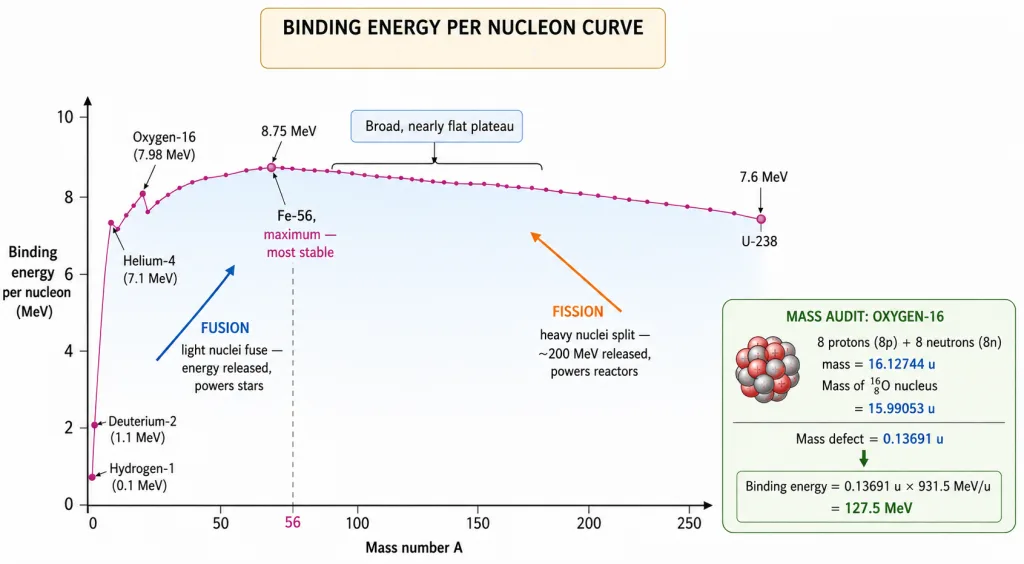
The oxygen-16 audit (NCERT's worked case)
Expected mass of O nucleus (8 protons + 8 neutrons):
- 8 neutrons: 8 × 1.00866 u; 8 protons: 8 × 1.00727 u → total 16.12744 u (using 8 × 2.01593 u).
- Measured: atomic mass 15.99493 u minus 8 electrons (8 × 0.00055 u) = 15.99053 u.
- Shortfall: 0.13691 u.
This difference is the mass defect:
What the missing mass means
By , the bound nucleus has less energy than its separated constituents. To pull the nucleus apart into free nucleons you must supply ; conversely, assembling a nucleus from free nucleons releases that energy. This is the binding energy:
For oxygen-16: MeV.
Binding energy per nucleon
The more useful measure of how tightly a nucleus is glued:
— the average energy needed to remove one nucleon. For oxygen-16: 127.5/16 ≈ 8.0 MeV per nucleon.
[JEE Tip] Bookkeeping discipline: when given atomic masses, either subtract Z electron masses to get nuclear masses, or use hydrogen-ATOM masses ( = 1.007825 u) for protons — the electrons then cancel: . NCERT's exercise data supplies for exactly this reason.
The Binding-Energy Curve: Physics' Most Consequential Graph
Plot against mass number A for all nuclei (NCERT Fig. 13.1). Its anatomy:
- A broad flat plateau: ≈ constant (~8.0 MeV) for 30 < A < 170 — practically independent of A.
- The maximum: about 8.75 MeV at A = 56 (iron's neighbourhood — the most tightly bound matter in the universe).
- Droop at the heavy end: down to 7.6 MeV at A = 238.
- Droop at the light end: lower for A < 30 (with local spikes at He, O — evidence of shell structure, per Points to Ponder).
Reading the curve: four conclusions
- (i) The nuclear force is attractive and strong enough to yield ~MeV-per-nucleon binding.
- (ii) The plateau's constancy ⇒ the force is short-ranged and saturates: a nucleon inside a large nucleus feels only its p nearest neighbours, so its binding ≈ pk regardless of A. Adding distant nucleons changes nothing for it.
- (iii) Fission pays: A = 240 sits at ~7.6 MeV; two A = 120 fragments sit at ~8.5 MeV. Breaking the heavy nucleus tightens the binding — energy is released (~0.9 MeV × 240 ≈ 216 MeV). The germ of nuclear reactors.
- (iv) Fusion pays too: joining two very light nuclei (A ≤ 10) yields a heavier nucleus with higher — again energy released. The Sun's engine.
Key Point: Greater binding energy ⇒ smaller total mass. Any transformation moving nuclei up the curve (toward iron, from either side) releases energy. Both fission and fusion are just downhill rolls toward A ≈ 56.
[NEET Important] The four numbers — 8.0 MeV plateau, 8.75 MeV max at A = 56, 7.6 MeV at A = 238, range 30 < A < 170 — are quizzed verbatim. So is 'why is the curve flat?' (short range + saturation).
Solved Examples
Example 1: Energy in a gram (NCERT Example 13.2)
Calculate the energy equivalent of 1 g of substance.
Solution:
- Formula: .
- Compute: J.
- Takeaway: total conversion of one gram powers a city for a day — the reason nuclear energetics dwarfs chemistry.
Example 2: 1 u in MeV (NCERT Example 13.3)
Find the energy equivalent of one atomic mass unit in joules and MeV; express oxygen-16's mass defect in MeV/.
Solution:
- Joules: J.
- eV: eV = 931.5 MeV.
- Oxygen: u = MeV/.
- Takeaway: 931.5 MeV per u — the chapter's master conversion; oxygen-16 needs 127.5 MeV to fully dismantle.
Example 3: Binding energy of nitrogen-14 (NCERT Exercise 13.1)
Given = 14.00307 u (atomic), = 1.007825 u, = 1.008665 u, find .
Solution:
- Atomic-mass bookkeeping: .
- Compute constituents: u.
- Defect: u.
- Energy: MeV.
- Takeaway: ≈ 7.5 MeV per nucleon — nitrogen sits below the plateau, as a light nucleus should.
Example 4: Iron vs bismuth (NCERT Exercise 13.2)
Find the binding energies of Fe (55.934939 u) and Bi (208.980388 u), and compare .
Solution:
- Iron: u.
- MeV; MeV.
- Bismuth: u.
- MeV; MeV.
- Takeaway: iron out-binds bismuth per nucleon (8.79 vs 7.85 MeV) — the curve's peak versus its heavy-side droop, in real numbers.
Example 5: Tearing apart a copper coin (NCERT Exercise 13.3)
A 3.0 g coin of pure Cu (62.92960 u): how much energy separates all its neutrons and protons?
Solution:
- Atoms in the coin: .
- Per-nucleus defect: u.
- Per-nucleus energy: MeV.
- Total: MeV MeV J.
- Takeaway: dismantling one small coin nucleus-by-nucleus costs the energy of a small power plant running for hours — binding energies are colossal at everyday scales.
Example 6: Reading the curve for fission [Board Conceptual]
Using curve values, estimate the energy released when an A = 240 nucleus splits into two A = 120 fragments.
Solution:
- Before: MeV → total binding ≈ 240 × 7.6 = 1824 MeV.
- After: MeV → total ≈ 240 × 8.5 = 2040 MeV.
- Gain: ≈ 0.9 MeV per nucleon × 240 ≈ 216 MeV released — NCERT's own estimate of ~200 MeV per fission.
- Takeaway: tighter binding after = energy out; the curve is a lookup table for reaction energetics.
Example 7: Why the plateau? [Board Derivation]
Explain the constancy of for 30 < A < 170 from the nuclear force's short range.
Solution:
- A nucleon deep inside a large nucleus interacts only with neighbours within the force's few-fm range — say a maximum of p of them.
- Its binding energy ≈ pk (k an energy constant), independent of how big the nucleus is beyond that.
- Most nucleons of a large nucleus are interior ones, so the average — — stays ≈ pk as A grows: the plateau.
- This 'a nucleon only feels its neighbours' property is the saturation of the nuclear force. ∎
Example 8: Mass of the products [JEE Conceptual]
In an exothermic nuclear reaction, how does the total rest mass of products compare with reactants?
Solution:
- Energy released means final kinetic energy > initial — that energy comes from rest mass.
- Products are lighter: .
- Equivalently: products are more tightly bound (more binding energy = less mass).
- Takeaway: 'released energy' ↔ 'lost mass' ↔ 'gained binding' — three phrasings of one fact; exams rotate among them.
Example 9: Binding energy per nucleon of helium-4 [NEET Numerical]
Given = 4.002603 u (atomic), = 1.007825 u, = 1.008665 u, find .
Solution:
- Defect: u.
- Binding energy: MeV.
- Per nucleon: MeV.
- Takeaway: helium-4's unusually high for its size (a spike on the curve) signals shell structure — and explains why alpha particles are nature's favourite ejected package.
Example 10: How much mass does binding steal? [JEE Numerical]
What fraction of oxygen-16's constituent mass is 'missing' as binding energy?
Solution:
- Fraction: .
- Compute: ≈ 0.0085 → about 0.85%.
- Takeaway: nuclear binding shaves off nearly 1% of the mass — chemistry's binding shaves ~. The million-fold energy gap between nuclear and chemical reactions in one ratio.