
A Million Times Chemistry
The binding-energy curve's long flat middle (A = 30 to 170, ~8.0 MeV) with drooping ends is an energy map: moving nucleons from loosely bound arrangements to tightly bound ones releases the difference. Greater binding = less total mass — so transformations toward tighter binding shed mass as energy.
Two routes exist:
- Fission: a heavy nucleus (A > 170 region, ~7.6 MeV/nucleon) splits into middle-mass fragments (~8.5 MeV/nucleon).
- Fusion: light nuclei (A < 30) merge into a heavier, tighter nucleus.
The scale of the prize
Chemical reactions (coal, petroleum) turn over eV per atom; nuclear reactions turn over MeV per nucleus — a factor of a million:
| Fuel (1 kg) | Energy |
|---|---|
| Coal (burning) | ~ J |
| Uranium (fission) | ~ J |
Fission: Splitting the Heavyweights
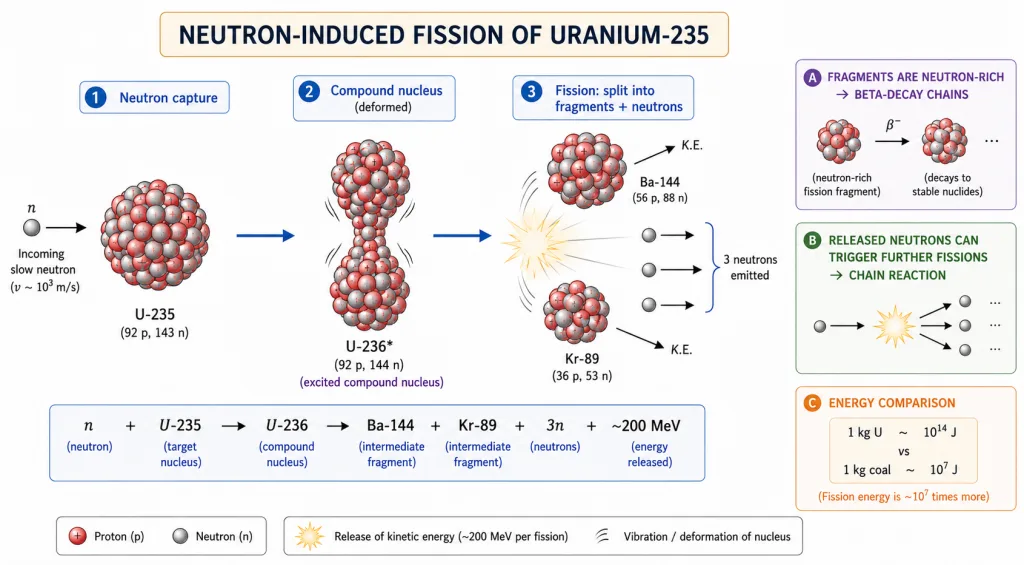
Beyond natural decays, nuclei can be bombarded with protons, neutrons, alphas… The most important neutron-induced reaction is fission. A slow neutron absorbed by U forms U, which promptly splits:
The same capture can yield other fragment pairs:
Note the bookkeeping in each: A and Z balance on both sides, and 2-4 fresh neutrons emerge — the seed of chain reactions.
The fragments are radioactive
Fragment nuclei inherit the parent's neutron-rich N/Z ratio — too high for their mass range — so they emit beta particles in succession until they reach stable end products.
The 200 MeV estimate
From the curve (as computed in Section 3): A = 240 at 7.6 MeV/nucleon → two A = 120 fragments at 8.5 MeV/nucleon; gain ≈ 0.9 MeV × 240 ≈ 216 MeV. The actual Q value ≈ 200 MeV per fission, appearing first as kinetic energy of fragments and neutrons, then degraded to heat in the surroundings.
- Controlled fission chain → nuclear reactors (the heat drives turbines).
- Uncontrolled chain → the atom bomb.
[NEET Important] Q value definition (NCERT summary): Q = final kinetic energy - initial kinetic energy = (sum of initial masses - sum of final masses). Exothermic: Q > 0 (products lighter); endothermic: Q < 0 (energy must be supplied).
How Nuclear Equations 'Balance' (NCERT Example 13.4's Wisdom)
Three subtle questions, answered NCERT's way:
(a) Are nuclear equations balanced like chemical ones?
A chemical equation balances atoms of each element (atoms are merely regrouped). In nuclear reactions elements transmute — atom counts per element are NOT conserved. What balances instead: the number of protons and the number of neutrons, each separately (at ordinary energies; strictly, total charge and baryon number).
(b) If proton and neutron numbers are conserved, where does the mass-energy conversion happen?
The rest masses of free protons and neutrons match on both sides — but binding energy contributes (negatively) to each nucleus's mass, and the total binding energy differs between the two sides. That binding-energy difference is what appears as released (or absorbed) energy. 'The difference in the total mass of nuclei on the two sides gets converted into energy.'
(c) Is mass-energy interconversion exclusive to nuclear reactions?
No — chemical reactions do it too, in principle: chemical binding energy also gives a (tiny) negative mass contribution, so reacting molecules' total mass changes. But chemical mass defects are ~a million times smaller, hence undetectable by weighing — the source of the (incorrect) impression that only nuclear reactions convert mass.
Key Point: Energy release in ANY reaction = binding-energy gain = mass loss. Nuclear reactions are only quantitatively, not qualitatively, special.
[JEE Tip] Q-value machinery for numericals: MeV with masses in u. Atomic masses may be used throughout when electron counts balance (they do in fission and most reactions; beta decays need care).
Solved Examples
Example 1: Energy from 1 kg of plutonium (NCERT Exercise 13.7)
The average fission of Pu releases 180 MeV. How much energy is released if all atoms in 1 kg of pure Pu fission?
Solution:
- Number of atoms: .
- Total energy: MeV MeV.
- In joules: → J.
- Takeaway: ~ J per kilogram — NCERT's million-times-coal claim, verified by direct count.
Example 2: Is iron fission possible? (NCERT Exercise 13.6)
Could Fe (55.93494 u) split into two Al (27.98191 u)? Compute Q.
Solution:
- Q value: .
- Compute: MeV.
- Verdict: Q < 0 — energetically impossible spontaneously; ~27 MeV would have to be SUPPLIED.
- Takeaway: iron sits at the curve's peak — nothing pays from there. Fission profits only for heavy nuclei on the drooping right flank.
Example 3: Q values of two reactions (NCERT Exercise 13.5)
Find Q for (i) and (ii) , given m(H) = 2.014102 u, m(H) = 3.016049 u, m(C) = 12.000000 u, m(Ne) = 19.992439 u, m(H) = 1.007825 u, m(He) = 4.002603 u.
Solution:
- (i) .
- MeV → endothermic (needs energy).
- (ii) .
- MeV → exothermic (releases energy).
- Takeaway: the sign of the mass difference IS the verdict; carbon-carbon fusion powers heavy stars, while reaction (i) runs backward for free.
Example 4: Balancing a fission equation [Board Numerical]
Complete: . Identify X.
Solution:
- Mass numbers: 1 + 235 = 140 + A + 2 → A = 94.
- Atomic numbers: 0 + 92 = 54 + Z + 0 → Z = 38 (strontium).
- Answer: Sr — NCERT Eq. 13.12's fragment pair.
- Takeaway: protons and neutrons balance separately — two quick sums identify any missing fragment.
Example 5: Energy per fission from curve values [Board Numerical]
Estimate the energy released when U (treat as A = 236 at 7.6 MeV/nucleon) splits into fragments averaging 8.5 MeV/nucleon.
Solution:
- Before: 236 × 7.6 ≈ 1794 MeV of binding.
- After: 236 × 8.5 ≈ 2006 MeV.
- Released: ≈ 212 MeV — the canonical '~200 MeV per fission'.
- Takeaway: you never need fragment identities for the estimate; the curve alone prices the split.
Example 6: Why are fission fragments beta-active? [NEET Conceptual]
Explain why fission fragments are radioactive and what decay they undergo.
Solution:
- Heavy nuclei carry N/Z ≈ 1.55 (e.g. U-235); stable middle-mass nuclei want N/Z ≈ 1.2-1.3.
- Fragments inherit the parent's high ratio → they are neutron-rich for their size.
- They therefore emit beta-minus particles in succession (n → p conversions) until reaching stable end products — NCERT's exact statement.
- Takeaway: fission's radioactivity problem (waste) is the N/Z mismatch playing out.
Example 7: Counting fissions for a power station [JEE Numerical]
A reactor delivers 1000 MW of fission heat. How many U fissions occur per second (200 MeV each)?
Solution:
- Per fission: 200 MeV = J.
- Rate: fissions per second.
- Takeaway: -scale event rates from gram-scale fuel consumption — divide power by energy-per-event, always.
Example 8: Chemical vs nuclear mass defect [Conceptual Numerical]
Burning 1 kg of coal releases J. What mass does the products' total fall by, and why is it unmeasurable?
Solution:
- Mass loss: kg — a tenth of a microgram.
- Fractionally: ~ of the fuel mass — hopeless to weigh.
- Contrast: fission converts ~ of the mass (0.09%) — a billion times more, easily seen in mass spectrometry.
- Takeaway: NCERT Example 13.4(c): chemistry converts mass too, just a million times less per event — the 'only nuclear reactions convert mass' impression is strictly wrong.
Example 9: What is conserved? (NCERT Example 13.4a)
In what sense is balanced?
Solution:
- Not in atoms of each element — barium and krypton did not exist beforehand (transmutation!).
- Balanced in: proton number (92 = 56 + 36) and neutron number (1 + 143 = 88 + 53 + 3 → 144 = 144 ✔), each separately.
- (At very high energies, the strict laws are conservation of total charge and baryon number.)
- Takeaway: chemical balancing preserves atoms; nuclear balancing preserves nucleon types.
Example 10: Uranium vs coal, per kilogram [Board Numerical]
Verify the million-fold claim: compare energy per kilogram of U-235 fission (200 MeV/nucleus) vs coal ( J/kg).
Solution:
- Uranium: nuclei/kg.
- Energy: J ≈ J ≈ J.
- Ratio: — ten million times coal (NCERT's 'million times' is the conservative order).
- Takeaway: the eV-vs-MeV gap per event, times similar atom counts, gives the macroscopic million-plus factor.