
Fusion: Climbing the Curve from the Left
When two light nuclei fuse, the product is more tightly bound (higher , left flank of the curve) — energy is released. NCERT's three flagship reactions:
(Proton + proton → deuteron + positron; deuteron + deuteron → helium-3 + neutron, or triton + proton.)
The Coulomb barrier
For fusion, the nuclei must come within nuclear-force range — but both are positively charged and repel. They need enough kinetic energy to climb the Coulomb barrier, whose height depends on the charges and radii involved: ~400 keV for two protons, higher for higher charges.
The temperature price
When does a gas of protons average 400 keV?
Fusion achieved by sheer temperature is thermonuclear fusion. But note: the Sun's core is only K — far below the estimate. Solar fusion runs on the high-energy tail of the proton distribution: protons with energies much above average do the burning.
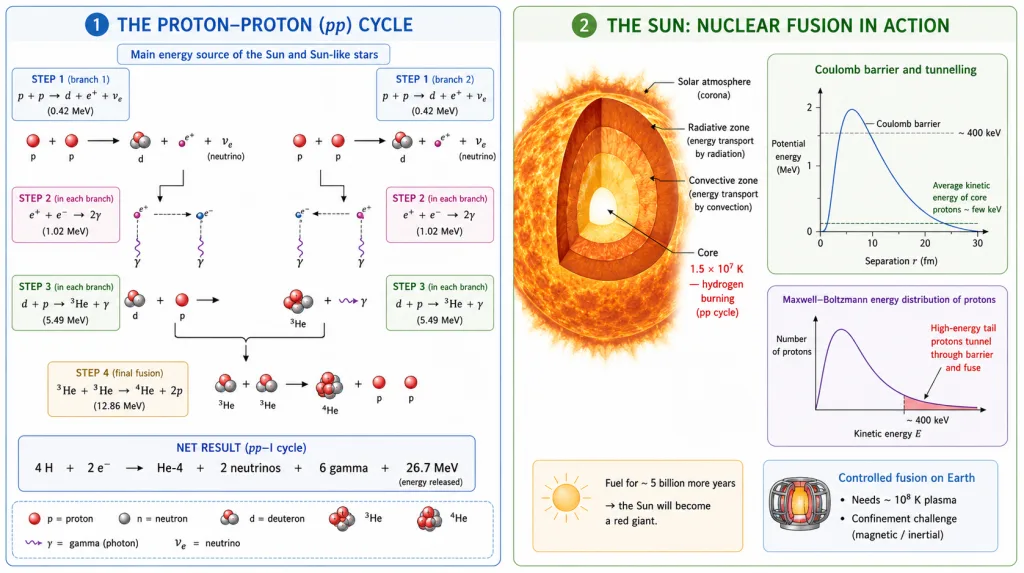
The Proton-Proton Cycle: The Sun's Furnace
The Sun burns hydrogen into helium in its core via a multi-step proton-proton (p, p) cycle:
For step (iv) to run once, steps (i)-(iii) must run twice. Net effect of 2(i) + 2(ii) + 2(iii) + (iv):
Four hydrogen atoms burn into one helium atom, releasing 26.7 MeV.
The Sun's biography
- Age: about years; hydrogen enough for another ~5 billion years.
- Then: hydrogen burning stops → core cools → gravitational collapse raises core temperature → at ~ K, helium fuses into carbon; the envelope expands — the Sun becomes a red giant.
- Successive burnings build heavier elements — but only up to the iron peak of the binding curve; beyond it, fusion costs energy (heavier elements need other processes).
Controlled thermonuclear fusion
Replicating the star: heat fuel to ~ K, where it is a plasma (positive ions + electrons). The challenge: no container withstands such temperatures — the plasma must be confined by other means (several countries, including India, are developing techniques). Success would mean almost unlimited power.
[NEET Important] Number bank: 0.42 / 1.02 / 5.49 / 12.86 / 26.7 MeV; barrier ~400 keV; K estimate vs K solar core; helium→carbon at K. [JEE Tip] Fusion is per-KILOGRAM even richer than fission: 26.7 MeV from just 4 nucleons ≈ 6.7 MeV/nucleon versus fission's ~0.85 MeV/nucleon — hydrogen fuel outperforms uranium ~7× by mass.
Solved Examples
Example 1: The lamp on deuterium (NCERT Exercise 13.8)
How long can a 100 W lamp glow on the fusion of 2.0 kg of deuterium via MeV?
Solution:
- Deuterons available: .
- Reactions: each uses 2 deuterons → reactions, releasing 3.27 MeV each.
- Total energy: J.
- Time: s ≈ years.
- Takeaway: two kilograms of heavy hydrogen light a bulb for fifty millennia — fusion's promise in one number.
Example 2: Coulomb barrier of two deuterons (NCERT Exercise 13.9)
Find the barrier height for a head-on collision of two deuterons (radius 2.0 fm each).
Solution:
- At contact: centres separated by d = 2 × 2.0 = 4.0 fm.
- Coulomb energy: J.
- Compute: J ≈ 360 keV.
- Takeaway: a few hundred keV — consistent with NCERT's ~400 keV two-proton figure; each nucleus supplies half (~180 keV) in a symmetric collision.
Example 3: The temperature estimate [Board Numerical]
Show that protons averaging 400 keV correspond to T ~ K.
Solution:
- Equipartition: .
- Solve: .
- Compute: K.
- Takeaway: NCERT's estimate exactly; the Sun (at K) burns anyway because its energetic-tail protons far exceed the average — a favourite conceptual follow-up.
Example 4: Auditing the p-p cycle [Board Numerical]
Verify that 2(i) + 2(ii) + 2(iii) + (iv) releases 26.7 MeV.
Solution:
- Twice (i): 2 × 0.42 = 0.84 MeV.
- Twice (ii): 2 × 1.02 = 2.04 MeV.
- Twice (iii): 2 × 5.49 = 10.98 MeV.
- Once (iv): 12.86 MeV.
- Total: 0.84 + 2.04 + 10.98 + 12.86 = 26.72 ≈ 26.7 MeV. ✔
- Takeaway: four protons in, one helium out, 26.7 MeV released — the Sun's balance sheet checks to the decimal.
Example 5: How much hydrogen does the Sun burn? [JEE Numerical]
The Sun radiates W. Estimate the mass of hydrogen converted per second (26.7 MeV per 4 protons).
Solution:
- Energy per proton: MeV J.
- Protons per second: .
- Mass rate: kg/s.
- Takeaway: the Sun burns ~600 million tonnes of hydrogen every second — and still has 5 billion years of fuel. Astronomy from arithmetic.
Example 6: Fusion vs fission per kilogram [JEE Comparison]
Compare the energy per kilogram from hydrogen fusion (26.7 MeV per 4 u) and uranium fission (200 MeV per 235 u).
Solution:
- Fusion: MeV per nucleon (u).
- Fission: MeV per nucleon.
- Ratio: ≈ 7.8× in fusion's favour per unit mass.
- Takeaway: fusion fuel is nearly an order of magnitude richer — plus hydrogen is abundant and the products non-radioactive. Hence the reactor dream.
Example 7: Why fusion needs heat but fission doesn't [NEET Conceptual]
Fission is triggered by slow neutrons at room temperature; fusion needs - K. Why the difference?
Solution:
- Fission's trigger is a neutron: electrically neutral, it feels no Coulomb barrier and strolls into the uranium nucleus at any speed.
- Fusion's ingredients are both positive nuclei: they must overcome ~400 keV of Coulomb repulsion before the nuclear force can grab them.
- Only extreme temperatures give nuclei such kinetic energies — hence THERMOnuclear fusion.
- Takeaway: the barrier belongs to charged projectiles; neutrality is fission's skeleton key.
Example 8: The Sun's future [Board Conceptual]
Describe the sequence of events when the Sun's core hydrogen runs out.
Solution:
- Hydrogen burning stops → the core (now helium) cools → pressure support weakens.
- The star collapses under gravity, which heats the core.
- At ~ K, helium fuses into carbon; the outer envelope expands enormously — the Sun becomes a red giant.
- Successive fusion stages can build heavier elements, but only up to the binding-curve peak (iron region) — beyond that, fusion absorbs energy.
- Takeaway: a star's life is gravity versus fusion, negotiated stage by stage up the periodic table.
Example 9: The plasma problem [Board Conceptual]
What is the central engineering challenge of controlled fusion, and why?
Solution:
- Working temperature ~ K turns the fuel into plasma — a mixture of positive ions and electrons.
- No material container can withstand contact with matter at such temperatures.
- The challenge is confinement of the plasma (by non-material means); several countries including India are developing techniques.
- Takeaway: success promises 'almost unlimited power to humanity' — NCERT's own phrase, and a favourite short-answer quote.
Example 10: Positron's fate in the cycle [NEET Conceptual]
What happens to the positron produced in step (i) of the p-p cycle, and how much energy does that step contribute?
Solution:
- The positron meets one of the plasma's abundant electrons and annihilates: .
- Energy released: 1.02 MeV (= MeV, the pair's rest-mass energy) — step (ii) of the cycle.
- This is why the net equation consumes 2 electrons and emits 6 gammas.
- Takeaway: annihilation is bookkept INSIDE the 26.7 MeV total — matter itself is part of the Sun's fuel.