
Measuring the Unmeasurable
How do you measure something m across? You throw things at it.
From closest approach to an upper bound
Geiger and Marsden's 5.5 MeV alphas approached the gold nucleus to about m at closest — and since Rutherford's pure-Coulomb calculation matched the data perfectly, the positive charge must sit entirely within that distance: the gold nucleus is smaller than m.
Use higher-energy alphas and the closest approach shrinks — until, at some energy, the results deviate from Rutherford's Coulomb-only predictions: the alpha has begun to feel the short-range nuclear force. The distance where deviations set in reveals the nuclear size.
Electron scattering: the precision tool
The accurate sizes come from scattering fast electrons off nuclei. (Electrons feel only the electromagnetic force — no nuclear-force complications — so they cleanly map the charge distribution.)
The radius rule
All measurements fit one beautiful formula:
Radius grows as the cube root of the mass number: gold (A = 197) is only times wider than silver (A = 107).
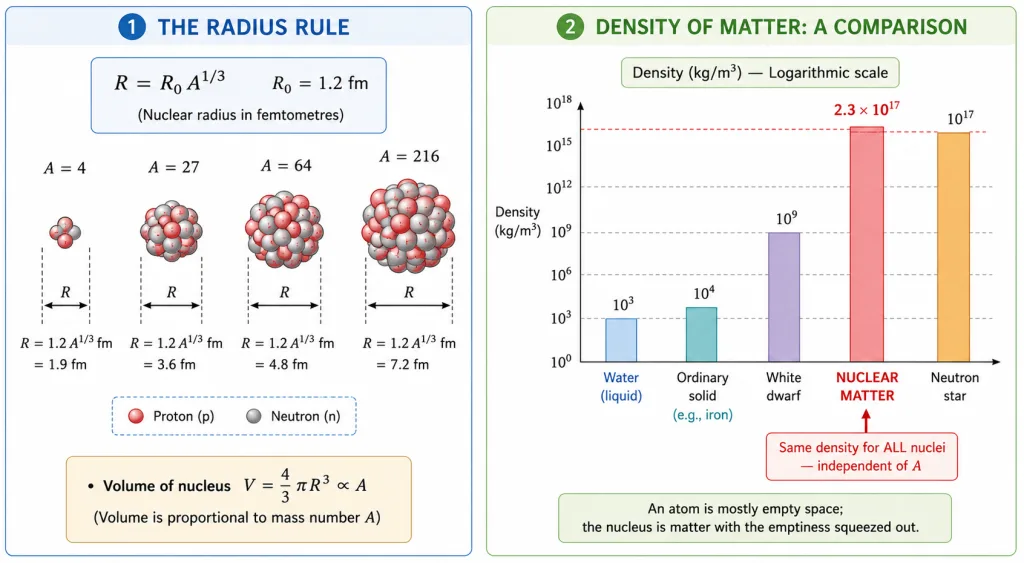
The Astonishing Consequence: Constant Density
The cube-root law hides a deep fact. Nuclear volume:
Volume is proportional to the number of nucleons. So the density,
is independent of A — the A cancels! Every nucleus, from helium to uranium, is a droplet of the same universal liquid:
Compare water's kg/m³ — nuclear matter is ~ times denser. No contradiction: ordinary matter is mostly the empty space of atoms; the nucleus is matter with the emptiness squeezed out.
NCERT Example 13.1: iron's density
With u kg and A = 56:
Neutron stars have comparable density — matter compressed until the star resembles one giant nucleus.
[JEE Tip] Ratio drills: — NCERT Exercise 13.4 (gold vs silver): . And density questions answer themselves: constant, same for all nuclei. If a 'nuclear density depends on A' option appears, it's wrong.
[NEET Important] Points to Ponder nuance: electron scattering senses the charge distribution; alpha scattering senses nuclear matter — the two radii differ slightly. Asked as assertion-reason.
Solved Examples
Example 1: Nuclear density of iron (NCERT Example 13.1)
Given the iron nucleus mass 55.85 u and A = 56, find the nuclear density.
Solution:
- Mass: kg.
- Volume: .
- Density: kg/m³.
- Takeaway: the same number emerges for ANY nucleus — density is A-independent by construction.
Example 2: Gold vs silver radii (NCERT Exercise 13.4)
Find the ratio of the nuclear radii of Au and Ag.
Solution:
- Rule: .
- Compute: .
- Answer: gold's nucleus is only ~23% wider despite nearly double the nucleons — the cube root at work.
Example 3: Radius of a uranium nucleus [Board Numerical]
Estimate the radius of U.
Solution:
- Formula: fm.
- Cube root: .
- Answer: R ≈ 7.4 fm = m.
- Takeaway: even the heaviest natural nucleus is under 8 fm — all of nuclear physics happens within ~10 fm.
Example 4: Constant density, shown generally (NCERT Exercise 13.10)
From , show that nuclear matter density is independent of A.
Solution:
- Mass: ≈ where m ≈ 1 u (a nucleon's mass).
- Volume: .
- Density: — A cancels.
- Numerically: kg/m³. ∎
Example 5: Which nucleus has double the radius? [JEE Numerical]
A nucleus has mass number A = 27 and radius R. Which mass number gives radius 2R?
Solution:
- Rule: , so doubling R needs A to grow by .
- Compute: .
- Takeaway: radii double only when nucleon numbers octuple — cube the radius factor.
Example 6: Volume ratio [NEET Numerical]
Find the ratio of the volumes of Zn and Be nuclei… using only mass numbers.
Solution:
- Volume ∝ A: .
- Radius check: ; volume ratio . ✔
- Takeaway: for volumes skip the cube root entirely — V ∝ A directly.
Example 7: Mass of a teaspoon of nuclear matter [Conceptual Numerical]
Estimate the mass of 5 mL (a teaspoon) of nuclear-density matter.
Solution:
- Volume: 5 mL = m³.
- Mass: .
- Answer: ≈ kg — a billion tonnes in a teaspoon.
- Takeaway: this is neutron-star matter; the number makes 'nuclear density is enormous' vivid and is a favourite talking-point question.
Example 8: When does Rutherford's formula fail? [Board Conceptual]
Why do very high-energy alpha particles deviate from Rutherford's scattering predictions, and what is learned from the deviation?
Solution:
- Rutherford's analysis assumes pure Coulomb repulsion between alpha and nucleus.
- Higher energy → smaller closest approach; once within a few fm, the short-range nuclear force acts, altering the scattering.
- The distance at which deviations set in marks where the nuclear force begins — i.e. the nuclear size.
- Takeaway: agreement with Coulomb-only = 'still outside the nucleus'; deviation = 'touched it'. The failure of the formula is itself the measurement.
Example 9: Radius from femtometre data [NEET Numerical]
The radius of Al is 3.6 fm. Predict the radius of Te.
Solution:
- Ratio: .
- Compute: fm.
- Takeaway: exam setters choose perfect cubes (27, 125) — spot them and the cube root is mental arithmetic.
Example 10: Two probes, two radii [JEE Conceptual]
Why do electron scattering and alpha scattering give slightly different nuclear radii?
Solution:
- Electrons interact electromagnetically only → they map the charge (proton) distribution.
- Alphas feel the nuclear force too → they sense the nuclear matter distribution (protons + neutrons).
- The two distributions differ slightly, so the extracted radii differ — NCERT Points to Ponder 2.
- Takeaway: 'what force the probe feels decides what the probe measures' — a neat assertion-reason discriminator.