
A Force of a Totally Different Kind
Atoms are held together by the familiar Coulomb force, with binding energies of a few eV. But the nucleus binds at ~8 MeV per nucleon — a million times stronger. And it must do something Coulomb cannot: hold positively charged protons together at femtometre range, where their mutual repulsion is ferocious, while also gripping neutral neutrons.
The conclusion: a strong attractive force of a totally different kind operates in the nucleus. Its properties were mapped by experiments between roughly 1930 and 1950:
Property 1: It is the strongest force
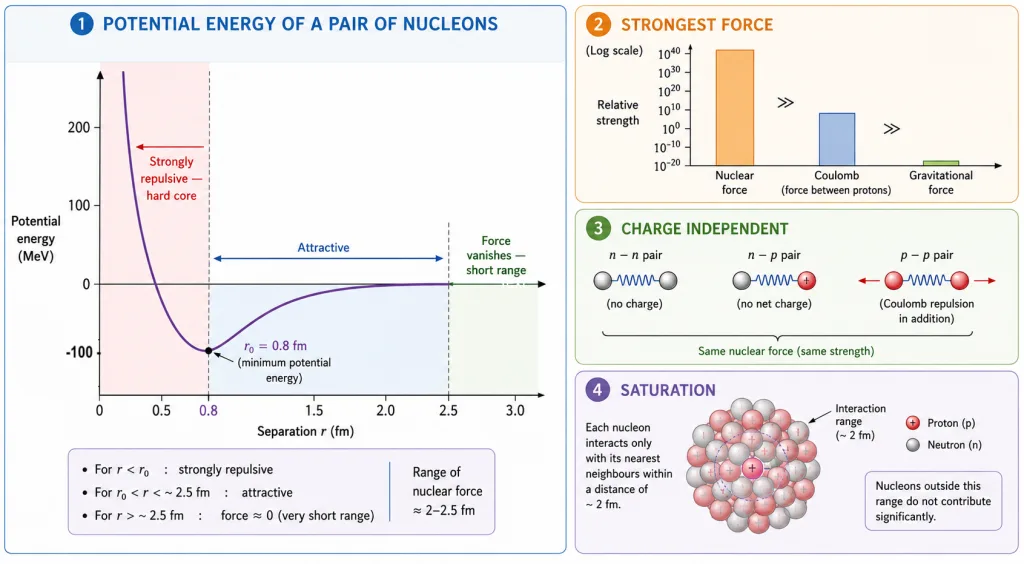
The nuclear force dominates the Coulomb repulsion between protons inside the nucleus — possible only because it is much stronger than the Coulomb force. (Gravity, for comparison, is weaker than even Coulomb by ~ — utterly negligible here.) Strength ordering: nuclear ≫ Coulomb ≫ gravitational.
Property 2: It is short-ranged, hence saturating
The force between two nucleons falls rapidly to zero beyond a few femtometres. Consequence: in a medium or large nucleus, each nucleon bonds only with nearby neighbours — the force saturates, which is exactly why the binding energy per nucleon is constant across the plateau (Section 3's argument).
The Potential-Energy Curve and Charge Independence
The pair potential (NCERT Fig. 13.2)
A rough plot of the potential energy of two nucleons versus their separation shows:
- A minimum at fm.
- For r > : potential rises with distance → the force is attractive (pulls them back together).
- For r < : potential climbs steeply → the force is strongly repulsive (a hard core — nucleons resist being squeezed closer than ~0.8 fm).
This repulsive core is why nuclear matter has a fixed density: nucleons pack like marbles, not like collapsing dust.
Property 3: Charge independence
The nuclear force between neutron-neutron, proton-neutron and proton-proton is approximately the same — it does not depend on electric charge. The force sees nucleons, not charges.
Property 4 (the honest one): No simple formula
Unlike Coulomb's law or Newton's gravitation, there is no simple mathematical form of the nuclear force. Its properties are catalogued from experiment, not derived from an inverse-square-style law.
Key Point: Four claims to recite — strongest of all forces; short-range (few fm) with saturation; minimum of the pair potential at ~0.8 fm with attraction outside and strong repulsion inside; charge-independent. Plus the disclaimer: no simple closed formula exists.
[NEET Important] 'The nuclear force between p-p is weaker than n-n because of charge' — a tempting FALSE statement. The nuclear force is the same; the p-p pair additionally feels Coulomb repulsion, but that is a separate force, not a modification of the nuclear one.
Solved Examples
Example 1: Ranking the forces [Board Rapid]
Rank the gravitational, Coulomb and nuclear forces between two protons inside a nucleus.
Solution:
- Nuclear — strongest (must overpower proton-proton Coulomb repulsion at fm range).
- Coulomb — next (substantial at fm separations, but beaten).
- Gravitational — weakest by ~36 orders of magnitude; irrelevant in nuclei.
- Takeaway: nuclear ≫ Coulomb ≫ gravitational — the ordering NCERT states outright.
Example 2: Reading the pair potential [Board Graph]
From the potential-energy curve of a nucleon pair, state the force's character at r = 2 fm, r = 0.8 fm and r = 0.5 fm.
Solution:
- r = 2 fm (> ): potential slopes upward with r → force attractive.
- r = 0.8 fm (= ): the minimum — zero net force, equilibrium separation.
- r = 0.5 fm (< ): steeply rising potential inward → strongly repulsive.
- Takeaway: attraction outside, hard-core repulsion inside, equilibrium at ~0.8 fm — the whole curve in one sentence.
Example 3: Why doesn't the nucleus collapse? [NEET Conceptual]
The nuclear force is hugely attractive. Why don't nucleons collapse into a point?
Solution:
- Below fm the force turns strongly repulsive — the hard core.
- Nucleons therefore settle at ~fm spacings, like packed marbles.
- This fixed packing is exactly why nuclear density is constant (Section 2) — every nucleus is an incompressible droplet.
- Takeaway: attraction binds; the repulsive core sizes. Both halves of the curve are essential.
Example 4: Charge independence in action [Board Conceptual]
Compare the nuclear force in the pairs n-n, n-p and p-p, and the TOTAL force in each case.
Solution:
- Nuclear force: approximately equal for all three pairs — charge-independent.
- Total force: the p-p pair additionally suffers Coulomb repulsion; n-p and n-n do not.
- So p-p is the least bound pairing overall — but by Coulomb's doing, not the nuclear force's.
- Takeaway: separate the two forces in your head; exams probe exactly this distinction.
Example 5: Why more neutrons in heavy nuclei? [JEE/NEET Link]
Light stable nuclei have N/Z ≈ 1, heavy ones N/Z ≈ 3/2. Explain using force properties.
Solution:
- Nuclear attraction is short-range: each nucleon binds only neighbours.
- Coulomb repulsion is long-range: every proton pair in the nucleus repels, however far apart.
- As Z grows, total repulsion grows fast (~ pairs) while attraction grows only ~A; extra neutrons add glue without adding repulsion.
- Takeaway: hence N/Z drifts from 1 : 1 (light) to about 3 : 2 (heavy) — NCERT Points to Ponder 8, and the seed of beta-decay stability logic.
Example 6: Range from the binding plateau [Conceptual]
What feature of the binding-energy curve proves the nuclear force is short-ranged?
Solution:
- If the force were long-range (every nucleon binding every other), total binding would grow like the number of pairs ~, so — rising steadily.
- Observed: is flat across 30 < A < 170.
- Flatness ⇒ each nucleon binds only a fixed number of neighbours ⇒ the force reaches only a few fm: short range and saturation.
- Takeaway: the plateau is the fingerprint of short range — curve and force explain each other.
Example 7: Coulomb vs nuclear at 2 fm [JEE Numerical]
Estimate the Coulomb repulsion between two protons 2 fm apart, and compare with the ~MeV scale of nuclear binding.
Solution:
- Coulomb energy: J.
- Compute: J ≈ 0.72 MeV.
- Compare: nucleon binding ~8 MeV — the nuclear attraction outweighs this repulsion roughly tenfold at these separations.
- Takeaway: the MeV scale of Coulomb energy at fm range shows why only a super-strong force can build nuclei — and why the p-p Coulomb tax matters for heavy-nucleus stability.
Example 8: No inverse-square law [Board Conceptual]
A student writes for the nuclear force. What's wrong?
Solution:
- NCERT is explicit: there is no simple mathematical form of the nuclear force, unlike Coulomb's or Newton's laws.
- An inverse-square force is long-range — it would forbid saturation and make grow with A, contradicting the plateau.
- The real force: attractive beyond ~0.8 fm, repulsive within, dying off entirely beyond a few fm — no single power law captures that.
- Takeaway: the absence of a formula is itself a listed property; don't invent one.
Example 9: Which properties explain which observations? [Matching]
Match: (a) constant nuclear density, (b) flat plateau, (c) mirror-nuclei similarity (e.g. H vs He binding) — with force properties.
Solution:
- (a) ← repulsive core at r < 0.8 fm: nucleons keep fixed spacing → incompressible droplet.
- (b) ← short range/saturation: neighbour-only bonding caps each nucleon's binding.
- (c) ← charge independence: swapping protons ↔ neutrons barely changes nuclear binding (differences trace to Coulomb effects).
- Takeaway: each experimental fact is one force property wearing data's clothing.
Example 10: The equilibrium separation [NEET Numerical]
Two nucleons sit at their potential minimum. State the separation, and what happens if they are nudged (i) closer, (ii) apart.
Solution:
- Separation: fm — the minimum of the pair potential.
- (i) Nudged closer (r < ): strong repulsion pushes them back out.
- (ii) Nudged apart (r > ): attraction pulls them back in.
- Takeaway: the minimum is a stable equilibrium — nucleon pairs oscillate about ~0.8 fm like masses on a spring, the microscopic basis of the liquid-drop picture.