
What Biodiversity Means
The term biodiversity was popularised by the socio-biologist Edward Wilson. It describes the combined diversity at all levels of biological organisation - the totality of genes, of species and of ecosystems in a given region. The word is a single label for three quite different things, and NEET tests which of the three a given example belongs to far more often than it tests the definition itself.
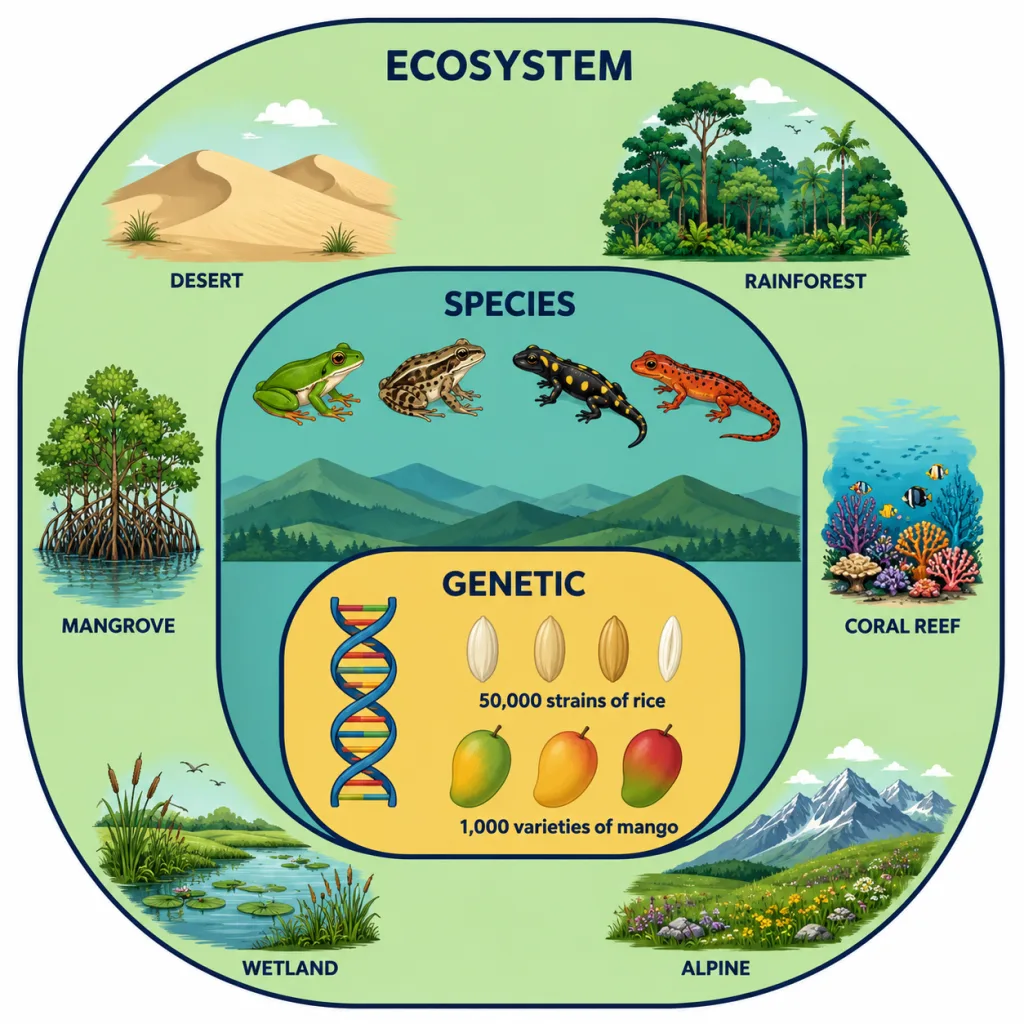
Genetic diversity. A single species may show high diversity at the genetic level over its distributional range. Rauwolfia vomitoria, the medicinal plant growing in different Himalayan ranges, shows genetic variation in the potency and concentration of the chemical reserpine that it produces. India has more than 50,000 genetically different strains of rice and 1,000 varieties of mango. The unit of variation here sits inside one species.
Species diversity. This is diversity at the level of species themselves. The Western Ghats have a greater amphibian species diversity than the Eastern Ghats - the standard NCERT comparison. The unit of variation is the number and kinds of species in a place.
Ecological diversity. At the ecosystem level, India, with its deserts, rain forests, mangroves, coral reefs, wetlands, estuaries and alpine meadows, has a greater ecosystem diversity than a Scandinavian country such as Norway. The unit of variation is whole habitats.
How Many Species Are There on Earth
More than 1.5 million species have been described and recorded so far - the IUCN figure. But this is only the catalogue, not the total. Using statistical comparisons between the temperate and tropical species inventories, the ecologist Robert May placed the global species diversity at about 7 million. The gap between 1.5 million described and 7 million estimated is the single most examined number pair in this chapter.
The composition of the described species is just as heavily tested:
| Group | Share of all recorded species |
|---|---|
| Animals (all) | more than 70 per cent |
| Plants (algae, fungi, bryophytes, gymnosperms, angiosperms together) | 22 per cent |
| Insects, as a share of all animals | more than 70 per cent |
Read that last row carefully - the 70 per cent for insects is a share of animals, not of all species. Out of every 10 animals on this planet, 7 are insects. The number of fungi species in the world is more than the combined total of the species of fishes, amphibians, reptiles and mammals.
Prokaryotes are the honest gap. Biologists are not certain about how many species of prokaryotes there really are, because the conventional taxonomic methods are not suitable for identifying microbial species, and many species are simply not culturable under laboratory conditions.
India's Share
India has only 2.4 per cent of the world's land area, yet its share of the global species diversity is an impressive 8.1 per cent. That is what makes India one of the 12 mega-diversity countries of the world. Nearly 45,000 species of plants and 90,000 species of animals have been recorded from India.
If May's global estimate is applied to India's own inventory, there may be more than 100,000 plant species and more than 300,000 animal species in India still waiting to be discovered and described. Conserving biodiversity, in other words, means conserving a great deal that has never been named.