
Patterns of Biodiversity - Latitudinal Gradients
Species diversity is not distributed evenly on Earth, and it is not distributed randomly either. It follows patterns tight enough to be written as rules, and both of the rules in this chapter are heavily examined.
The first is the latitudinal gradient. In general, species diversity decreases as we move away from the equator towards the poles. With very few exceptions, tropics - the latitudinal range between 23.5 degrees North and 23.5 degrees South - harbour more species than temperate or polar areas.
The comparisons NCERT uses are worth memorising as a set, because NEET asks them as ordering questions:
- Colombia, near the equator, has nearly 1,400 species of birds.
- New York, at 41 degrees N, has 105 species.
- Greenland, at 71 degrees N, has only 56 species.
- India, which lies largely in the tropics, has more than 1,200 species of birds.
- A tropical forest region such as Ecuador has up to 10 times as many species of vascular plants as a forest of equal area in the Midwest of the USA.
The Amazonian rain forest in South America has the greatest biodiversity on Earth. It is home to more than 40,000 species of plants, 3,000 of fishes, 1,300 of birds, 427 of mammals, 427 of amphibians, 378 of reptiles and more than 1,25,000 invertebrates. Scientists estimate that in this forest there may be two million insect species still waiting to be discovered and named.
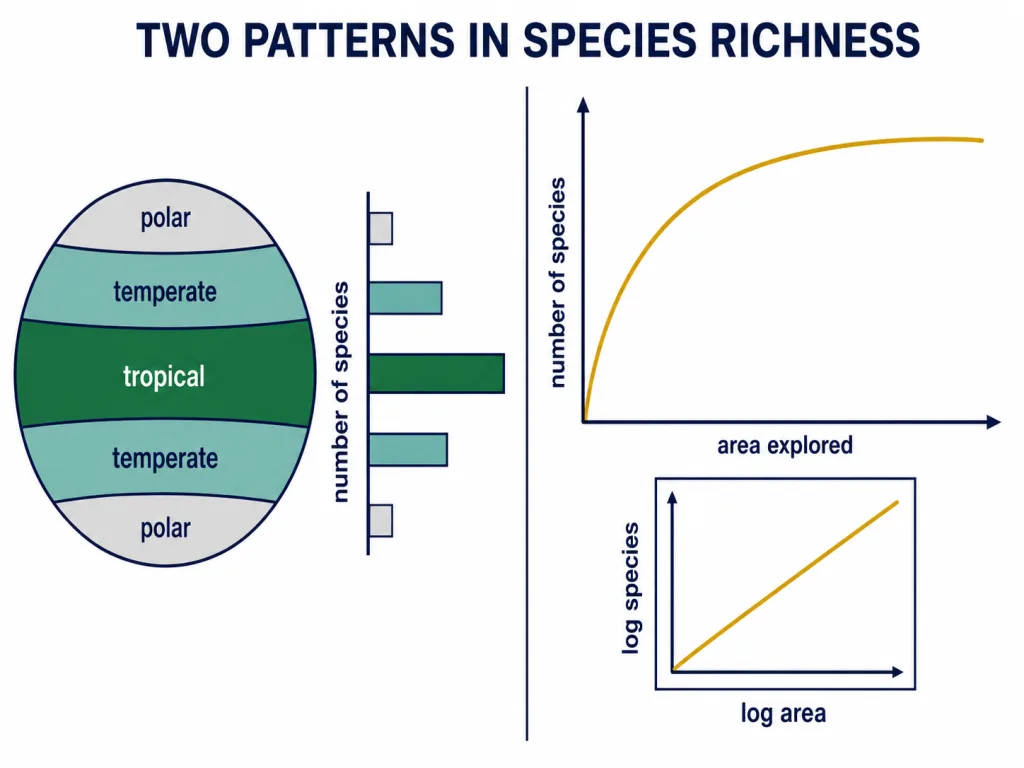
Why are tropics so much richer? Ecologists propose three reasons, and a NEET question will usually ask you to pick the ones that are correct:
- Time. Temperate regions were subjected to frequent glaciations in the past, while tropical latitudes have remained relatively undisturbed for millions of years. That gave tropical species a long evolutionary time for diversification.
- Constancy. Tropical environments, unlike temperate ones, are less seasonal, relatively more constant and predictable. Such constant environments promote niche specialisation and lead to greater species diversity.
- Energy. There is more solar energy available in the tropics, which contributes to higher productivity, and this in turn contributes indirectly to greater diversity.
Note what is not on that list: the claim that tropical environments are more seasonal is the standard distractor, and it is the exact opposite of reason 2.
The Species-Area Relationship
The German naturalist and geographer Alexander von Humboldt observed, during his pioneering explorations of the South American jungles, that within a region species richness increased with increasing explored area, but only up to a limit.
The relation between species richness and area for a wide variety of taxa - angiosperm plants, birds, bats, freshwater fishes - turns out to be a rectangular hyperbola. On a logarithmic scale the same relationship becomes a straight line:
log S = log C + Z log A
where S is species richness, A is area, Z is the slope of the line, also called the regression coefficient, and C is the Y-intercept.
Ecologists have discovered something remarkable about that slope. The value of Z lies in the range of 0.1 to 0.2, regardless of the taxonomic group or the region - whether it is the plants of Britain, the birds of California or the molluscs of New York state, the slope of the regression line is almost the same. But if the analysis is done among very large areas like entire continents, the slope is much steeper, with Z values in the range of 0.6 to 1.2. For frugivorous birds and mammals in the tropical forests of different continents, the slope is found to be 1.15.