
The Evil Quartet - Four Causes of Biodiversity Loss
Accelerated rates of species extinction that the world is facing now are largely due to human activities. There are four major causes, and they are collectively called 'The Evil Quartet'. Learn them as a closed set of four - almost every NEET question on this topic is really a test of whether you can tell a member of the quartet from a plausible non-member such as pollution, mutation, migration, drought or competition.
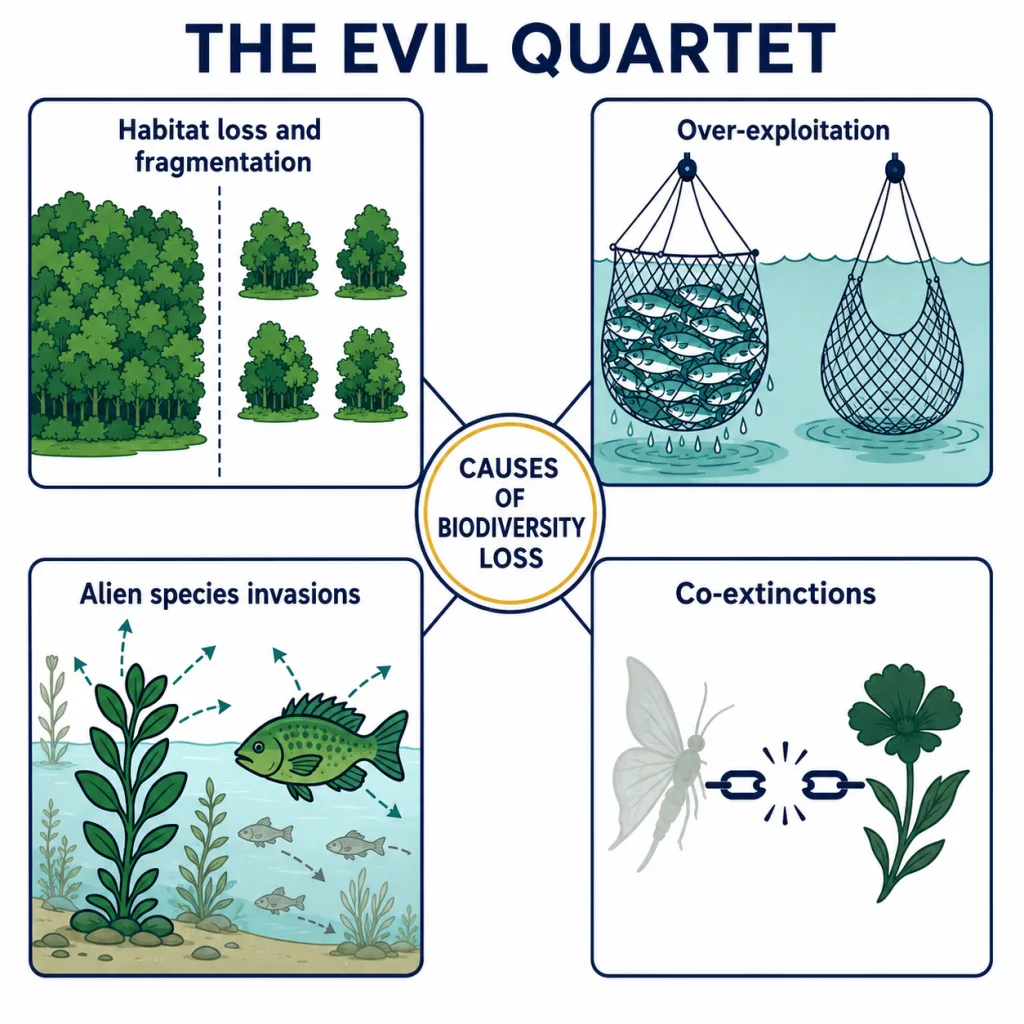
1. Habitat loss and fragmentation
This is the most important cause driving animals and plants to extinction. The clearest case is the tropical rain forests, once covering more than 14 per cent of the Earth's land surface and now less than 6 per cent. They are being destroyed fast, and by the time you finish reading this chapter several hundred hectares will have been lost.
The Amazon rain forest - so huge that it is called the 'lungs of the planet' - is being cut and cleared for cultivating soya beans and for conversion to grasslands for raising beef cattle.
Besides outright loss, fragmentation does its own damage: when large habitats are broken up into small pieces, mammals and birds requiring large territories and certain animals with migratory habits are badly affected, leading to population declines. Pollution also contributes, by degrading habitat quality - which is why pollution belongs inside this first cause rather than as a fifth member of the quartet.
2. Over-exploitation
Humans have always depended on nature for food and shelter, but when need turns to greed, it leads to over-exploitation of natural resources. Many species extinctions in the last 500 years - the Steller's sea cow and the passenger pigeon are the two named examples - were due to over-exploitation by humans. At present, many marine fish populations around the world are over-harvested, endangering the continued existence of some commercially important species.
3. Alien species invasions
When alien species are introduced unintentionally or deliberately for whatever purpose, some of them turn invasive and cause decline or extinction of indigenous species.
- The Nile perch introduced into Lake Victoria in East Africa led eventually to the extinction of an ecologically unique assemblage of more than 200 species of cichlid fish in the lake.
- The invasive weed species carrot grass (Parthenium), Lantana and water hyacinth (Eichhornia) posed a threat to the native species in India.
- The recent illegal introduction of the African catfish Clarias gariepinus for aquaculture purposes is posing a threat to the indigenous catfishes in our rivers.
4. Co-extinctions
When a species becomes extinct, the plant and animal species associated with it in an obligatory way also become extinct. When a host fish species becomes extinct, its unique assemblage of parasites also meets the same fate. Another example is the case of a plant-pollinator mutualism where extinction of one invariably leads to the extinction of the other.
A useful check. If a proposed cause is pollution, mutation, migration, drought and floods, competition or population explosion, it is not a member of the Evil Quartet - even though pollution genuinely does harm habitats under cause 1.