
Why Should We Conserve Biodiversity?
The arguments fall into three categories, and the labels themselves are examined.
Narrowly utilitarian. Humans derive countless direct economic benefits from nature - food (cereals, pulses, fruits), firewood, fibre, construction material, industrial products (tannins, lubricants, dyes, resins, perfumes) and products of medicinal importance. More than 25 per cent of the drugs currently sold in the market worldwide are derived from plants, and 25,000 species of plants contribute to the traditional medicines used by native peoples around the world. Bioprospecting - exploring molecular, genetic and species-level diversity for products of economic importance - means nations rich in biodiversity can expect to reap enormous benefits.
Broadly utilitarian. Biodiversity plays a major role in many ecosystem services that nature provides. The Amazon forest is estimated to produce, through photosynthesis, 20 per cent of the total oxygen in the Earth's atmosphere. Pollination, without which plants cannot give us fruits or seeds, is carried out by bees, bumblebees, birds and bats. And there are the intangible aesthetic pleasures - walking through thick woods, watching spring flowers in full bloom, waking up to a bulbul's song.
Ethical. Every species has an intrinsic value, even if it is of no economic value to us. We have a moral duty to care for their well-being and to pass on our biological legacy in good order to future generations.
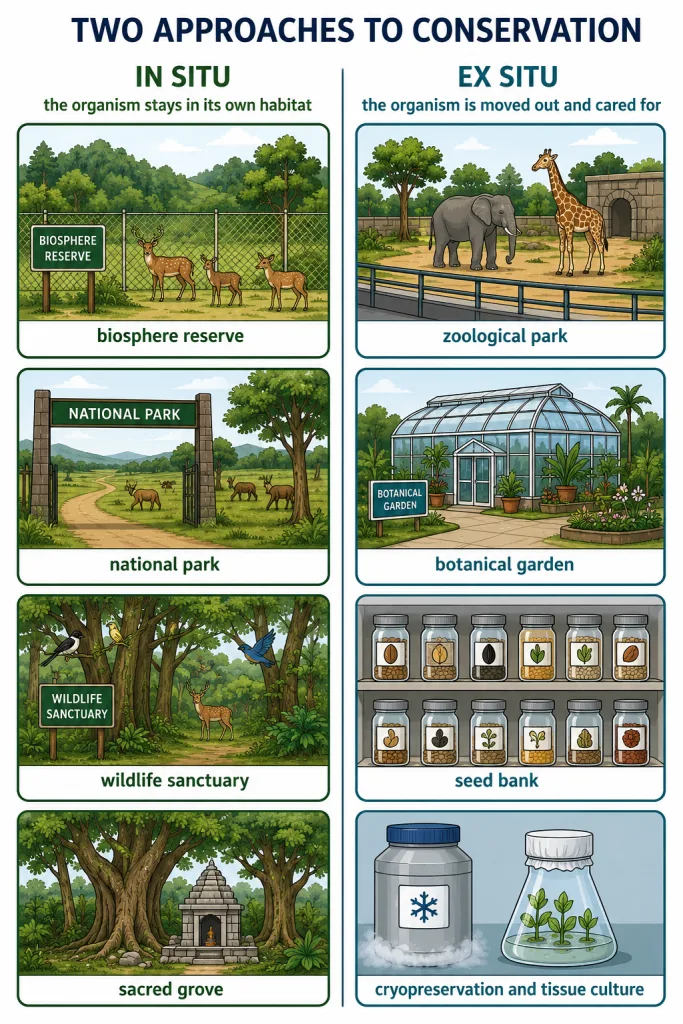
In Situ Conservation - Saving the Whole Home
In situ (on site) conservation means conserving the whole ecosystem so that all levels of biodiversity within it are protected together. Since all species cannot be saved with equal effort, ecologists prioritise.
Biodiversity hotspots, an idea from Norman Myers, are regions with very high levels of species richness and a high degree of endemism - species confined to that region and not found anywhere else. Initially 25 biodiversity hotspots were identified; subsequently the number was raised to 34. Together they cover less than 2 per cent of the Earth's land area, yet the number of species they collectively harbour is extremely high, and strict protection of these could reduce the ongoing mass extinctions by almost 30 per cent.
Three of the 34 hotspots are found in India: the Western Ghats and Sri Lanka, the Indo-Burma region, and the Himalaya.
India legally protects its ecologically unique and biodiversity-rich regions as 14 biosphere reserves, 90 national parks and 448 wildlife sanctuaries, and has also identified 26 Ramsar sites for wetland protection.
Sacred groves are the cultural form of in situ conservation - tracts of forest set aside where all the trees and wildlife within are venerated and given total protection. They are found in the Khasi and Jaintia Hills of Meghalaya, the Aravalli Hills of Rajasthan, the Western Ghat regions of Karnataka and Maharashtra, and the Sarguja, Chanda and Bastar areas of Madhya Pradesh.
Ex Situ Conservation - Saving the Occupants
Ex situ (off site) conservation means threatened animals and plants are taken out of their natural habitat and placed in a special setting where they can be protected and given special care. Zoological parks, botanical gardens and wildlife safari parks serve this purpose.
Modern techniques have gone well beyond keeping animals in enclosures:
- Cryopreservation - gametes of threatened species preserved in viable and fertile condition for long periods at very low temperature.
- In vitro fertilisation - eggs fertilised outside the body.
- Tissue culture - plants propagated using tissue culture methods.
- Seed banks - seeds of different genetic strains of commercially important plants stored for long periods.
Reading the Species-Area Line Quantitatively
This section is also where the species-area relation is used as an equation rather than a description. On a log scale the relation is a straight line, log S = log C + Z log A, so a tenfold increase in area multiplies species richness by 10 raised to the power Z. With a typical small-area slope of Z = 0.2, a hundredfold increase in area (log A rises by 2) raises log S by 0.4, so species richness rises by about 2.5 times - a useful check that a "10 times the area gives 10 times the species" answer is always wrong for small areas.
The Two Summits
- The Earth Summit, held at Rio de Janeiro in 1992 - the historic Convention on Biological Diversity - called upon all nations to take appropriate measures for conservation of biodiversity and sustainable utilisation of its benefits.
- The World Summit on Sustainable Development, held in Johannesburg, South Africa, in 2002 - 190 countries pledged their commitment to achieve, by 2010, a significant reduction in the current rate of biodiversity loss at global, regional and local levels.