
Why Species Diversity Matters to an Ecosystem
Does the number of species in a community actually change how that community behaves? For a long time this was an open question. Two lines of work settled it, and both are named in NEET questions.
David Tilman's field experiments. Tilman ran long-term ecosystem experiments using outdoor plots. His findings were direct and quantitative. Plots with more species showed less year-to-year variation in total biomass. He also showed that increased diversity contributed to higher productivity. Note that these are two separate results - stability of biomass, and amount of biomass - and a question may test either one alone.
A stable community, in the ecologist's sense, should meet three conditions: it should not show too much variation in productivity from year to year; it must be either resistant or resilient to occasional disturbances, natural or man-made; and it must also be resistant to invasions by alien species.
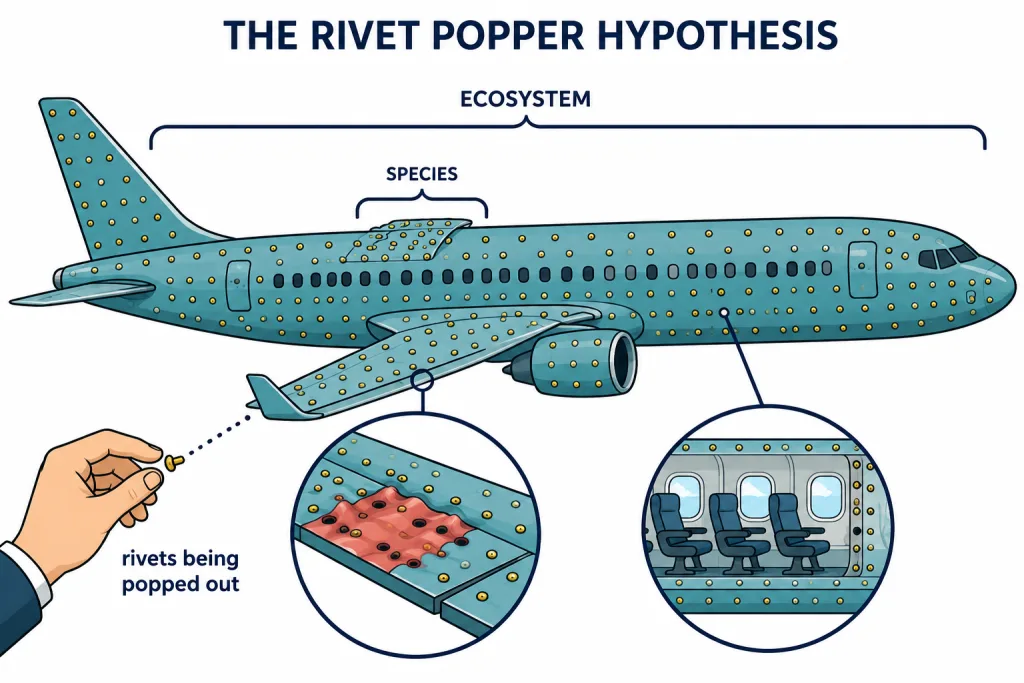
The rivet popper hypothesis. The Stanford ecologist Paul Ehrlich put the argument as an analogy. Think of an aeroplane as an ecosystem and every rivet holding it together as a species. If passengers begin popping a rivet to take home, it may not affect flight safety at first - but as more and more rivets go, the plane becomes dangerously weak. Further, the loss of rivets on the wings is a more serious threat to safety than the loss of a few rivets on the seats inside the plane. Rivets on the wings stand for key species that drive major ecosystem functions; the seat rivets stand for species whose removal the system absorbs.
The Loss of Biodiversity
The biological wealth of the planet has been declining rapidly, and the accusing finger points at human activities.
The IUCN Red List (2004) documents, for the last 500 years, the extinction of 784 species. That figure breaks down as 338 vertebrates, 359 invertebrates and 87 plants.
Earlier than these records, the colonisation of the tropical Pacific Islands is believed to have wiped out more than 2,000 native bird species. At present 15,500 species face the threat of extinction - 12% of birds, 23% of mammals, 32% of amphibians and 31% of gymnosperms.
The recent extinctions NCERT names should be learnt with their places, because match-the-list questions use exactly these pairs:
| Species | Where it was lost |
|---|---|
| Dodo | Mauritius |
| Quagga | Africa |
| Thylacine | Australia |
| Steller's sea cow | Russia |
| Three subspecies of tiger (Bali, Javan, Caspian) | - |
In the last twenty years alone, 27 species have disappeared. The current losses are being called the sixth extinction, and what makes it different from the five earlier episodes is the rate: the present rates are estimated to be 100 to 1,000 times faster than in pre-human times, and human activities are responsible. If the present trends continue, nearly half of all the species on Earth might be wiped out within the next 100 years.
Why should we be worried? Ecologists warn that the loss of biodiversity in a region may lead to three things:
- decline in plant production,
- lowered resistance to environmental perturbations such as drought, and
- increased variability in certain ecosystem processes - plant productivity, water use, and pest and disease cycles.
Those three consequences are simply Tilman's laboratory results read backwards, at the scale of the planet.