
What A : B :: C : ? Means for Figures
A figure analogy shows three figures and a box with a question mark, written like this: first figure : second figure :: third figure : ?. Read it as "the first is to the second as the third is to the question mark". One change turns the first figure into the second. Do the same change to the third figure, and you have the answer.
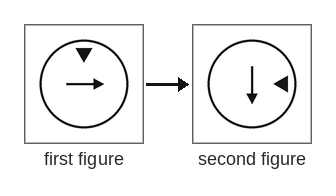
Say the change in one sentence
Before you even look at the third figure, say in one sentence what happened between the first and the second. For the picture above: "the whole figure turned 90° clockwise". Other sentences you will use often are "left and right swapped, as in a mirror", "black and white swapped", and "the dot was taken away".
If you cannot say it in one short sentence, you have not found the change yet. Look again, one part at a time: where did each part go, which way does it point now, what shade is it, and is anything new or missing?
The changes you will meet
| Change | What you see from the first figure to the second |
|---|---|
| Turn | every part moves round the centre by the same angle, and every arrow turns by that angle |
| Mirror image | left and right swap, or top and bottom swap |
| Fill swap | black parts become white and white parts become black, and nothing moves |
| Inner and outer swap | the big outside shape and the small inside shape change places |
| Part added or taken away | one part appears or disappears, and the rest stays |
| Sides up or down by one | a triangle becomes a square, for example |
| Parts change places | two parts swap positions, each keeping its own direction |
One change for the whole figure
The change works on the whole figure, not on one part. When the first figure turns 90°, every part of the third figure must turn 90° too. So the answer is never the third figure left as it is, and an option where only one part changed is a trap.
Aim to finish a figure analogy in 30–40 seconds.
Turns, and Telling a Turn from a Mirror Image
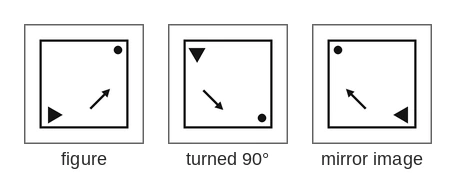
Finding the angle of a turn
Pick the part that shows direction best: an arrow, the point of a small triangle, or a shaded slice. Compare its direction in the first and second figures and count the turn in steps of 45°. Up to right is 90° clockwise, up to down-right is 135° clockwise, and up to down is 180°.
Then check a second part. In a turn, every part goes round the centre by the same angle, so a dot at the top-left corner goes to the top-right corner in a 90° clockwise turn. If the second part does not agree, the change is not a turn.
Clockwise or anticlockwise?
A turn of 90° clockwise and a turn of 90° anticlockwise both move the top part to a side. Follow one part: if the dot at the top goes to the right, the turn is clockwise. If it goes to the left, it is anticlockwise. Wrong options often turn the third figure the wrong way, so make this check every time.
Turn or mirror image?
A turn and a mirror image can look alike, especially for a turn of 180°. Two tests tell them apart:
- Slanting arrows. After a half turn, an arrow pointing up-right points down-left. In a left–right mirror it points up-left, and in a top–bottom mirror it points down-right.
- Order round the figure. Go round the first figure clockwise and name the parts in order, for example arrow, dot, triangle. A turn keeps that order. A mirror image reverses it.
In the picture, the turned figure still has the dot, the arrow and the triangle in the same clockwise order. In the mirror image the order is reversed, and the arrow slants the other way.
Solved Questions
Question 1
Select the option figure that is related to the third figure in the same way as the second figure is related to the first figure.
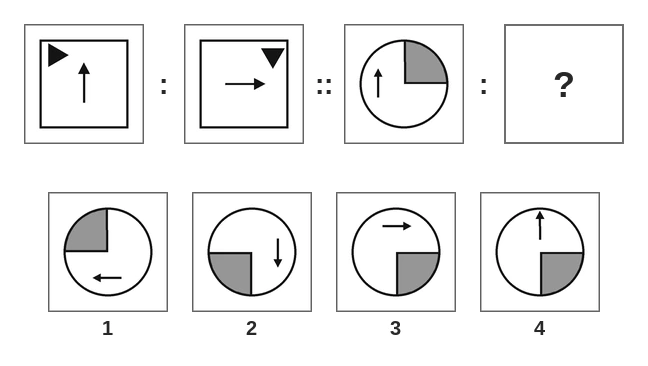
(a) Figure 1 (b) Figure 2 (c) Figure 3 (d) Figure 4
Answer. Say the change first. In the first figure the arrow points up, and the small triangle sits at the top-left corner pointing right. In the second the arrow points right, and the triangle sits at the top-right corner pointing down. The triangle has moved a quarter of the way round clockwise, and both the arrow and the triangle have turned 90° clockwise. So the whole figure has turned 90° clockwise. Now turn the third figure the same way, one part at a time. The grey quarter at the top-right goes to the bottom-right. The short arrow at the left goes to the top, and it turns from pointing up to pointing right. Figure 4 moves the short arrow to the top but forgets to turn it, and Figure 1 turns the figure anticlockwise. So the answer is (c) Figure 3.
Question 2
Select the option figure that is related to the third figure in the same way as the second figure is related to the first figure.
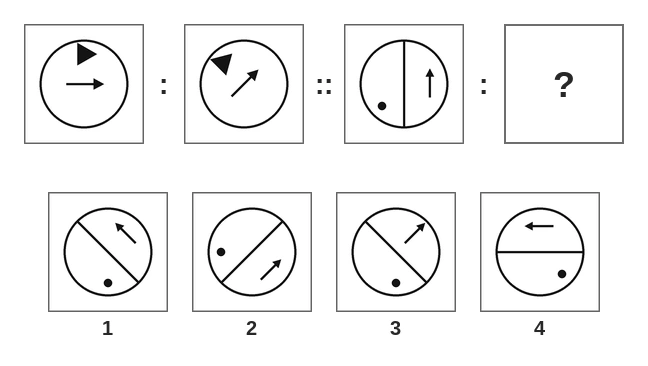
(a) Figure 1 (b) Figure 2 (c) Figure 3 (d) Figure 4
Answer. The arrow pointed right and now points up-right. The small black triangle was at the top pointing right, and now it is at the top-left, turned along with the rest. Each part has moved one eighth of a full turn anticlockwise, and each point has turned 45° anticlockwise too, so the change is a turn of 45° anticlockwise. Do the same to the third figure. The upright line tilts to run from the top-left to the bottom-right. The short arrow goes from the right to the top-right, and it turns from pointing up to pointing up-left. The black dot goes from the bottom-left to the bottom. Figure 3 puts the short arrow at the top-right but turns it the wrong way, so it points up-right. Figure 2 turns the whole figure clockwise. So the answer is (a) Figure 1.
Question 3
Select the option figure that is related to the third figure in the same way as the second figure is related to the first figure.
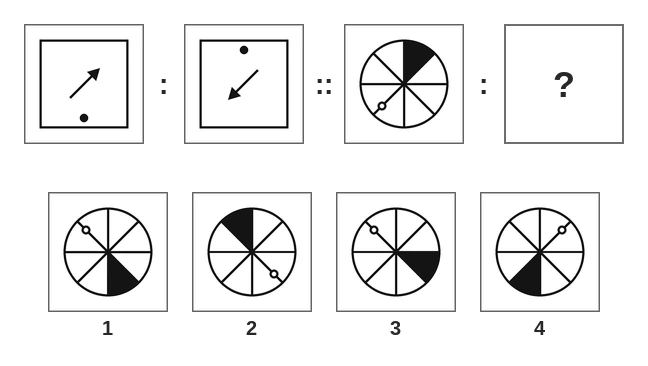
(a) Figure 1 (b) Figure 2 (c) Figure 3 (d) Figure 4
Answer. The arrow pointed up-right and now points down-left, the opposite way. The dot went from the bottom-middle to the top-middle. That is a half turn, 180°. Check that it is not a mirror image: in a left–right mirror the arrow would point up-left, and in a top–bottom mirror it would point down-right. Neither matches, so it is a turn. Turn the third figure through 180°. The black slice just right of the top goes to just left of the bottom, and the white dot goes from the bottom-left to the top-right. Figure 2 is the left–right mirror image of the third figure, and Figure 1 is its top–bottom mirror image. So the answer is (d) Figure 4.
Mirror Changes: Left–Right and Top–Bottom
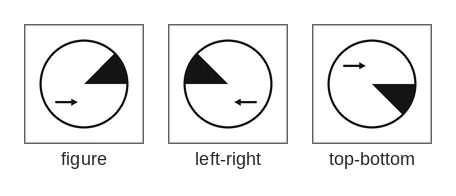
Left and right swap
In a left–right mirror image every part keeps its height but moves to the other side. A part at the top-left goes to the top-right, and a part at the left-middle goes to the right-middle. Parts on the middle line stay where they are. Directions change only from left to right:
| Arrow in the first figure | After a left–right swap | After a top–bottom swap |
|---|---|---|
| up | up | down |
| right | left | right |
| up-right | up-left | down-right |
| down-right | down-left | up-right |
Top and bottom swap
In a top–bottom mirror image every part keeps its left or right side but moves from top to bottom. A part at the top-left goes to the bottom-left. An arrow pointing up now points down, while an arrow pointing right still points right. This is also what a figure looks like in still water below it.
Checking a mirror change
Take two parts and check both. One part can fit several changes by chance, but two parts together rarely do. For a slice of a circle, look at which line it sits next to: a slice just above the right becomes just above the left in a left–right swap, and just below the right in a top–bottom swap.
A left–right swap followed by a top–bottom swap is the same as a half turn. That is why a figure turned through 180° makes such a good trap in mirror questions.
[SSC Tip] For a mirror analogy, find one part that is not on the middle line and has a slant. It shows at once whether left and right swapped or top and bottom.
Solved Questions: Mirror Changes
Question 4
Select the option figure that is related to the third figure in the same way as the second figure is related to the first figure.
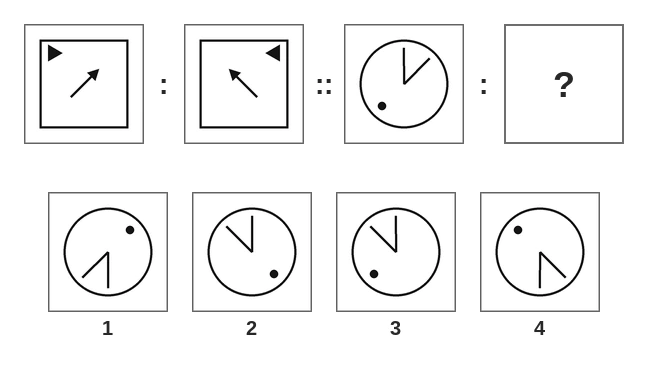
(a) Figure 1 (b) Figure 2 (c) Figure 3 (d) Figure 4
Answer. From the first figure to the second, the triangle moves from the top-left corner to the top-right corner and now points left, and the arrow that slanted up-right now slants up-left. The top stays at the top. Only left and right have swapped, so this is a mirror image in an upright mirror. Do the same to the third figure. The two lines from the centre point up and up-right, so they become up and up-left. The dot at the bottom-left moves to the bottom-right. Figure 3 flips the lines but leaves the dot where it was. Figures 4 and 1 send the lines to the bottom, which a left–right swap never does. So the answer is (b) Figure 2.
Question 5
Select the option figure that is related to the third figure in the same way as the second figure is related to the first figure.
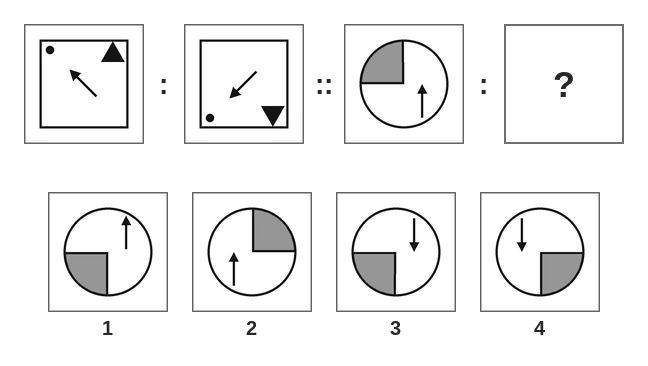
(a) Figure 1 (b) Figure 2 (c) Figure 3 (d) Figure 4
Answer. The black dot goes from the top-left corner to the bottom-left corner. The small triangle goes from the top-right corner to the bottom-right corner, and it pointed up but now points down. The long arrow slanted up-left and now slants down-left. Left stays left and right stays right, but top and bottom have swapped. That is a top–bottom mirror image. Apply it to the third figure. The grey quarter at the top-left goes to the bottom-left. The short arrow at the bottom-right goes to the top-right, and since it pointed up, it now points down, just like the small triangle in the first pair. Figure 1 moves the short arrow to the top but leaves it pointing up. Figure 2 swaps left and right instead. So the answer is (c) Figure 3.
Question 6
Select the option figure that is related to the third figure in the same way as the second figure is related to the first figure.
(a) Figure 1 (b) Figure 2 (c) Figure 3 (d) Figure 4
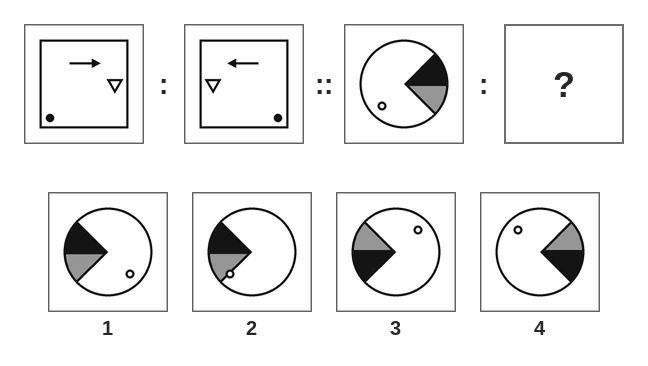
Answer. Look at the first two figures. The arrow at the top pointed right and now points left. The black dot went from the bottom-left corner to the bottom-right corner, and the white triangle from the right-middle to the left-middle, still pointing down. Every part swapped sides and nothing moved up or down, so this is a left–right mirror image. In the third figure the black slice is just above the right, so it moves to just above the left. The grey slice just below the right moves to just below the left. The white dot at the bottom-left goes to the bottom-right. Figure 2 flips the two slices but forgets the dot. Figure 3 is the third figure turned through 180°, so its black and grey slices are the wrong way round. So the answer is (a) Figure 1.
Fill Swaps and Inner–Outer Swaps
Black and white swap
In a fill swap nothing moves. Every black part becomes white and every white part becomes black. Parts drawn only as lines, like an arrow or a frame, have no shade, so they stay as they are.
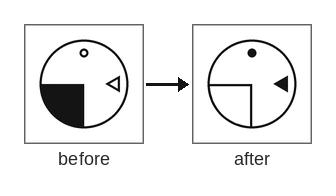
When you apply a fill swap to the third figure, go through its shaded parts one at a time. The usual wrong options change only some of them, or swap the shades and also move a part.
Inner and outer shapes swap
Some figures are one shape inside another: a circle with a square inside, for example. In an inner–outer swap the two shapes change places. The big outside shape becomes the kind of shape that was inside, and the small inside shape becomes the kind that was outside. The sizes stay where they were: big outside, small inside.
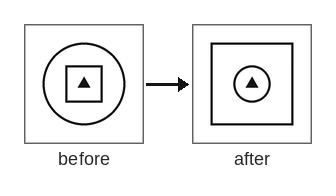
Anything else in the figure, such as a dot or a small triangle in the middle, stays as it is. When the inside shape has a point, check which way it points. A triangle pointing up inside a circle becomes a big triangle pointing up outside, not a triangle turned upside down.
Solved Questions: Fill Swaps and Inner–Outer Swaps
Question 7
Select the option figure that is related to the third figure in the same way as the second figure is related to the first figure.
(a) Figure 1 (b) Figure 2 (c) Figure 3 (d) Figure 4
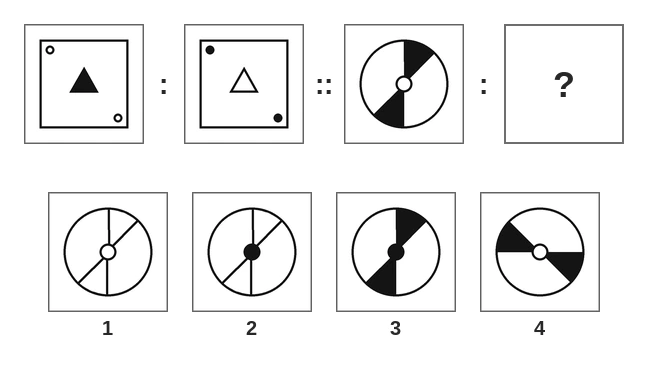
Answer. Nothing has moved between the first two figures. The triangle in the middle was black and is now white, and the two white dots are now black. So black and white have swapped. In the third figure there are two black slices and a white dot in the middle. After the swap the slices are white and the dot is black. Figure 1 changes only the slices, Figure 3 changes only the dot, and Figure 4 turns the figure without changing any shade. So the answer is (b) Figure 2.
Question 8
Select the option figure that is related to the third figure in the same way as the second figure is related to the first figure.
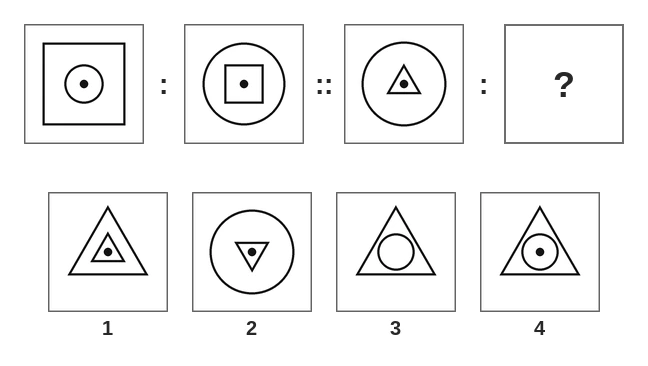
(a) Figure 1 (b) Figure 2 (c) Figure 3 (d) Figure 4
Answer. In the first figure a square sits outside and a circle inside. In the second a circle sits outside and a square inside, and the dot in the middle has not changed. The outer and inner shapes have changed places. The third figure has a circle outside and a triangle pointing up inside. After the swap a big triangle pointing up sits outside, with a small circle inside, and the dot stays in the middle. Figure 3 has lost the dot. Figure 1 changes the outside shape but keeps the small triangle inside, so the circle has gone altogether. Figure 2 is only the third figure turned through 180°. So the answer is (d) Figure 4.
Question 9
Select the option figure that is related to the third figure in the same way as the second figure is related to the first figure.
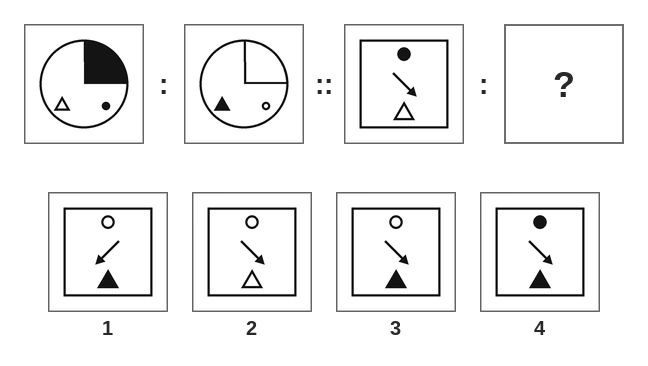
(a) Figure 1 (b) Figure 2 (c) Figure 3 (d) Figure 4
Answer. From the first figure to the second, the black quarter has turned white, the white triangle has turned black and the black dot has turned white. Nothing moved, so the shades have swapped. The arrow in the third figure is drawn only with lines and has no shade, so it stays as it is, pointing down-right. The black dot at the top becomes white and the white triangle at the bottom becomes black. Figure 4 changes the triangle but not the dot. Figure 2 changes the dot but not the triangle. Figure 1 swaps both but turns the arrow as well. So the answer is (c) Figure 3.
Parts Added, Taken Away or Changing Places
Added or taken away
Count the parts in the first and second figures. If the second has one more part, say exactly what was added and where: "a black dot at the centre" or "a flat line across the middle". If it has one part fewer, say which one went: "the white dot" or "the arrow". Then do exactly that to the third figure and leave every other part alone.
Be careful about what decides the part. If the first figure loses its white dot, the third figure loses its white dot too, wherever that dot sits. Options that remove a different part, or that change a part instead of removing it, are the usual traps.
Sides up or down by one
A shape can gain or lose one side: a triangle (three sides) becomes a square (four sides). The new shape usually keeps the same size, centre and shade. Count the sides of the new shape, and check how it stands: if the second figure has a square with upright sides, the answer has a square with upright sides too.
Parts that change places
Sometimes two parts simply swap positions. Each part keeps its own shape, shade and direction: it only moves to where the other one was.
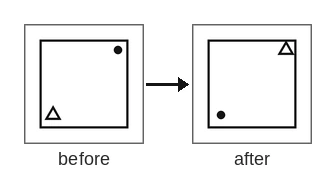
In the picture the dot goes to the bottom-left corner and the triangle goes to the top-right corner, still pointing up. Lines that divide the frame do not move.
A swap of places can look like a turn of 180° when the two parts sit at opposite corners. Look at a part with a direction. After a swap the triangle still points up. After a half turn it would point down.
Solved Questions: Parts Added or Taken Away
Question 10
Select the option figure that is related to the third figure in the same way as the second figure is related to the first figure.
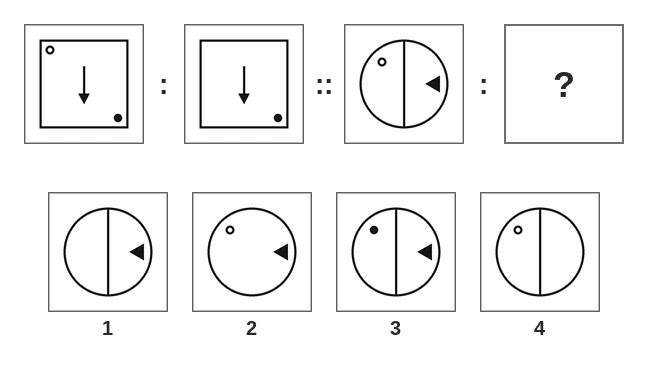
(a) Figure 1 (b) Figure 2 (c) Figure 3 (d) Figure 4
Answer. The first figure has an arrow, a white dot at the top-left corner and a black dot at the bottom-right corner. In the second the white dot has gone and nothing else has changed. So the change is: take away the white dot. The third figure has an upright line, a white dot at the top-left and a black triangle at the right. Take away the white dot and keep the line and the triangle as they are. Figure 3 turns the white dot black instead of taking it away. Figures 4 and 2 take away the wrong part. So the answer is (a) Figure 1.
Question 11
Select the option figure that is related to the third figure in the same way as the second figure is related to the first figure.
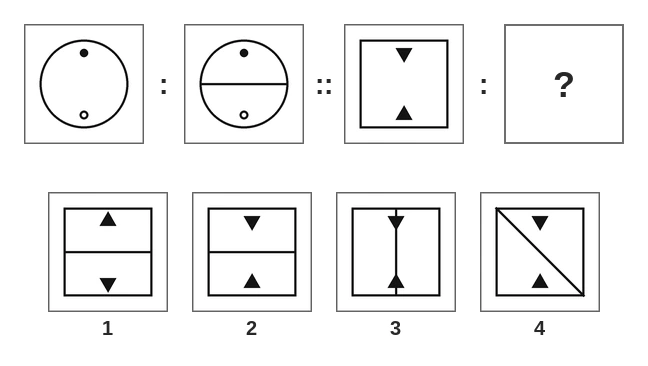
(a) Figure 1 (b) Figure 2 (c) Figure 3 (d) Figure 4
Answer. The first figure has a black dot at the top and a white dot at the bottom. The second has the same dots and a straight line across the middle from left to right. So a flat line through the centre has been added. Add the same line to the third figure and change nothing else: the two triangles still point at each other, with the flat line between them. Figure 3 adds an upright line instead, joining the triangles. Figure 4 adds a slanting line. Figure 1 has the flat line but turns both triangles round. So the answer is (b) Figure 2.
Question 12
Select the option figure that is related to the third figure in the same way as the second figure is related to the first figure.
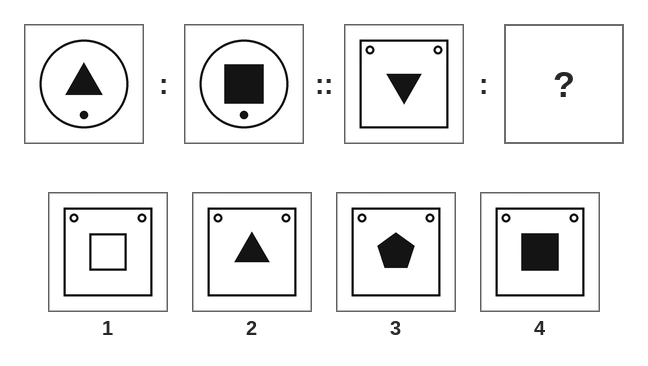
(a) Figure 1 (b) Figure 2 (c) Figure 3 (d) Figure 4
Answer. The black triangle inside the circle has become a black square of the same size with upright sides, and the black dot has not moved. Three sides became four. In the third figure the shape in the middle is also a black triangle, pointing down, with two white dots above it. Give it one more side: it becomes a black square with upright sides, and the dots stay. Figure 3 has five sides, one too many. Figure 1 is a square, but white. Figure 2 only turns the triangle. So the answer is (d) Figure 4.
Solved Questions: Parts That Change Places
Question 13
Select the option figure that is related to the third figure in the same way as the second figure is related to the first figure.
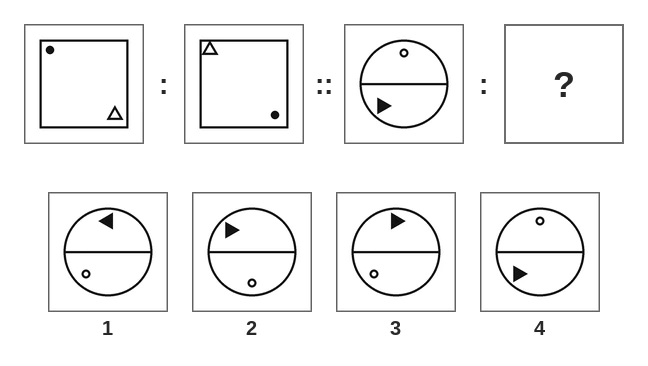
(a) Figure 1 (b) Figure 2 (c) Figure 3 (d) Figure 4
Answer. In the first figure the black dot is at the top-left corner and the white triangle is at the bottom-right corner, pointing up. In the second they have changed places, and the triangle still points up. So the two parts swap places and keep their own directions. In the third figure the white dot is at the top and the black triangle is at the bottom-left, pointing right. Swap them: the triangle goes to the top, still pointing right, and the white dot goes to the bottom-left. The flat line stays. Figure 1 swaps them but turns the triangle to point left. Figure 2 is a top–bottom mirror image, not a swap. So the answer is (c) Figure 3.
Question 14
Select the option figure that is related to the third figure in the same way as the second figure is related to the first figure.
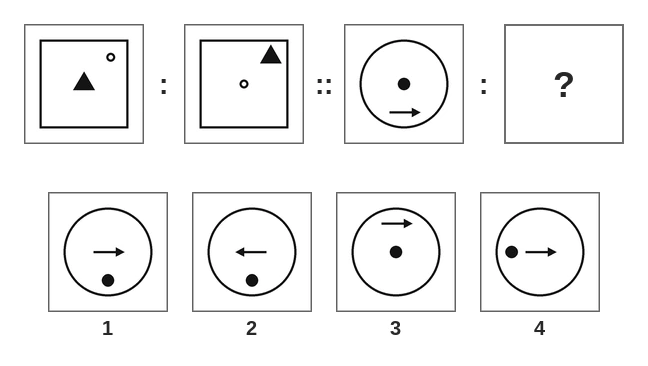
(a) Figure 1 (b) Figure 2 (c) Figure 3 (d) Figure 4
Answer. The black triangle was in the centre and the white dot near the top-right corner. In the second figure they have changed places, and the triangle still points up. In the third figure the black dot is in the centre and the arrow is near the bottom, pointing right. Swap them: the arrow goes to the centre, still pointing right, and the dot goes near the bottom, where the arrow was. Figure 2 turns the arrow round. Figure 4 puts the dot at the left instead of where the arrow was. So the answer is (a) Figure 1.
Question 15
Select the option figure that is related to the third figure in the same way as the second figure is related to the first figure.
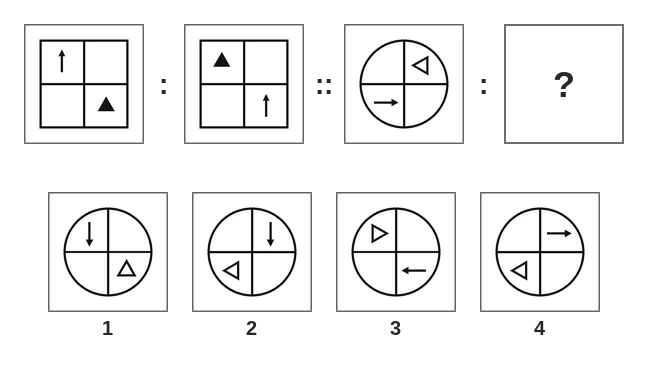
(a) Figure 1 (b) Figure 2 (c) Figure 3 (d) Figure 4
Answer. In the first figure the arrow is in the top-left quarter and the black triangle in the bottom-right quarter, both pointing up. In the second they have swapped quarters and both still point up. The dividing lines do not move. So the arrow and the triangle change places. In the third figure the arrow is in the bottom-left quarter pointing right, and the white triangle is in the top-right quarter pointing left. After the swap the arrow is in the top-right quarter, still pointing right, and the triangle is in the bottom-left quarter, still pointing left. Figure 2 turns the arrow to point down. Figure 1 turns the whole figure a quarter turn, and Figure 3 is a mirror image. So the answer is (d) Figure 4.
A Checking Habit
Most wrong answers in figure analogies come from doing the right change carelessly. This habit catches nearly all of them.
Five steps
- Say the change from the first figure to the second in one sentence.
- Test that sentence on every part of the first figure. If one part does not follow it, find a better sentence.
- Apply the change to the third figure one part at a time, and say where each part ends up and how it points.
- Check the options against your list, one part at a time, crossing out any option that fails.
- Pick the option that passes on every part.
Common mistakes
The wrong options are made by spoiling the right answer in one way:
- the figure turned the wrong way (clockwise instead of anticlockwise)
- a mirror image when the change was a turn, or a turn when it was a mirror image
- a half turn instead of a mirror image
- one part changed and another left as it was
- the third figure copied with no change
So when an option looks right at a glance, still check each part before you mark it.
When two changes seem to fit
Sometimes two different sentences both turn the first figure into the second, for example a half turn and a mirror image of a figure that is the same on both sides. Apply both to the third figure. Usually only one of the results is among the options, and that is the answer.
Time and marks
The Reasoning section has 25 questions and its own locked 15-minute clock. A right answer gets +2 and a wrong one costs 0.5, so a careful 30–40 seconds on a figure analogy is better than a quick guess.
Solved Questions: Checking Part by Part
Question 16
Select the option figure that is related to the third figure in the same way as the second figure is related to the first figure.
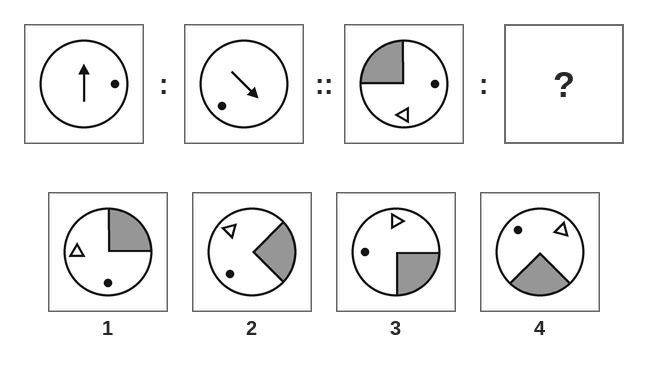
(a) Figure 1 (b) Figure 2 (c) Figure 3 (d) Figure 4
Answer. The arrow pointed up and now points down-right. Count the turn in 45° steps clockwise: up-right, right, down-right. That is three steps, so 135° clockwise. Check with the dot: it went from the right to the bottom-left, which is also three places clockwise (bottom-right, bottom, bottom-left). Now turn the third figure 135° clockwise. The grey quarter faces up-left, so it will face right. The black dot goes from the right to the bottom-left, as in the first figure. The white triangle goes from the bottom to the top-left, and its point turns from left to up-right. Figure 4 turns the figure anticlockwise, Figure 1 turns it only 90°, and Figure 3 turns it 180°. So the answer is (b) Figure 2.
Question 17
Select the option figure that is related to the third figure in the same way as the second figure is related to the first figure.
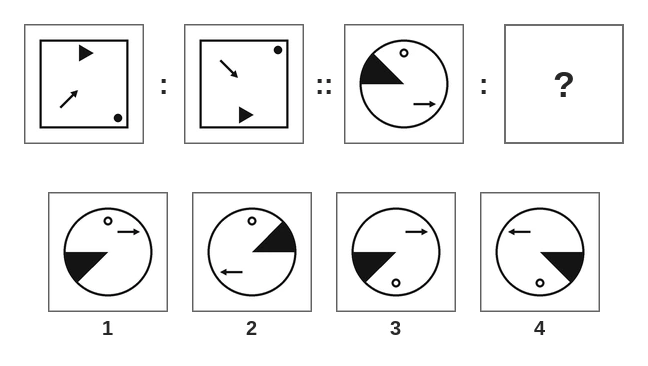
(a) Figure 1 (b) Figure 2 (c) Figure 3 (d) Figure 4
Answer. In the second figure the triangle that was at the top-middle is at the bottom-middle, still pointing right. The dot went from the bottom-right corner to the top-right corner. The arrow went from the lower left to the upper left, and it slanted up-right but now slants down-right. Left and right did not change, but top and bottom did. That is a top–bottom mirror image. In the third figure the black slice is just above the left, so it moves to just below the left. The arrow at the bottom-right points right, so it moves to the top-right and still points right. The white dot at the top moves to the bottom. Figure 1 moves the slice and the arrow but leaves the dot at the top. Figure 2 swaps left and right, and Figure 4 turns the figure through 180°. So the answer is (c) Figure 3.
Question 18
Select the option figure that is related to the third figure in the same way as the second figure is related to the first figure.
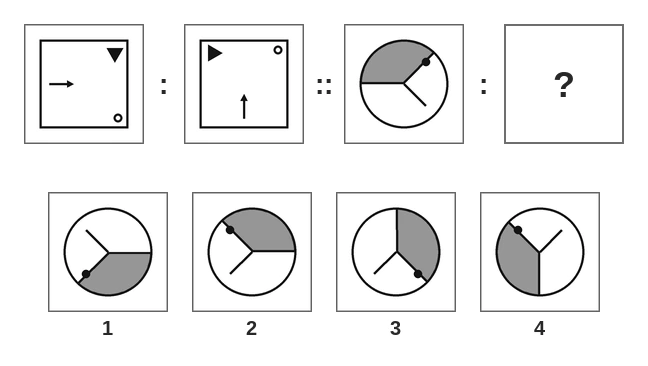
(a) Figure 1 (b) Figure 2 (c) Figure 3 (d) Figure 4
Answer. Follow each part from the first figure to the second. The arrow at the left pointed right, and now it is at the bottom pointing up. The black triangle at the top-right corner pointed down, and now it is at the top-left corner pointing right. The white dot went from the bottom-right corner to the top-right corner. Each part has gone a quarter of the way round anticlockwise, and each direction has turned 90° anticlockwise. So the figure turns 90° anticlockwise. Do the same to the third figure. The grey part, which runs from the left round to the top-right, now runs from the bottom round to the top-left. The black dot moves from the top-right to the top-left, and the line from the centre turns from down-right to up-right. Figure 3 turns clockwise, Figure 2 is a mirror image and Figure 1 is a half turn. So the answer is (d) Figure 4.