
What a Figure Series Question Looks Like
A figure series question shows a row of four or five boxes, the problem figures, and then a box with a question mark. Under them sit four answer figures numbered 1 to 4. Something in the problem figures changes from one box to the next by a fixed rule. Your job is to find that rule and pick the answer figure that comes next.
What can change
Almost every series is built from a few kinds of change:
- Place. A part moves round the box. A dot goes from the top-left corner to the top-middle, then to the top-right corner, and so on.
- Direction. A part stays where it is and turns. An arrow points up, then right, then down.
- Number. Parts are added or taken away: one line, two lines, three lines.
- Shading. A black or grey slice moves round a divided circle, or a part changes between black and white.
The frame round the parts (a square or a circle) and any lines that divide it usually stay still. They are there to help you see where things are.
One part at a time
The usual mistake is to stare at all the figures together and hope the answer jumps out. When two parts move, it rarely does. Work like this instead:
- Pick one part, say the black dot.
- Write where it is in each figure, in order. In rough work, short names like TL, TM, TR are enough.
- Say its step in plain words: "one place clockwise each time".
- Work out where that part must be in the next figure.
- Do the same for the next part.
Look at the options only after you know what the next figure must have. If you look at them first, a near miss can pull you in.
How the wrong options are made
The wrong options are not random drawings. Each one is usually the answer with one thing spoiled: a part moved one place too far, an arrow turned the wrong way, a slice with the wrong shade, or a copy of the last problem figure. So when two options look almost the same, that is normal. Find the one part where they differ and check only that.
Aim to finish a figure series in 30–45 seconds.
The Eight Places Round the Box
Most moving parts sit on one of eight places round the edge of the box: the four corners and the middles of the four sides. Learn them in clockwise order, starting at the top-left corner.
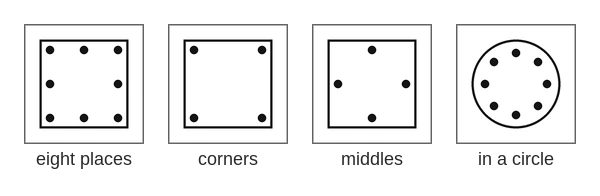
| Number | Place | Short name |
|---|---|---|
| 1 | top-left corner | TL |
| 2 | top-middle | TM |
| 3 | top-right corner | TR |
| 4 | right-middle | RM |
| 5 | bottom-right corner | BR |
| 6 | bottom-middle | BM |
| 7 | bottom-left corner | BL |
| 8 | left-middle | LM |
Clockwise is the way the hands of a clock go: along the top from left to right, down the right side, along the bottom from right to left, and up the left side. Anticlockwise is the opposite way.
In a circle frame the same eight places sit round the rim: top-left, top, top-right, right, bottom-right, bottom, bottom-left and left. Everything in this section works the same way for them.
Counting steps
A step of one place takes a corner to the next middle, or a middle to the next corner. A step of two places takes a corner to the next corner, or a middle to the next middle. A step of three places takes the top-left corner to the right-middle, passing the top-middle and the top-right corner on the way.
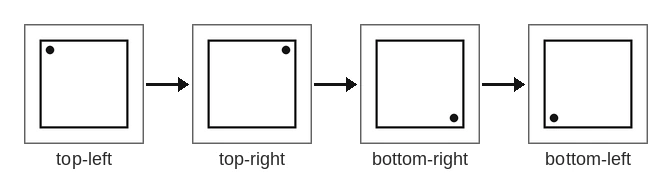
In the picture the dot moves two places clockwise each time: top-left, top-right, bottom-right, bottom-left. Count the places you land on, not the place you start from. From the top-left corner, one step lands on the top-middle and two steps land on the top-right corner.
Write numbers in rough
With the table, a part's journey becomes a short list of numbers. A dot at 1, 4, 7, 2 is jumping three places each time: 1 to 4, 4 to 7, and 7 to 10, where 10 is place 2 once you go past 8. So the next place is 2 + 3 = 5, the bottom-right corner. Add for clockwise steps, take away for anticlockwise steps, and add or take away 8 when you go past the end.
[SSC Tip] A part that moves two places each time is back at its start after four steps, so on its own it would make the answer a copy of the first figure. Look for a second change before you settle on an option.
Solved Questions
Question 1
Select the figure that will replace the question mark (?) in the following figure series.
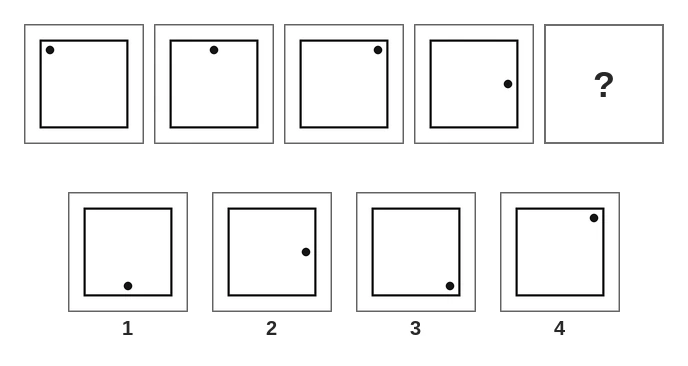
(a) Figure 1 (b) Figure 2 (c) Figure 3 (d) Figure 4
Answer. Only one part moves here, the black dot. Write its places in order: top-left corner, top-middle, top-right corner, right-middle. Each time it goes one place clockwise. One more place clockwise from the right-middle is the bottom-right corner, so the next figure has the dot there. Figure 1 moves it two places, and Figure 2 leaves it where it was. So the answer is (c) Figure 3.
Question 2
Select the figure from among the given options that can replace the question mark (?) in the following series.
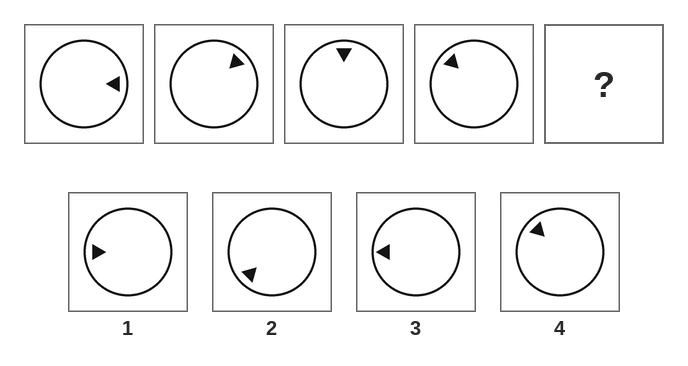
(a) Figure 1 (b) Figure 2 (c) Figure 3 (d) Figure 4
Answer. Follow the small black triangle. It starts at the right, then goes to the top-right, the top and the top-left. That is one place anticlockwise each time, and in every figure one corner points at the centre. One more place anticlockwise from the top-left is the left. There the triangle must point at the centre, which means it points to the right. Figure 3 puts it at the left but pointing away from the centre, and Figure 2 goes one place too far. So the answer is (a) Figure 1.
Question 3
Which figure should replace the question mark (?) if the series were to be continued?
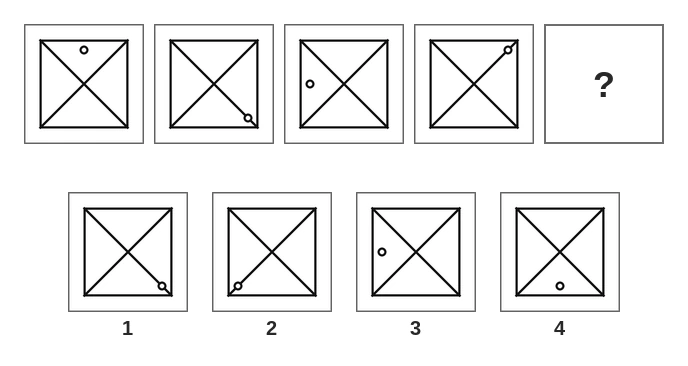
(a) Figure 1 (b) Figure 2 (c) Figure 3 (d) Figure 4
Answer. The two diagonals never change, so watch the small white dot. From the top-middle to the bottom-right corner is three places clockwise (top-right, right-middle, bottom-right). From there to the left-middle is three more, and from the left-middle to the top-right corner is three more. So it jumps three places clockwise each time. Three places on from the top-right corner are the right-middle, the bottom-right corner and the bottom-middle. The dot must sit at the bottom-middle. Figure 1 moves it only two places, and Figure 2 moves it four. So the answer is (d) Figure 4.
Turning by 45°, 90°, 135° and 180°
Some parts stay in one place and only turn. Arrows are the easiest to read because the head shows the direction. A small triangle works the same way while it points straight up, down, left or right. Turned to a slant, all three of its corners look like points, so for a slanting triangle trust its place more than its direction.
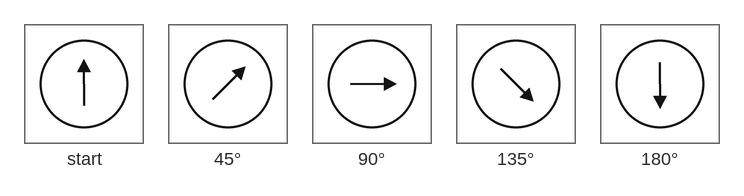
Measuring a turn
Look at where the head points in one figure and in the next, and count the turn in steps of 45°.
| Turn | Starting from "up", turning clockwise | How it looks |
|---|---|---|
| 45° | up-right | from straight to slanting |
| 90° | right | a quarter turn |
| 135° | down-right | a quarter turn and half a quarter more |
| 180° | down | a half turn, pointing the opposite way |
A clockwise turn goes the way clock hands go. Up, turning clockwise, goes to up-right, right, down-right and down. Anticlockwise goes the other way: up, up-left, left, down-left, down.
Two facts save time. A turn of 90° clockwise ends where a turn of 270° anticlockwise ends, so always describe a turn the short way round. And a turn of 180° ends in the same place whichever way you turn.
Steps of 135°
A 45° step is easy to spot, because the arrow goes from straight to slanting to straight. A 135° step is harder, because the arrow seems to jump about: right, down-left, up, down-right. Check each step as "90° and 45° more". From right, 90° clockwise is down, and 45° more is down-left. If every step works out the same, the rule is a turn of 135°.
A part that moves and turns
Sometimes one arrow moves round the places and turns at the same time. Treat this as two lists, one of places and one of directions. For example, an arrow might go top-left, top-right, bottom-right, bottom-left (one corner clockwise each time) while it points right, up-right, up, up-left (45° anticlockwise each time). Next it is back at the top-left, pointing left. Mixing up the two lists is the usual way to go wrong.
Solved Questions: Turning Parts
Question 4
Select the figure that will replace the question mark (?) in the following figure series.
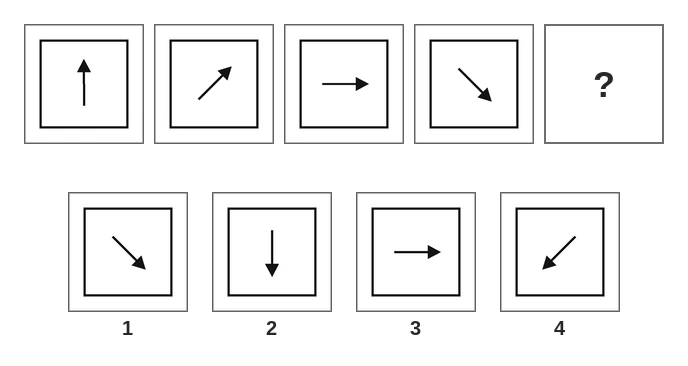
(a) Figure 1 (b) Figure 2 (c) Figure 3 (d) Figure 4
Answer. Here nothing moves round the box. The arrow stays in the middle and only turns. It points up, then up-right, then right, then down-right. Each time the head moves on by 45°, the way a clock hand goes, so it turns 45° clockwise each step. The next 45° clockwise from down-right is straight down. Figure 4 turns it 90° instead, and Figure 3 turns it back the wrong way. So the answer is (b) Figure 2.
Question 5
Select the figure from among the given options that can replace the question mark (?) in the following series.
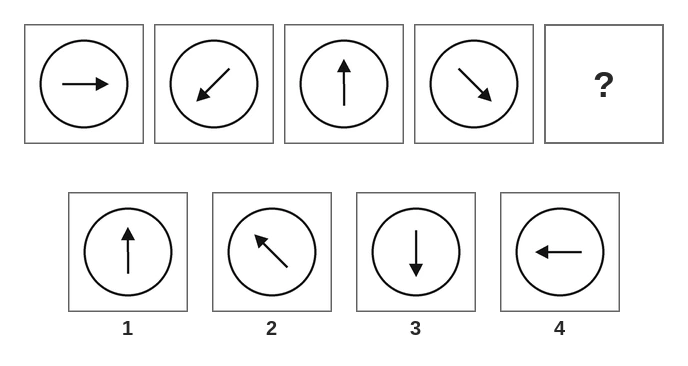
(a) Figure 1 (b) Figure 2 (c) Figure 3 (d) Figure 4
Answer. The arrow points right, then down-left, then up, then down-right. From right to down-left is 90° to point down and 45° more, so 135° clockwise. Down-left to up is the same: 90° to up-left, then 45° more to up. Up to down-right is 135° clockwise again. So turn the last arrow 135° clockwise: 90° takes down-right to down-left, and 45° more takes it to left. The next arrow points left. Figure 3 turns only 45°, and Figure 1 turns the wrong way. Time check: an arrow that only turns should take you about 30 seconds. So the answer is (d) Figure 4.
Question 6
Which figure should replace the question mark (?) if the series were to be continued?
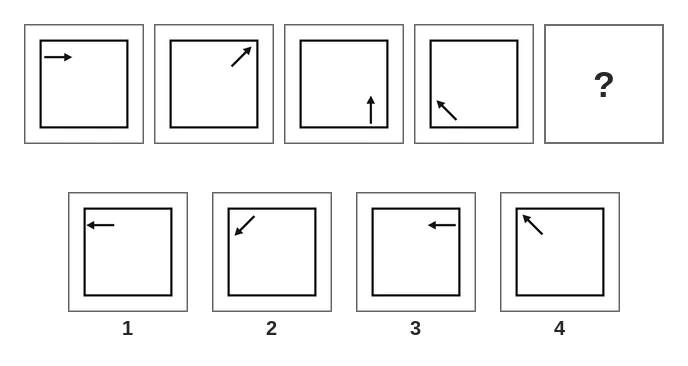
(a) Figure 1 (b) Figure 2 (c) Figure 3 (d) Figure 4
Answer. One arrow, but two things change, so take them one at a time. Its place first: top-left, top-right, bottom-right, bottom-left. It moves one corner clockwise (two places) each time, so next it is back at the top-left corner. Now its direction: right, up-right, up, up-left. It turns 45° anticlockwise each time, so next it points left. The answer has the arrow at the top-left corner pointing left. Figure 4 has the right place but forgot to turn, and Figure 3 turned correctly but went one corner too far. So the answer is (a) Figure 1.
Parts Added or Taken Away
In some series a part appears or disappears at each step. Then the question is not where one part is, but how many parts there are and where the newest one goes.
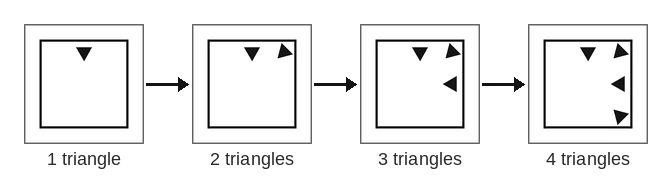
Count first
Count each kind of part in every figure and write the counts in a row. The usual patterns are:
- up by one: 1, 2, 3, 4, so next 5
- up by two: 1, 3, 5, 7, so next 9
- down by one: 8, 7, 6, 5, so next 4
The count alone often cuts the options from four to two.
Then find where the change happens
A part that is added each time usually goes in the next place clockwise or anticlockwise from the last new one. A part that is taken away usually leaves from one end of the group. In the picture a small triangle is added each time, going clockwise from the top-middle, so the fifth triangle goes at the bottom-middle, next to the last one. A wrong option will often have the right count with the new part on the wrong side, or with a gap.
One kind replacing another
Sometimes the count of one kind goes up while another goes down by the same amount. For example, white dots on the eight places can turn into black triangles one by one: triangles 1, 2, 3, 4 and dots 7, 6, 5, 4. Count both kinds, then check where the latest change happened.
[SSC Tip] When the rule is a count, check the count in each option before anything else. It takes a few seconds and often leaves only one figure.
Solved Questions: Counting Parts
Question 7
Select the figure that will replace the question mark (?) in the following figure series.
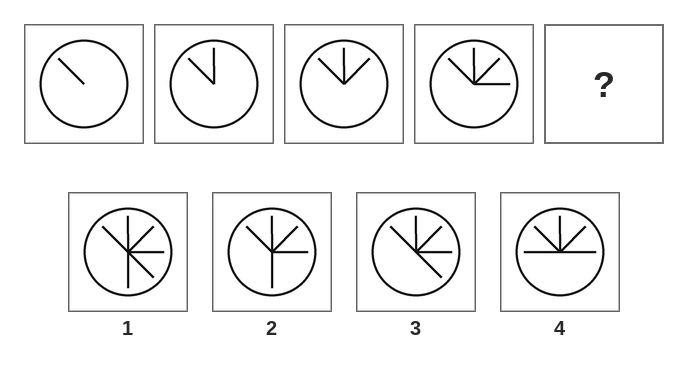
(a) Figure 1 (b) Figure 2 (c) Figure 3 (d) Figure 4
Answer. Count the lines from the centre: 1, 2, 3, 4. One line is added each time. Now ask where the new line goes. The first points to the top-left, and each new one points to the next place clockwise: top, top-right, right. So the fifth line points to the bottom-right, next to the one pointing right. Figure 1 has six lines. Figure 4 has five lines, but its new line is on the wrong side, at the left. Figure 2 also has five, but leaves a gap. So the answer is (c) Figure 3.
Question 8
Select the figure from among the given options that can replace the question mark (?) in the following series.
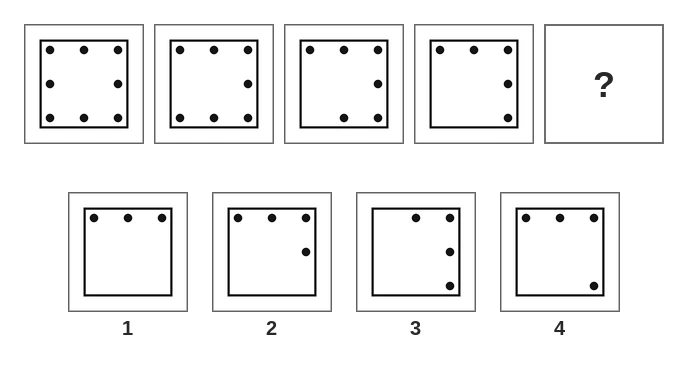
(a) Figure 1 (b) Figure 2 (c) Figure 3 (d) Figure 4
Answer. Count the dots: 8, 7, 6, 5. One dot is taken away each time. First the left-middle dot goes, then the bottom-left one, then the bottom-middle one. They leave one by one, going anticlockwise. Next to leave is the bottom-right corner, so four dots stay: top-left, top-middle, top-right and right-middle. Figure 4 also has four dots, but it lost the right-middle dot instead of the bottom-right one. Figure 1 has taken away two at once. So the answer is (b) Figure 2.
Question 9
Which figure should replace the question mark (?) if the series were to be continued?
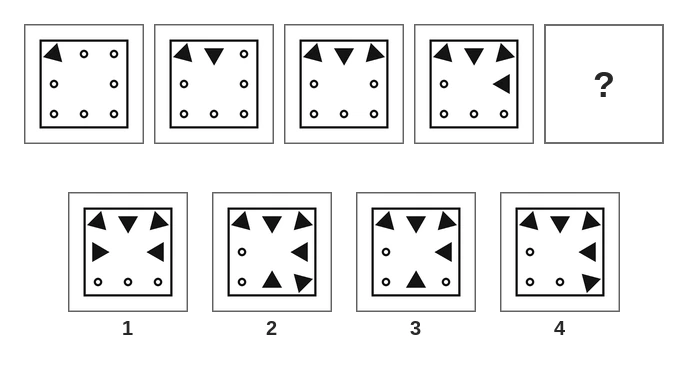
(a) Figure 1 (b) Figure 2 (c) Figure 3 (d) Figure 4
Answer. There are two kinds of parts, so count both. Triangles: 1, 2, 3, 4. White dots: 7, 6, 5, 4. Each time one dot becomes a triangle, and the change goes one place clockwise: top-middle, top-right corner, right-middle. Next it is the turn of the bottom-right corner. So the answer has five triangles, from the top-left round to the bottom-right corner, and three dots at the bottom-middle, bottom-left and left-middle. Figure 1 changes the dot at the left-middle instead, going the wrong way round from the top-left. Figure 3 skips the bottom-right corner. So the answer is (d) Figure 4.
Shading That Moves Round a Divided Figure
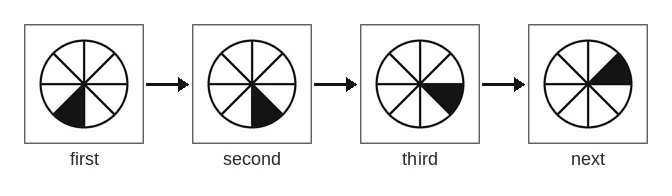
A circle cut by four lines through its centre has eight equal slices. When one slice is shaded and the shading moves, read it just like a dot moving round eight places.
Naming the slices
Name a slice by the line it sits next to: just right of the top line, just above the right line, just below the right line, just right of the bottom line, and so on round the circle. In the picture the black slice goes just left of the bottom, just right of the bottom, just below the right. That is one slice anticlockwise each time, so the next figure has it just above the right.
Each slice is 45° of the circle, so "one slice clockwise" is the same as "the shading turns 45° clockwise". A bigger shaded part, such as a black quarter of the circle, moves in the same way. Follow the middle of the shaded part.
Two things to check
Shading questions usually test two things:
- Where the shaded part is. Count slices, just as you count places.
- What shade it is. Black and grey can take turns (black, grey, black, grey), or a second shaded slice can move the other way round.
Check the place first and cross out the options with the wrong place. Then check the shade in the options that are left.
Shading that grows
Sometimes no slice moves. Instead one more slice is shaded each time, so the black part grows round the circle: one slice, two, three, four. The answer then has one more slice, joined to the others on the side where they have been growing.
Solved Questions: Moving Shading
Question 10
Select the figure that will replace the question mark (?) in the following figure series.
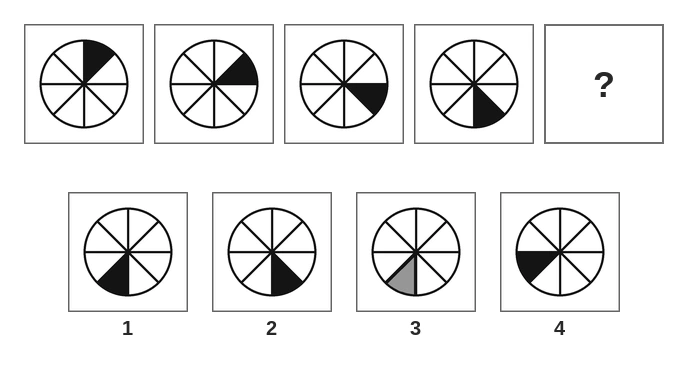
(a) Figure 1 (b) Figure 2 (c) Figure 3 (d) Figure 4
Answer. The circle is cut into eight equal slices by four lines, and one slice is black. Track the black slice: just right of the top, just above the right, just below the right, just right of the bottom. It moves one slice clockwise each time. The next slice clockwise is the one just left of the bottom. Figure 3 has the right slice but shades it grey, and Figure 4 goes one slice too far. So the answer is (a) Figure 1.
Question 11
Select the figure from among the given options that can replace the question mark (?) in the following series.
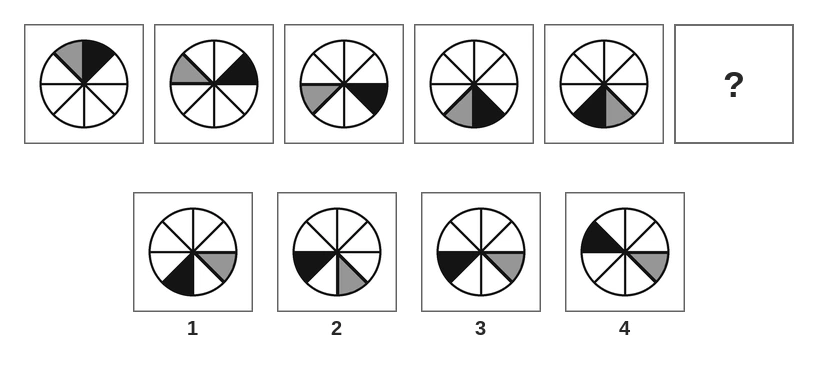
(a) Figure 1 (b) Figure 2 (c) Figure 3 (d) Figure 4
Answer. Two slices move, so follow one at a time. Black: just right of the top, just above the right, just below the right, just right of the bottom, just left of the bottom. One slice clockwise each time, so next it is just below the left. That leaves Figures 3 and 2. Grey: just left of the top, just above the left, just below the left, just left of the bottom, just right of the bottom. One slice anticlockwise each time, so next it is just below the right. In Figure 2 the grey slice has not moved. So the answer is (c) Figure 3.
Question 12
Which figure should replace the question mark (?) if the series were to be continued?
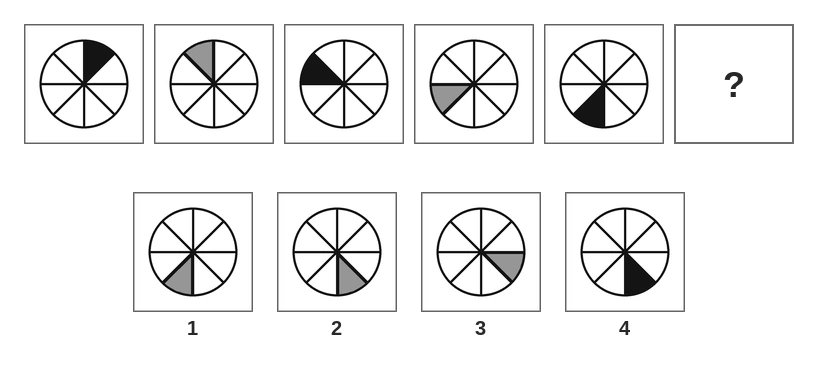
(a) Figure 1 (b) Figure 2 (c) Figure 3 (d) Figure 4
Answer. Two things change for the one shaded slice. Its place first: just right of the top, just left of the top, just above the left, just below the left, just left of the bottom. One slice anticlockwise each time, so next it is just right of the bottom. Now its shade: black, grey, black, grey, black. It swaps every time, so the next one is grey. Figure 4 has the right place but keeps it black. Figure 1 changes the shade but forgets to move. So the answer is (b) Figure 2.
Two Parts at Different Speeds, and Alternating Rules
Two moving parts
When two parts move, each has its own rule, and the two rules are usually different. A black dot might go one place clockwise while a white triangle goes two places anticlockwise. Do not look for one rule that covers both. Make two rows in rough:
| Figure | 1 | 2 | 3 | 4 | 5 | next |
|---|---|---|---|---|---|---|
| Dot | LM | TL | TM | TR | RM | BR |
| Triangle | TR | TL | BL | BR | TR | TL |
Fill the "next" box of each row on its own. The answer must match both rows. Use every problem figure you are given: with five figures, each part has four steps to prove its rule.
Alternating rules
Sometimes the steps of a part are not all the same, but they take turns. Write the steps between the figures:
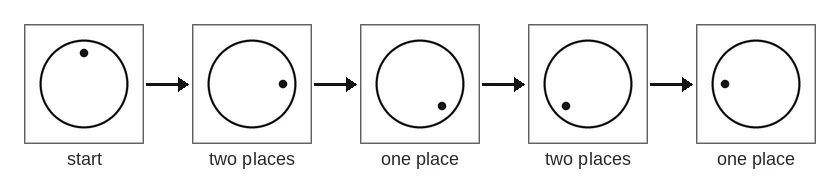
Here the dot moves two places, then one place, then two, then one, all clockwise. The four steps show the pair 2, 1 twice, so the next step is two places. Other rules that take turns:
- turns: 90° clockwise, then 45° anticlockwise, then 90° clockwise again
- colours: black, white, black, white
- shades: black, grey, black, grey
A rule that takes turns needs five problem figures, so that the pattern shows twice. When a series has five figures and the steps of a part do not match, look for steps that take turns.
When the steps will not settle
If you cannot find any pattern in a part's steps, first check your counting. Most slips come from counting the starting place as a step. Then check that you followed the same part from figure to figure. With two dots or two triangles in the box, it is easy to jump from one to the other.
Solved Questions: Two Parts and Steps That Take Turns
Question 13
Select the figure that will replace the question mark (?) in the following figure series.
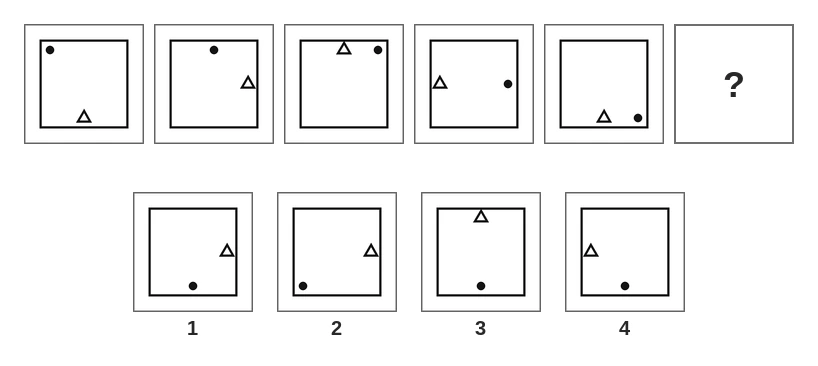
(a) Figure 1 (b) Figure 2 (c) Figure 3 (d) Figure 4
Answer. There are two moving parts with different speeds. Do the dot first: top-left corner, top-middle, top-right corner, right-middle, bottom-right corner. One place clockwise each time, so next it is at the bottom-middle. Figure 2 puts it one place further, so cross it out. Now the triangle: bottom-middle, right-middle, top-middle, left-middle, bottom-middle. It goes two places anticlockwise each time, so next it is at the right-middle. Figure 3 moves it four places, and Figure 4 moves it the wrong way. So the answer is (a) Figure 1.
Question 14
Select the figure from among the given options that can replace the question mark (?) in the following series.
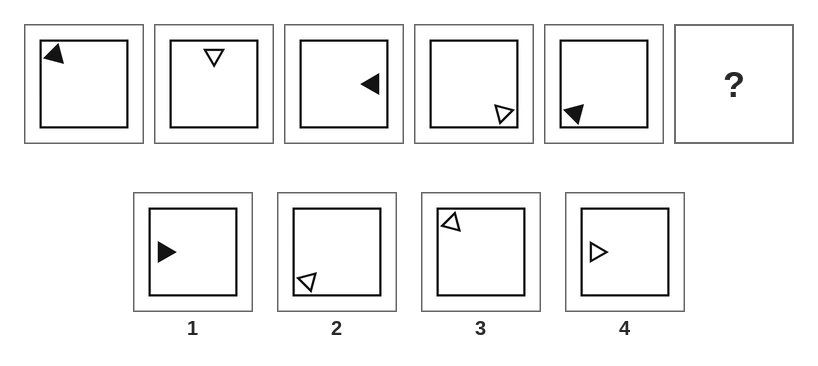
(a) Figure 1 (b) Figure 2 (c) Figure 3 (d) Figure 4
Answer. One triangle, two changes. Its place: top-left corner, top-middle, right-middle, bottom-right corner, bottom-left corner. The steps are one place, two places, one place, two places, all clockwise. The pattern 1, 2, 1, 2 says the next step is one place, so the triangle goes to the left-middle. Its colour: black, white, black, white, black, so next it is white. It still points at the centre. Figure 1 has the right place but the wrong colour. Figure 3 takes a step of two places. So the answer is (d) Figure 4.
Question 15
Which figure should replace the question mark (?) if the series were to be continued?
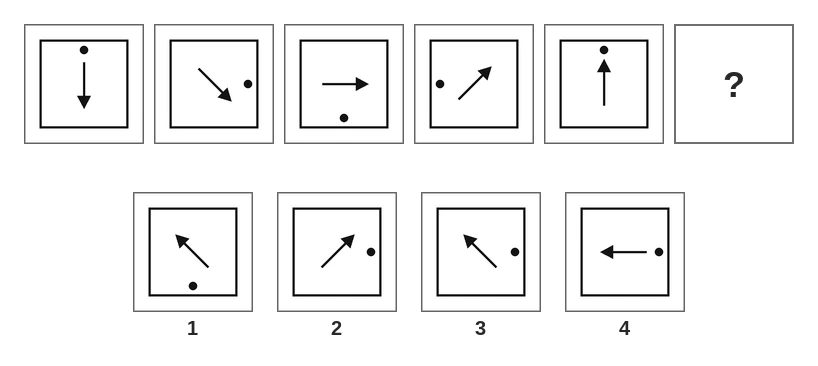
(a) Figure 1 (b) Figure 2 (c) Figure 3 (d) Figure 4
Answer. Start with the dot, because places are quick to check. Top-middle, right-middle, bottom-middle, left-middle, top-middle: two places clockwise each time, so next it is at the right-middle. That rules out Figure 1. Now the arrow: down, down-right, right, up-right, up. It turns 45° anticlockwise each step, so next it points up-left. Figure 2 turns it clockwise, and Figure 4 turns it 90°. So the answer is (c) Figure 3.
Using the Options to Cut the Work
Once you know the rule for one part, the options can do half the work for you.
The method
- Work out where the first part must be in the next figure.
- Look at that part only, in all four options, and cross out every option where it is wrong.
- Usually one or two options are left. Work out the second part and check it only in those.
- When one option is left, mark it and move on.
Start with the part that is quickest to check. A dot or a triangle on one of the eight places is quicker than an arrow's direction, and a count is quicker than either.
Why this works
Each wrong option is the answer with one thing spoiled, so each wrong option fails on one part. Checking part by part finds that failure at once. Looking at whole figures does the opposite: the near misses all look right.
If no option fits
Do not pick the closest-looking figure. Go back to the problem figures and count again. The usual slips are:
- counting the starting place as a step
- reading a turn as clockwise when it is anticlockwise
- missing steps that take turns, such as 1, 2, 1, 2
- following the wrong part when two parts look alike
Time and marks
The Reasoning section has 25 questions and its own locked 15-minute clock, and each right answer gets +2 while a wrong one costs 0.5. A figure series should take you 30–45 seconds. If you have cut the options to two and a fresh count still does not settle it, move on and come back later rather than guess in a hurry.
Solved Questions: Using the Options
Question 16
Select the figure that will replace the question mark (?) in the following figure series.
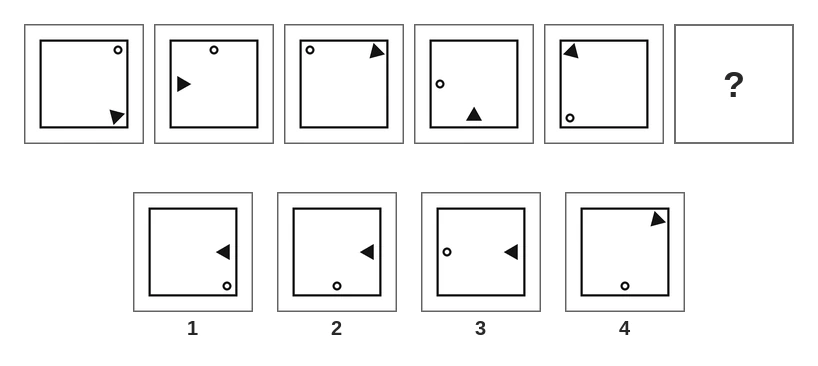
(a) Figure 1 (b) Figure 2 (c) Figure 3 (d) Figure 4
Answer. Use the options to save time. First the white dot: top-right corner, top-middle, top-left corner, left-middle, bottom-left corner. One place anticlockwise each time, so next it is at the bottom-middle. Look at the dot in all four options: Figure 1 has it at the bottom-right corner and Figure 3 at the left-middle, so both go. Now the triangle, only in the two figures left. Its places: bottom-right corner, left-middle, top-right corner, bottom-middle, top-left corner. Count three places clockwise each time. Three on from the top-left corner is the right-middle, pointing at the centre. Figure 4 has it at the top-right corner, only two places on. So the answer is (b) Figure 2.
Question 17
Select the figure from among the given options that can replace the question mark (?) in the following series.
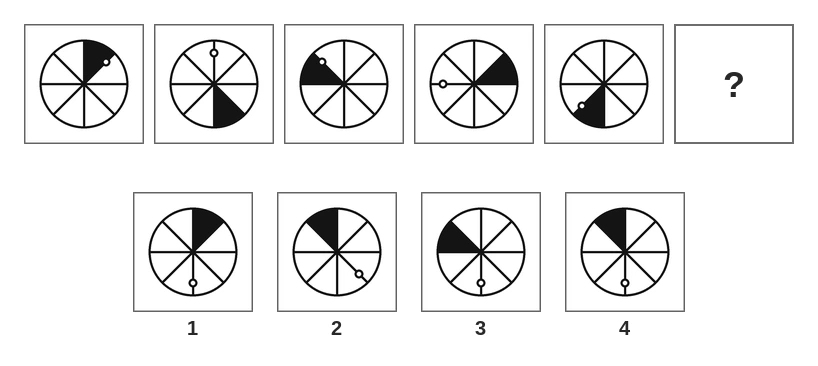
(a) Figure 1 (b) Figure 2 (c) Figure 3 (d) Figure 4
Answer. Two parts. The white dot sits on a line, so it is easy to track: top-right, top, top-left, left, bottom-left. One place anticlockwise each time, so next it is at the bottom. That rules out Figure 2. Now the black slice: just right of the top, just right of the bottom, just above the left, just above the right, just left of the bottom. Count the slices clockwise between them and you get three each time. Three slices on from just left of the bottom is just left of the top. Figure 3 moves it only two slices, and Figure 1 moves it four. So the answer is (d) Figure 4.
Question 18
Which figure should replace the question mark (?) if the series were to be continued?
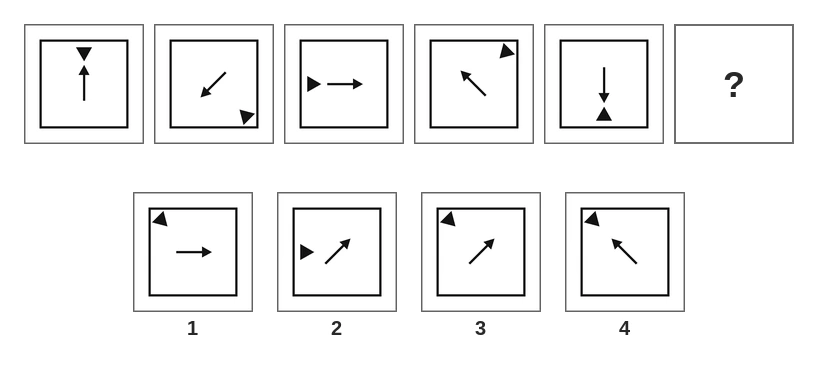
(a) Figure 1 (b) Figure 2 (c) Figure 3 (d) Figure 4
Answer. Take the triangle first. It sits at the top-middle, bottom-right corner, left-middle, top-right corner and bottom-middle, always pointing at the centre. That is three places clockwise each time, so next it is at the top-left corner. Figure 2 has it at the left-middle, only two places on, so it goes. Now the arrow: up, down-left, right, up-left, down. Each step is 135° anticlockwise (90° and then 45° more). From down, 90° anticlockwise is right, and 45° more is up-right. Figure 4 turns the wrong way and Figure 1 turns only 90°. Time check: with the options doing half the work, this should take about 40 seconds. So the answer is (c) Figure 3.