
What the Question Asks
In a figure classification question you get four figures, numbered 1 to 4. Three of them share something you can see, and the fourth does not. You have to find that fourth figure. The question usually reads: "Three of the following four figures are alike in a certain way and thus form a group. Which is the one that does NOT belong to that group?"
The figures are built from a few simple parts: flags, L shapes, hooks, stars, moons, semicircles, dots and short lines. What ties three of them together is nearly always one of these.
| What to test | What you look at |
|---|---|
| Turns | three are one figure turned round, the fourth is its mirror image |
| Counts | how many parts, lines, sides or dots each figure has |
| Direction | what a flag, an arrow or a moon points at, or the clockwise order of the parts |
| Fills | which parts are black, grey or white, and which shape sits inside which |
Test one property at a time
The usual mistake is to compare Figure 1 with Figure 2, then Figure 2 with Figure 3, and soon lose track. Work the other way. Pick one property and check it on all four figures before you move on. Say the result as four short answers.
For example: count the stars. If you get 3, 3, 2, 3, then Figure 3 is the odd one by count, and you are nearly done. If you get 3, 2, 3, 2, the count splits two and two, so it is not the property. Drop it and test the next one.
A property helps only when it splits the figures three and one. Two and two tells you nothing, and neither does four different answers.
A good order to test in
Start with what is quickest to see. First look for figures that seem to be one figure turned round, because a mirror image hidden among turns is the trap most students fall into. Then count. Then look at directions, and last at fills. Most questions open up at the first or second test.
Time check: aim for 30–40 seconds on a classification question. The Reasoning section has 25 questions on its own 15-minute clock, a right answer earns 2 marks and a wrong one costs 0.5, so a question that will not open after 40 seconds is better left for the end.
Same Figure Turned, or Its Mirror Image
In many classification questions the four figures look nearly the same. They have the same parts, in the same colours, spaced about the same way. Three of them are one figure turned to different sides. The fourth is the mirror image of that figure, usually turned as well. Your eye says "all four are the same", and that is the trap.
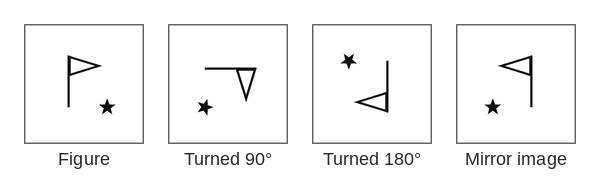
The first figure in the picture is a flag with a black star at the bottom-right. Turned 90° clockwise, the pole lies flat and the star moves to the bottom-left. Turned 180°, the flag hangs upside down. Whatever the turn, if you stand the pole upright again with the cloth at the top, the cloth points right. Now look at the mirror image. It has the star at the bottom-left, just like the figure turned 90°, but stand its pole upright and the cloth points left. No turn can do that.
The test with a flag, an L or a hook
A flag, an L or a hook is the easiest part to test, because its mirror image is never a turn of it. Pick one such part. In your head, turn each figure until that part stands the normal way up:
- a flag with its pole upright and the cloth at the top
- an L with its long stroke upright and its short stroke at the bottom
- a hook like the letter J, stem up and curl at the bottom
Then check one thing in each figure: whether the cloth, the short stroke or the curl goes to the right or to the left. Three figures give one answer. The mirror image gives the other.
When every part looks the same in a mirror
A star, a moon, a semicircle or a dot looks the same in a mirror once you turn it, so testing one of these parts alone tells you nothing. Use the order instead. Start at one named part and go clockwise round the box, naming the parts you meet: "moon, black star, semicircle". A turn never changes this order. A mirror reverses it, so the mirror image gives "moon, semicircle, black star".
[SSC Tip] Write the order in the margin as initials, such as M B S for moon, black star, semicircle. Three letters for each figure are quicker to compare than four pictures turned in your head.
Solved Questions
Question 1
Three of the following four figures are alike in a certain way and thus form a group. Which is the one that does NOT belong to that group?
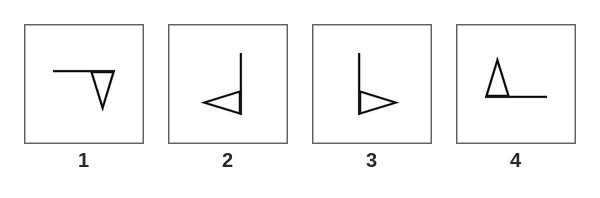
(a) Figure 1 (b) Figure 2 (c) Figure 3 (d) Figure 4
Answer. All four figures are one flag, so counting and colours give nothing. The question is whether each flag is a turn of the same flag. In your head, turn each one until the pole stands upright with the cloth at the top. Figure 1 needs a quarter turn anticlockwise, and then its cloth points right. Figure 2 needs a half turn, and its cloth points right. Figure 4 needs a quarter turn clockwise, and again the cloth points right. Figure 3 also needs a half turn, but then its cloth points left. Figures 2 and 3 look almost alike, both hanging upside down, yet their cloths point opposite ways. A turn can never change that, so Figure 3 is the mirror image. So the answer is (c) Figure 3.
Question 2
Three of the following four figures are alike in a certain way and thus form a group. Which is the one that does NOT belong to that group?
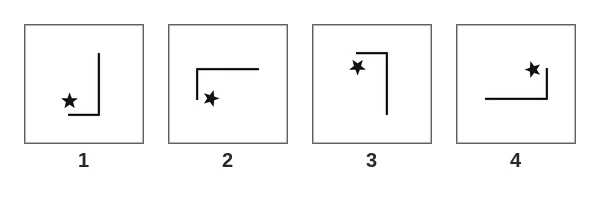
(a) Figure 1 (b) Figure 2 (c) Figure 3 (d) Figure 4
Answer. Each figure is an L with a small black star resting on its short stroke. Stand each L the normal way up, long stroke upright and short stroke at the bottom. Figure 2 needs a quarter turn anticlockwise, Figure 3 a half turn and Figure 4 a quarter turn clockwise. In all three the short stroke then goes to the right, like a printed L, with the star just above it. Figure 1 is upright already, and its short stroke goes to the left. It is a backward L, the mirror image of the others. So the answer is (a) Figure 1.
Question 3
Three of the following four figures are alike in a certain way and thus form a group. Which is the one that does NOT belong to that group?
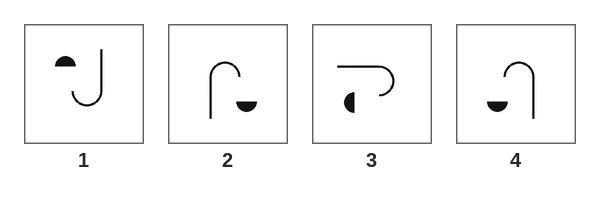
(a) Figure 1 (b) Figure 2 (c) Figure 3 (d) Figure 4
Answer. Every figure has the same two parts, a hook and a black semicircle, so test for turns using the hook. Hold each hook like the letter J, stem up and curl at the bottom. Figure 1 is already that way: its curl bends to the left, and the black semicircle is up on the left. Figure 2 needs a half turn and Figure 3 a quarter turn clockwise, and both then match Figure 1. Figure 4 needs a half turn too, but then its curl bends to the right and the semicircle is on the right. That is a J seen in a mirror. So the answer is (d) Figure 4.
Question 4
Three of the following four figures are alike in a certain way and thus form a group. Which is the one that does NOT belong to that group?
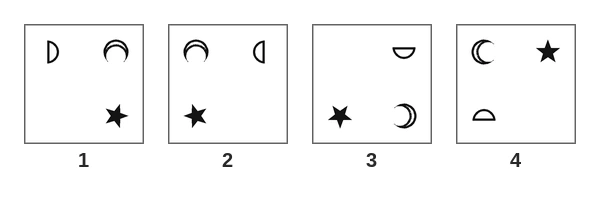
(a) Figure 1 (b) Figure 2 (c) Figure 3 (d) Figure 4
Answer. A moon, a star and a semicircle look the same in a mirror once you turn them, so testing one part will not work here. Use the order. In each figure start at the moon and go clockwise round the box. Figure 1: moon at the top-right, then the black star at the bottom-right, then the semicircle at the top-left. Figure 3: moon, black star, semicircle again. Figure 4: moon at the top-left, black star at the top-right, semicircle at the bottom-left, the same order. Figure 2: moon at the top-left, then the semicircle at the top-right, and only then the black star at the bottom-left. The order is reversed, so Figure 2 is the mirror image. So the answer is (b) Figure 2.
Counting Parts, Lines, Sides and Dots
When the figures do not look alike at all, counting is the next thing to try. Each figure may be a jumble of different parts, but three of them have the same number of something.
What to count
- Parts of one kind: how many stars, how many hooks, how many dots.
- All the parts together: stars and moons together, say. Sometimes no single kind gives a group, but the total does.
- Straight lines: a short stroke is one line and an L is two. Count every L as two.
- Sides: a triangle has 3, a square 4, a pentagon 5 and a hexagon 6.
Counts that agree inside a figure
Sometimes the count changes from figure to figure, but in three figures it matches something else in the same figure. The number of dots equals the number of sides of the outer shape. Or there are as many dots inside a semicircle as there are stars outside it. If plain counts give nothing, look for two counts that agree inside each figure.
Count the same way every time
Start at the top-left corner, go clockwise round the box, and finish with whatever is in the middle. Touch each part with your pencil tip as you count it. This feels slow, but it stops you from counting a part twice or missing one, and that is how most counts go wrong.
For example: you count stars in four figures and get 4, 4, 4, 3. Before you choose, glance at the other parts. If every figure has one moon, the stars are the only thing that changes, and the figure with 3 stars is the answer.
Keep the counts short and write them down as you go: "dots 3, 4, 5, 5" and "sides 3, 4, 5, 6" side by side make the odd figure easy to see.
Solved Questions: Counting
Question 5
Three of the following four figures are alike in a certain way and thus form a group. Which is the one that does NOT belong to that group?
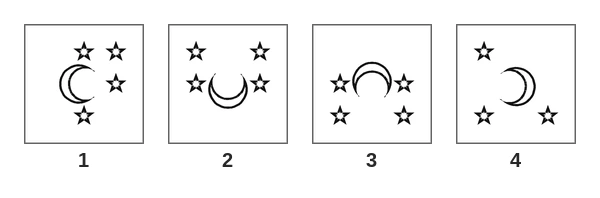
(a) Figure 1 (b) Figure 2 (c) Figure 3 (d) Figure 4
Answer. The moons face different ways and the stars are scattered, so nothing looks alike at first. Count instead. Every figure has exactly one moon. Now count the stars, going clockwise from the top-left corner: Figure 1 has 4, Figure 2 has 4, Figure 3 has 4 and Figure 4 has 3. The stars are the only thing whose number changes. So the answer is (d) Figure 4.
Question 6
Three of the following four figures are alike in a certain way and thus form a group. Which is the one that does NOT belong to that group?
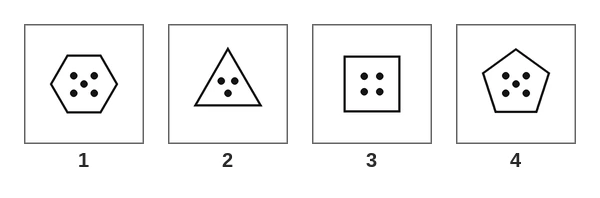
(a) Figure 1 (b) Figure 2 (c) Figure 3 (d) Figure 4
Answer. The outer shapes are all different, and the numbers of dots are 5, 3, 4 and 5. Neither gives a group of three by itself. So compare the two counts inside each figure. Figure 2 is a triangle, 3 sides, with 3 dots. Figure 3 is a square, 4 sides, with 4 dots. Figure 4 is a pentagon, 5 sides, with 5 dots. Figure 1 is a hexagon, 6 sides, but it has only 5 dots. So the answer is (a) Figure 1.
Question 7
Three of the following four figures are alike in a certain way and thus form a group. Which is the one that does NOT belong to that group?
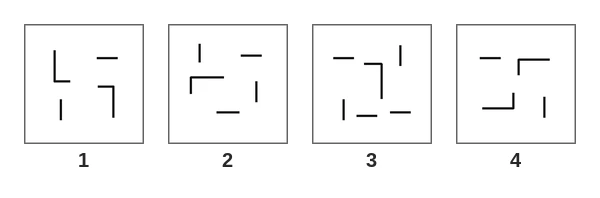
(a) Figure 1 (b) Figure 2 (c) Figure 3 (d) Figure 4
Answer. Every figure is made of straight strokes, some joined into L shapes. Counting parts gives 4, 5, 6 and 4, which is no group. So count straight lines, taking every L as two. Figure 1 has two Ls and two single lines: 4 + 2 = 6. Figure 2 has one L and four single lines: 2 + 4 = 6. Figure 4 has two Ls and two single lines: 4 + 2 = 6. Figure 3 has one L and five single lines: 2 + 5 = 7. So the answer is (c) Figure 3.
Direction: What Points Where
Some figures have a part that points: an arrow, the cloth of a flag, the short stroke of an L, the open side of a moon. Then the property is often about what that part points at.
Pointing at a part
Find the pointer in each figure and follow it with your eye. Ask what it points at: the black star, the dot, or nothing at all. Three figures agree. In the fourth the pointer faces away from that part, or at a different part.
Don't worry about which way the pointer faces in the box. It can face up in one figure and left in another. What matters is what it faces.
For example: in four figures a flag and a black star sit in different places. In three of them the cloth points at the star. In the fourth the cloth points right, but the star is on the left, behind the pole. That fourth figure is the answer.
Two pointers in one figure
With two flags or two moons in each figure, compare them with each other. Check whether the two flags point the same way, or whether the two moons open towards each other. Again three figures agree and one does not.
Clockwise order
When the figures look like turns of one figure and every part is a star, a moon or a semicircle, test the order. Start at one named part and go clockwise round the box, saying the parts in order. A turn carries every part round together, so it never changes the order. A mirror reverses it.
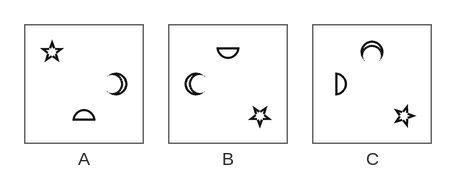
In A, start at the star and go clockwise: you meet the moon and then the semicircle. B is A turned halfway round, and from the star the order is still moon, then semicircle. C is a mirror image of A, turned a quarter: from the star you meet the semicircle first. So A and B go together, and C is the odd one.
Before you trust the order, make sure the figures really are turns. Every part must turn with the rest, including the way each moon or semicircle faces. If some parts stay as they were, the figures are not turns, and the order tells you nothing.
Solved Questions: Direction
Question 8
Three of the following four figures are alike in a certain way and thus form a group. Which is the one that does NOT belong to that group?
(a) Figure 1 (b) Figure 2 (c) Figure 3 (d) Figure 4
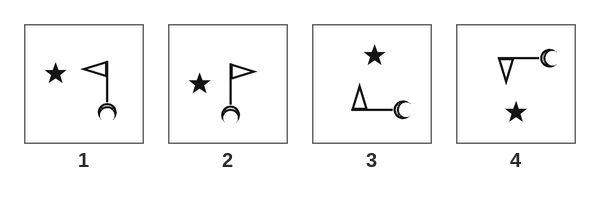
Answer. Each figure has a flag, a black star and a moon. First try the turn test on the flags. Stand each flag upright with its cloth at the top: the cloths in Figures 2 and 3 then point right, and those in Figures 1 and 4 point left. That splits the figures two and two, so turning cannot pick out one figure here. Look instead at what each flag points at. In Figure 1 the cloth points left, and the black star is on the left. In Figure 3 the flag lies on its side with the cloth pointing up, and the star is above it. In Figure 4 the cloth points down, and the star is below. In Figure 2 the cloth points right, but the star is on the left, behind the pole. So the answer is (b) Figure 2.
Question 9
Three of the following four figures are alike in a certain way and thus form a group. Which is the one that does NOT belong to that group?
(a) Figure 1 (b) Figure 2 (c) Figure 3 (d) Figure 4
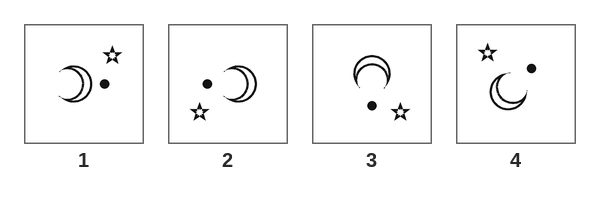
Answer. Every figure has a moon, a black dot and a small white star. A moon is open on one side, so ask where the open side faces. In Figure 2 it faces left, and the dot is on the left, right in front of it. In Figure 3 it faces down, towards the dot below. In Figure 4 it faces up and to the right, towards the dot there. In Figure 1 the moon also faces left, but the dot is on its right, behind its back. The star moves about in every figure and does not help. So the answer is (a) Figure 1.
Question 10
Three of the following four figures are alike in a certain way and thus form a group. Which is the one that does NOT belong to that group?
(a) Figure 1 (b) Figure 2 (c) Figure 3 (d) Figure 4
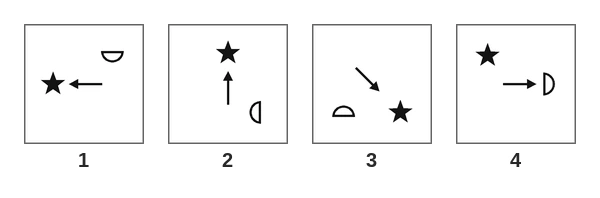
Answer. Each figure has an arrow, a black star and a white semicircle. Follow the arrow in each figure and see what it points at. In Figure 1 it points left, straight at the black star. In Figure 2 it points up at the black star. In Figure 3 it points down and to the right, at the black star in the corner. In Figure 4 it points right, at the white semicircle, while the black star sits away in the top-left corner. So the answer is (d) Figure 4.
Fills, and Shapes Inside Shapes
Shading is easy to see, and the property is often hidden in it. Here are the ways it usually shows up.
Counting shaded parts
Count the black parts in each figure, then the grey parts, then the white ones. Often one of these counts gives three figures alike and one different, and the others give nothing.
When the black count picks out a figure, the white count usually picks out the same figure, because every figure has the same number of parts. That is the same fact seen the other way round, not a second answer. But if one count picks out one figure and another count picks out a different figure, neither is the property. Keep looking.
Two more properties of the same kind: in three figures exactly half the parts are shaded, or every star is shaded while the fourth figure has one white star.
Which part is shaded
Find the part that carries the black, and check whether it is always the biggest part, or always the inner shape. Look at its size and its place, not only at its shape.
Inner and outer shapes
When a small shape sits inside a larger one, describe each pair in a few words. A small table does it neatly:
| Figure | Inner shape | Outer shape |
|---|---|---|
| 1 | black star | white circle |
| 2 | black square | white star |
| 3 | white dot | black square |
| 4 | black semicircle | white square |
Read down the table and the odd one jumps out. Three figures are black inside and white outside, and Figure 3 is the other way round.
Other properties of inner and outer shapes: the small shape faces the same way as the big one, or the small shape sits inside the big one in three figures and beside it in the fourth.
[SSC Tip] Say each pair aloud in a few words, like "black in, white out". It is quicker than comparing the pictures again and again.
Solved Questions: Fills and Inner Shapes
Question 11
Three of the following four figures are alike in a certain way and thus form a group. Which is the one that does NOT belong to that group?
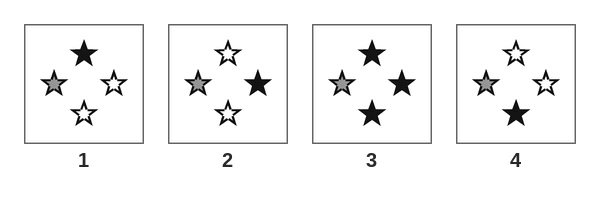
(a) Figure 1 (b) Figure 2 (c) Figure 3 (d) Figure 4
Answer. Each figure is the same cross of four big stars, and the left star is grey in all four, so the grey gives no group. Count the black stars. Figure 1 has 1, at the top. Figure 2 has 1, on the right. Figure 4 has 1, at the bottom. Figure 3 has 3. It is also the only figure with no white star, but that is the same fact seen the other way round. So the answer is (c) Figure 3.
Question 12
Three of the following four figures are alike in a certain way and thus form a group. Which is the one that does NOT belong to that group?
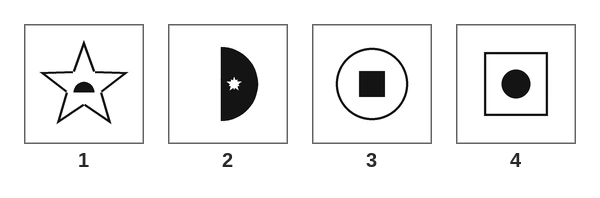
(a) Figure 1 (b) Figure 2 (c) Figure 3 (d) Figure 4
Answer. Each figure is a small shape inside a large one, and the shapes change every time. So look at the colours of each pair. In Figure 1 a black semicircle sits inside a white star. In Figure 3 a black square sits inside a white circle. In Figure 4 a black circle sits inside a white square. The pattern is black inside, white outside. Figure 2 has it the other way round, a white star inside a black semicircle. So the answer is (b) Figure 2.
Question 13
Three of the following four figures are alike in a certain way and thus form a group. Which is the one that does NOT belong to that group?
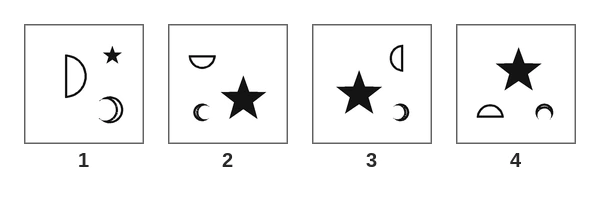
(a) Figure 1 (b) Figure 2 (c) Figure 3 (d) Figure 4
Answer. Every figure has one star, one moon and one semicircle, and in every figure the star is the black part. So the shapes and the colours are the same in all four. Look at the sizes instead. In Figures 2, 3 and 4 the black star is the biggest part. In Figure 1 the black star is the smallest part, and the biggest is the white semicircle. So the answer is (a) Figure 1.
Making Sure Only One Figure Stands Out
Finding a property that picks out one figure is only half the job. Before you mark the answer, make sure it is safe.
Check that it splits three and one
Write the result for all four figures, such as "stars: 4, 4, 4, 3". If it reads 4, 4, 3, 3, it is not your property, however neat it looks.
Check the other simple properties
Run through the short list once more: the number of parts, the kinds of shape, the fills, the directions, and whether the figures are turns of one another. Each of these should either give nothing, that is two and two or all different, or point at the same figure. If two properties point at two different figures, you have not found the real property yet, so look again. In a well-made question only one figure stands out.
Shapes that are all different
If each figure is built on a different shape, say a triangle, a square, a pentagon and a hexagon, then "only Figure 4 is a hexagon" is no reason at all. Each figure is the only one of its shape. The property must be something that three figures share.
When everything matches
If the parts, the counts and the fills are the same in all four figures, the difference is nearly always in how the figures are turned. Go straight to the flag, L or hook test, or to the clockwise order.
Time check: these checks take five or six seconds once you are used to them, and they keep you inside the 30–40 seconds a classification question should take. A wrong answer costs 0.5 marks, so the few seconds are well spent.
Solved Questions: Checking the Answer
Question 14
Three of the following four figures are alike in a certain way and thus form a group. Which is the one that does NOT belong to that group?
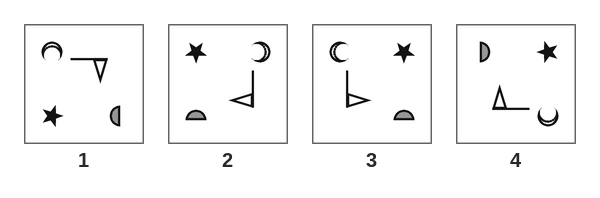
(a) Figure 1 (b) Figure 2 (c) Figure 3 (d) Figure 4
Answer. Run the quick checks first. Every figure has a flag, a grey semicircle, a black star and a moon, so the counts are the same. Every figure has one black part and one grey part, so the fills are the same too. The figures must differ in the way they are turned. Turn each figure until the flag stands upright with its cloth at the top. In Figures 1, 2 and 4 the cloth then points right. In Figure 3 it points left. To be sure, check the order as well. Going clockwise from the grey semicircle, Figures 1, 2 and 4 meet the black star and then the moon, while Figure 3 meets the moon first. So the answer is (c) Figure 3.
Question 15
Three of the following four figures are alike in a certain way and thus form a group. Which is the one that does NOT belong to that group?
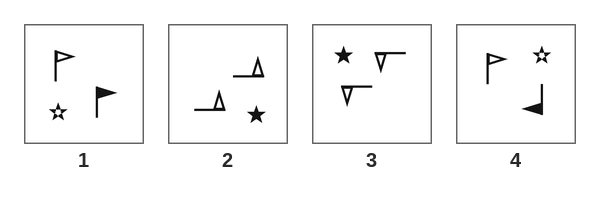
(a) Figure 1 (b) Figure 2 (c) Figure 3 (d) Figure 4
Answer. Each figure has two flags and one star. The star is white in Figures 1 and 4 and black in Figures 2 and 3, and only Figures 1 and 4 have a black flag, so the fills split two and two. Look at the directions instead. In Figure 1 both cloths point right. In Figure 2 both flags lie on their sides with their cloths pointing up. In Figure 3 both cloths point down. In Figure 4 the top flag points right but the black flag points left. So the answer is (d) Figure 4.
Question 16
Three of the following four figures are alike in a certain way and thus form a group. Which is the one that does NOT belong to that group?
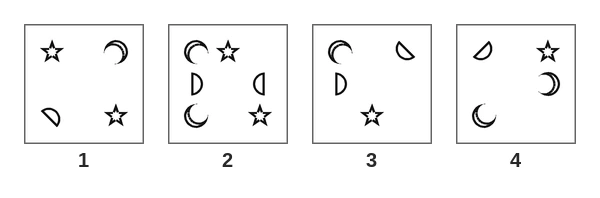
(a) Figure 1 (b) Figure 2 (c) Figure 3 (d) Figure 4
Answer. Every part is a star, a moon or a semicircle. Count the stars first: 2, 2, 1 and 1. That splits the figures two and two, so it is no group. Count the moons: 1, 2, 1 and 2. Two and two again. Count the semicircles: 1, 2, 2 and 1. Still two and two. No single kind gives a group, so count all the parts together. Figure 1 has 4, Figure 2 has 6, Figure 3 has 4 and Figure 4 has 4. That is three and one at last. So the answer is (b) Figure 2.
Solved Questions: Mixed Practice
Question 17
Three of the following four figures are alike in a certain way and thus form a group. Which is the one that does NOT belong to that group?
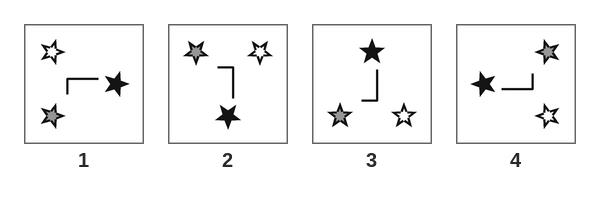
(a) Figure 1 (b) Figure 2 (c) Figure 3 (d) Figure 4
Answer. The four figures have the same parts: an L in the middle and three stars round it, one black, one grey and one white. The counts and the fills match, so test for turns. Use the L first. Stand it upright, long stroke up and short stroke at the bottom. In Figures 1, 2 and 4 the short stroke then goes right, like a printed L. In Figure 3 it goes left. Check with the stars too. Going clockwise from the black star, Figures 1, 2 and 4 meet the grey star next and the white one last, while Figure 3 meets the white star first. So the answer is (c) Figure 3.
Question 18
Three of the following four figures are alike in a certain way and thus form a group. Which is the one that does NOT belong to that group?
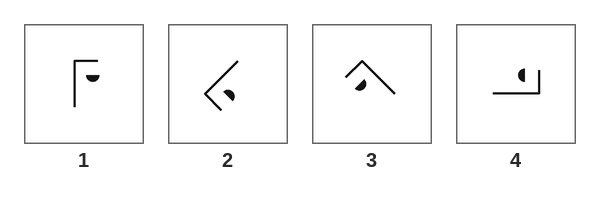
(a) Figure 1 (b) Figure 2 (c) Figure 3 (d) Figure 4
Answer. Each figure is an L with a small black semicircle resting on its short stroke, and in two figures it is turned to a slant. Stand each L upright, long stroke up and short stroke at the bottom. Figure 2 needs a turn of 45° anticlockwise, Figure 3 a turn of 135° anticlockwise and Figure 4 a quarter turn clockwise. In all three the short stroke then goes to the right, with the semicircle on top of it. Figure 1 has its short stroke at the top, so it needs a half turn, and then the short stroke goes to the left. Time check: once the L test is a habit, this takes about 20 seconds. So the answer is (a) Figure 1.