
Figure Series: Places, Turns and Counts
Follow one part at a time. Pick the part that moves most clearly, write its steps in the margin, and only then look at the next part.
The eight places
Most moving parts sit at one of eight places round the box: the four corners and the middles of the four sides. Going clockwise from the top-left corner they are top-left, top-middle, top-right, right-middle, bottom-right, bottom-middle, bottom-left and left-middle.
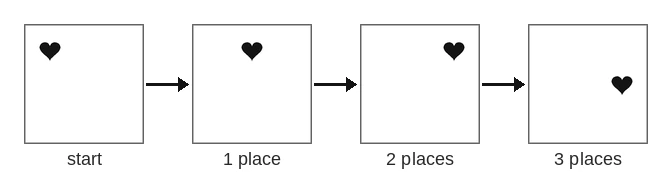
- One place takes a part from a corner to the next middle, or from a middle to the next corner. Eight places make a full round.
- Two places is corner to corner, or middle to middle. Three places jumps past a corner and a middle.
- A part that moves two places each time is back where it started after four steps. One that moves one or three places takes eight steps.
- Anticlockwise is the same eight places counted the other way.
Turns
A part that points somewhere, like the point of a heart or the right-angle corner of a triangle, can also turn. Turning clockwise, 45° takes a point from up to up-right, 90° from up to right, and 135° from up to down-right. Compare two neighbouring figures and name both the size and the way, such as "90° anticlockwise".
Some shapes hide part of a turn. A rectangle looks the same after a half turn and a diamond after a quarter turn, so a bar turning 45° each time looks the same in every fourth figure.
Counts
When the number of parts changes, count every figure: 1, 2, 3, 4 means the next has 5. Then check where the new part comes in, usually at the next place clockwise or anticlockwise.
Two-part rules
With two moving parts, use every problem figure you are given. Follow each part on its own, then pick the figure that has both. One part usually strikes out two options and the other part settles it. A part that goes black, white, black, white follows an alternating rule, and in the fifth figure that part must match the first and the third.
The wrong options are near misses: one place too far or too short, a turn the wrong way, the last problem figure copied. If your answer matches one of these, check it again.
Time check: a figure series takes 30–45 seconds.
Analogy and Classification: What to Test
Analogy: say the change first
Before you look at the third figure, say in one sentence how the first figure became the second. These are the changes to try:
- A turn of 45°, 90°, 135° or 180°, clockwise or anticlockwise. Every part moves round the centre together.
- A mirror image: left and right swap, or top and bottom swap.
- Black and white swap: every black part turns white and every white part turns black.
- Inner and outer swap: the outline shape and the small shape inside it change places.
- A part added or taken away, or two parts that change places.
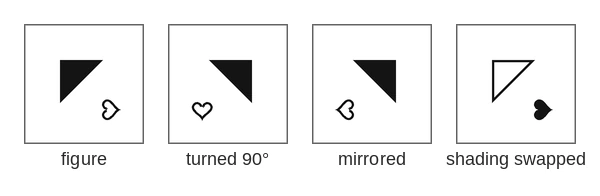
The picture shows one figure and three of these changes: a quarter turn clockwise, a left-right mirror image, and black and white swapped. Look at the second and third figures. The triangle is the same in both, and only the small heart tells them apart: turned, it points down, and mirrored, it points left.
To tell a turn from a mirror image, go round the figure clockwise: a turn keeps the order of the parts and a mirror reverses it. With only one or two parts, watch a part that points: in a turn it turns by the same amount as the whole figure.
Then apply the change to every part of the third figure, not just the big one. The wrong options are the same change done the other way, a mirror where a turn was needed, or one part left as it was.
Classification: one property at a time
Three figures share one property and the fourth lacks it. Test one property at a time on all four figures:
- the number of parts of each kind, such as arcs, hearts or sides,
- the shading of each part,
- direction, such as whether a point faces the black part or away from it,
- turned copy or mirror image.
Stop when a property splits off exactly one figure, and check that no other property splits off a different one. For turn or mirror, take one figure as the master and turn each of the others in your head until it matches. The one that will not match without a flip is the odd one.
Time check: a figure analogy takes 30–40 seconds, and a figure classification 30–40 seconds.
Mirror and Water Images of Figures
Which way things swap
- Mirror on the right or left (MN upright): left and right swap, and top and bottom stay as they are. A part at the top-left goes to the top-right, and a heart pointing up to the right now points up to the left.
- Mirror below or above (MN flat), and water: top and bottom swap, and left and right stay. A water image is the same as the image in a flat mirror below.
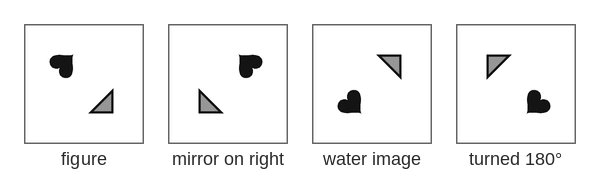
In the picture, the figure has a black heart at the top-left and a grey triangle at the bottom-right. The mirror image keeps both at the same height and swaps their sides. The water image keeps their sides and swaps top and bottom. The last figure is the first one turned 180°, which swaps both at once. That is a different figure from both images here, and a half turn often sits among the options as a trap.
The wrong options you will meet
- the other flip, top to bottom instead of left to right or the other way round,
- the figure turned 180°,
- the figure unchanged,
- the true image with one part not flipped, such as a heart that has moved across but still points the old way.
The two-part check
Pick one part that sits off-centre and one part that points. For the first, check its new place. For the second, check its new direction. Usually only one option gets both right. A part that looks the same after the swap, such as a plain upright bar in the middle of the left side seen in water, stays just as it was, so it cannot help you choose.
Time check: a mirror image of a figure takes 20–30 seconds, and a water image 20–30 seconds.
[SSC Tip] Do not turn the page or your head. Say the swap to yourself, "left goes right, up stays up", and check the parts one by one.
Combinations in a Mirror and in Water
The two rules
- Mirror on the right or left: the order reverses and every character is flipped left to right. The last character comes first, written backwards.
- Water, or a mirror below: the order stays the same and every character is flipped top to bottom.
Characters that look the same
| In a mirror on the right or left | In water or a mirror below |
|---|---|
| A, H, I, M, O, T, U, V, W, X, Y, 0, 8 | B, C, D, E, H, I, K, O, X, 0, 3, 8 |
H, I, O, X, 0 and 8 look the same both ways. In print, B, K, X, 3 and 8 are only nearly the same top to bottom: the top loop of a B, a 3 or an 8 is a little smaller than the bottom one. None of the questions here turns on that small difference.
These characters cannot tell the options apart. Pick a character that does change, such as F, J, L, P, R, 2, 4 or 7, and check that one first.
Look-alike letters
- N, S and Z look the same after a half turn, so the mirror image and the water image of each are alike: a backward N, S or Z. They cannot tell you which flip was used.
- In water, M looks like W and W looks like M, and P looks like a small b. Read the flipped shape, not the letter it reminds you of.
- Reversed but not flipped. One option may give the characters in the reverse order but each one written normally. In a mirror every character turns backwards as well, so this option is wrong.
- One character missed. Another near miss flips every character except one or two. Check every character, and the two ends most of all.
Time check: a mirror image of a combination takes 15–25 seconds, and a water image 20–30 seconds.