
Agriculture
Agriculture carried 5 marks in the 2026-27 sample paper, where it set the Geography 5-marker (tea or coffee; rice or wheat), and 3 marks in each 2026 board paper. It also brings MCQs that name a crop from clues or match slash and burn farming with states, a 2- or 3-marker on types of farming, and a leading crop state on the map (jute in 2025, tea in May 2026).
Marks are most often lost on mixing up the rabi, kharif and zaid crops, on giving the wrong rainfall or temperature for a crop, on calling a crop commercial or subsistence without saying where, and on marking a crop state in the wrong place.
Revise in 5 Minutes
Types of farming
| Type | Remember |
|---|---|
| Primitive subsistence (slash and burn) | small forest patches; hoe, dao, digging sticks; family labour; depends on monsoon and natural fertility; patch left when fertility falls |
| Intensive subsistence | small plots in crowded areas; high doses of biochemical inputs and irrigation; a lot of labour |
| Commercial | HYV seeds, chemical fertilisers, insecticides, pesticides; rice is commercial in Punjab and Haryana, subsistence in Odisha |
| Plantation (a kind of commercial farming) | one crop on a large area; capital and migrant labour; produce goes to industry; tea (Assam, north Bengal), coffee (Karnataka), rubber, sugarcane, banana |
Slash and burn names: jhumming (Assam, Meghalaya, Mizoram, Nagaland), Pamlou (Manipur), Dipa (Bastar), Bewar/Dahiya (MP), Podu/Penda (Andhra Pradesh), Pama Dabi/Koman/Bringa (Odisha), Kuruwa (Jharkhand), Kumari (Western Ghats), Valre/Waltre (south-east Rajasthan), Khil (Himalayan belt).
Seasons: rabi, sown October-December, harvested April-June (wheat, barley, peas, gram, mustard; winter rain from western temperate cyclones helps). Kharif, sown with the monsoon, harvested September-October (paddy, maize, jowar, bajra, tur, moong, urad, cotton, jute, groundnut, soyabean). Zaid, the short summer gap (watermelon, muskmelon, cucumber, vegetables, fodder). Assam, West Bengal and Odisha grow three paddy crops: aus, aman, boro.
Numbers to know: rice above 25°C and over 100 cm (plains of the north and north-east, coastal areas, deltas); wheat 50-75 cm; maize and sugarcane 21°C to 27°C (sugarcane 75-100 cm); rubber over 200 cm and above 25°C; cotton 210 frost-free days, 6-8 months.
Leading states: sugarcane - Uttar Pradesh; tea - Assam; coffee - Karnataka; rubber - Kerala; jute - West Bengal; cotton - Gujarat and Maharashtra.
Reforms: land reform (First Five Year Plan), Green and White Revolutions, crop insurance, Grameen banks, KCC, PAIS, minimum support price. Bhoodan-Gramdan: Vinoba Bhave, Pochampally.
Traps
- Sugarcane takes about a year, so it is in no single season.
- Arhar is the pulse that does not fix nitrogen.
- Jowar, not bajra, is the third most important food crop.
- Sesamum is kharif in the north but rabi in the south.
How to use this page: try each question on paper first, then read the answer. The marks against each step show what an examiner looks for. The 1-mark MCQs and Assertion-Reason questions are in the quiz at the end, together with questions that test how well you understand the chapter; every quiz answer comes with its explanation.
Short Answer Questions (2 and 3 Marks)
Question 1 (2 marks)
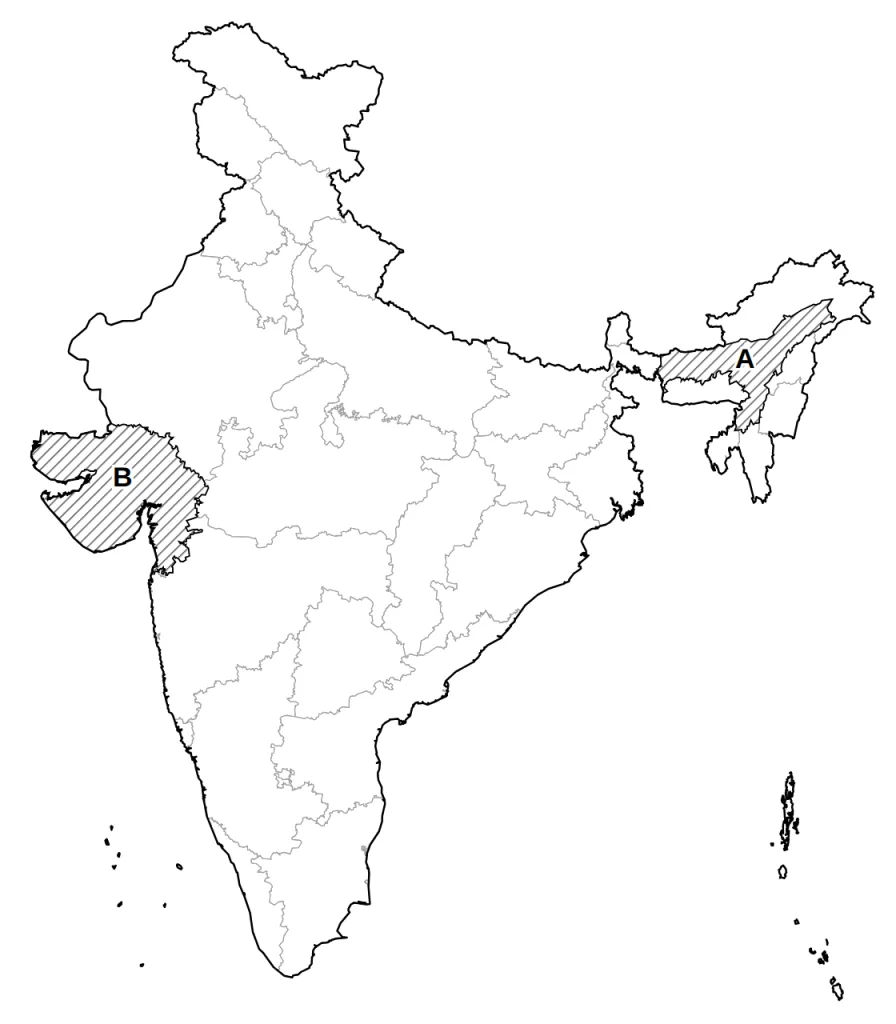
Two states, A and B, are shaded on the outline map of India given below. Identify them with the help of the following information and write their correct names.
A. The state that leads India in tea; many of its tea gardens lie in the Brahmaputra valley.
B. The western state that was the largest producer of groundnut in 2019-20 and is also a major cotton-growing state.
Answer.
Model answer:
A. Assam, in the north-east.
B. Gujarat, on the west coast.
Marking scheme:
- A: Assam — 1 mark
- B: Gujarat — 1 mark
Question 2 (2 marks)
Maize is a kharif crop in most of India, but in some states such as Bihar it is grown in the rabi season as well. State the temperature and soil maize needs, and give one reason why farmers value it.
Answer.
Model answer:
- Maize needs a temperature of 21°C to 27°C and grows well in old alluvial soil.
- Farmers value it because it gives both food for the family and fodder for animals.
Marking scheme:
- Temperature of 21°C to 27°C (0.5) and old alluvial soil (0.5). — 1 mark
- It is used both as food and as fodder for animals. (Also accept: modern inputs such as HYV seeds, fertilisers and irrigation give it high yields.) — 1 mark
Question 3 (3 marks)
Rice is called a commercial crop in Punjab and Haryana, but a subsistence crop in Odisha. Explain why, and state one feature of commercial farming.
Answer.
Model answer:
- In Punjab and Haryana rice is grown mainly for sale, so it is a commercial crop there.
- In Odisha most of the rice is eaten by the farmer's family, so it is a subsistence crop. How commercial a crop is varies by region.
- Commercial farming uses modern inputs such as HYV seeds, chemical fertilisers and pesticides.
Marking scheme:
- In Punjab and Haryana rice is grown mainly for sale in the market, not for the farmer's own family. — 1 mark
- In Odisha most of the rice is eaten by the farmer's own family, so it is a subsistence crop there; the degree of commercialisation of a crop varies from region to region. — 1 mark
- Feature: heavy use of modern inputs such as HYV seeds, chemical fertilisers, insecticides and pesticides to get high yields. (Also accept: large farms, use of machines, surplus sold in the market.) — 1 mark
Question 4 (3 marks)
Study the table about three farms (the cases are imaginary).
| Farm | What happens on the farm |
|---|---|
| P | A family clears a patch of forest on a hill slope in Nagaland, sows seeds with a digging stick and moves to a new patch after a few years. |
| Q | In a crowded district of West Bengal, three brothers now each farm one-third of the plot their father once worked. Each grows crops mainly to feed his own family. |
| R | A company grows only tea on 300 hectares with hired workers and processes the leaves in its own factory on the estate. |
Name the type of farming on each farm and give one feature from the table that shows it.
Answer.
Model answer:
- P: primitive subsistence farming (jhumming). The family clears a patch and moves on when the soil loses fertility.
- Q: intensive subsistence farming. In a crowded area land is split among heirs, so holdings shrink and feed the family.
- R: plantation agriculture. One crop is grown on a large estate with hired workers and processed there.
Marking scheme:
- P: primitive subsistence (slash and burn, jhumming) farming; the patch is cleared, sown with simple tools and left when its fertility falls. — 1 mark
- Q: intensive subsistence farming; in a crowded area the holding is divided among heirs, so plots keep shrinking and are farmed for the family's own needs. — 1 mark
- R: plantation agriculture; a single crop on a large area with hired labour, processed on the estate for industry and the market. — 1 mark
Question 5 (3 marks)
A cooperative wants to know whether a district can support a sugar mill. Describe the geographical conditions sugarcane needs, and name two products other than sugar made from it.
Answer.
Model answer:
- Sugarcane needs a hot and humid climate with a temperature of 21°C to 27°C.
- It needs 75-100 cm of rain a year; where rain is less, it must be irrigated. It grows on many soils but needs a lot of manual labour.
- Besides sugar, it gives gur (jaggery) and khandsari.
Marking scheme:
- It is a tropical and subtropical crop needing a hot and humid climate with a temperature of 21°C to 27°C. — 1 mark
- It needs 75-100 cm of annual rain, with irrigation in areas of less rain; it grows on many kinds of soil but needs manual labour from sowing to harvest. — 1 mark
- Any two products: gur (jaggery), khandsari, molasses. — 1 mark
Question 6 (2 marks)
Cotton needs about 210 frost-free days and takes 6 to 8 months to mature. Explain why it is not grown in the high hills of Himachal Pradesh but does well on the Deccan plateau.
Answer.
Model answer:
- The high hills get frost in winter, so cotton cannot get its long frost-free growing time there.
- The drier black soil areas of the Deccan give high temperature, bright sunshine and light rain or irrigation, which suit cotton.
Marking scheme:
- The high hills have cold winters with frost, so they cannot give cotton a long enough frost-free growing period. — 1 mark
- The drier parts of the Deccan's black soil region have high temperature, bright sunshine and light rain or irrigation, which cotton needs. — 1 mark
Question 7 (2 marks)
Farmers often grow pulses such as moong, urad and masur in rotation with other crops. Give two reasons why.
Answer.
Model answer:
- Pulses are legumes. All of them except arhar fix nitrogen from the air, so the soil becomes fertile again for the next crop.
- They need little moisture, so they can be grown between other crops without much water.
Marking scheme:
- Pulses are leguminous crops; all of them except arhar fix nitrogen from the air and restore the soil's fertility for the next crop. — 1 mark
- They need little moisture and survive even in dry conditions, so they fit easily between other crops without much water. (Also accept: they give an extra crop and income from the same field.) — 1 mark
Question 8 (2 marks)
Name the two important wheat-growing zones of India, and state two climatic conditions wheat needs.
Answer.
Model answer:
- The two zones are the Ganga-Satluj plains in the north-west and the black soil region of the Deccan.
- Wheat needs a cool growing season and bright sunshine when the grain ripens, with 50-75 cm of evenly spread rain.
Marking scheme:
- Zones: the Ganga-Satluj plains in the north-west (0.5) and the black soil region of the Deccan (0.5). — 1 mark
- Any two: a cool growing season; bright sunshine when the grain ripens; 50-75 cm of rain spread evenly over the growing season (0.5 each). — 1 mark
Long Answer and Case-Based Questions
Question 9 (5 marks)
Hari farms 1.2 hectares in coastal Odisha. In the last three years he has faced these problems:
(i) A cyclone destroyed his paddy just before the harvest.
(ii) He borrowed money for seed and fertiliser from a moneylender at a very high rate of interest.
(iii) After a good harvest, traders offered a price that did not even cover his costs.
(iv) His land lies in four small, scattered plots, which wastes his time and water.
(v) He sowed too early because he had no idea when the rains would come.
For each problem, name one technological or institutional reform that would help him, and explain how.
Answer.
Model answer:
- Cyclone loss: crop insurance would pay him for a crop lost to a cyclone, flood, drought, fire or disease.
- Moneylender's debt: a Kisan Credit Card, a Grameen bank or a cooperative bank would lend him money at low interest.
- Low price: the minimum support price, announced by the government, would stop traders and middlemen from exploiting him.
- Scattered plots: consolidation of holdings would join his four plots into one, saving time and water.
- Unknown rains: weather bulletins on radio and TV would tell him when to sow.
Marking scheme:
- (i) Crop insurance: it pays for crops lost to drought, flood, cyclone, fire and disease. — 1 mark
- (ii) Kisan Credit Card, Grameen banks or cooperative societies and banks: they give loans at lower rates of interest. — 1 mark
- (iii) Minimum support price, with remunerative and procurement prices: the government's announced price protects him from speculators and middlemen. — 1 mark
- (iv) Consolidation of holdings (a land reform): scattered plots are brought together into one, so farming is easier and cheaper. — 1 mark
- (v) Weather bulletins and farm programmes on radio and television: they tell him when rain is expected. (Accept any other fair reform for each problem.) — 1 mark
OR
Jowar, bajra and ragi are important millets of India. Describe the conditions each one needs and name the leading states for each. Why is ragi valued in the diet?
Answer.
Model answer:
- Jowar is the third most important food crop by area and production. It is rain-fed, grows in moist areas and hardly needs irrigation.
- Jowar leads in Maharashtra, followed by Karnataka, Andhra Pradesh and Madhya Pradesh.
- Bajra grows well on sandy and shallow black soils. Rajasthan is the largest producer, followed by Uttar Pradesh, Maharashtra and Gujarat.
- Ragi is a crop of dry regions and grows on red, black, sandy and loamy soils. Karnataka is the largest producer, followed by Tamil Nadu.
- Ragi is valued because it is very rich in iron, calcium and roughage.
Marking scheme:
- Jowar: the third most important food crop by area and production; rain-fed, grown mostly in moist areas and hardly needs irrigation. — 1 mark
- Jowar states: Maharashtra (the largest), Karnataka, Andhra Pradesh and Madhya Pradesh. — 1 mark
- Bajra: grows well on sandy soils and shallow black soil; states: Rajasthan (the largest), Uttar Pradesh, Maharashtra, Gujarat and Haryana. — 1 mark
- Ragi: a crop of dry regions that grows on red, black, sandy, loamy and shallow black soils; states: Karnataka (the largest), Tamil Nadu, Himachal Pradesh, Uttarakhand, Sikkim, Jharkhand and Arunachal Pradesh. — 1 mark
- Ragi is very rich in iron, calcium, other micronutrients and roughage, so it is very nutritious. — 1 mark
Question 10 (5 marks)
Explain five features of plantation agriculture in India. Use tea as your example wherever you can.
Answer.
Model answer:
- Single crop, large area: a plantation grows one crop over a big estate, like tea in Assam and north Bengal or coffee in Karnataka.
- Capital and labour: it needs a lot of money and many workers, often migrants. Tea picking needs many hands.
- Link with industry: the whole crop is raw material for an industry. Tea is processed in the garden itself to keep it fresh.
- For the market: the produce is sold, so good roads, railways and communication must link estates, factories and markets.
- Special areas: tea gardens lie in Assam, Darjeeling, Jalpaiguri and the southern hills; many were started by the British and are now owned by Indians.
Marking scheme:
- It is a type of commercial farming in which a single crop is grown on a large area, e.g. tea in Assam and north Bengal, coffee in Karnataka; rubber, sugarcane and banana are other plantation crops. — 1 mark
- It needs heavy capital-intensive inputs and a large number of labourers, often migrant; tea cultivation is labour-intensive. — 1 mark
- It is an interface of agriculture and industry: all the produce is used as raw material in industries; tea is processed within the garden to keep it fresh. — 1 mark
- Production is mainly for the market, so it needs a well-developed network of transport and communication linking the plantations, processing industries and markets. — 1 mark
- Plantations are found in particular areas: tea in Assam, the Darjeeling and Jalpaiguri districts of West Bengal, Tamil Nadu and Kerala; coffee in Karnataka, Kerala and Tamil Nadu. Tea was brought in by the British, and many gardens are now owned by Indians. — 1 mark
OR
An agricultural officer has the following data for three districts. The data are hypothetical.
| District | Land | Annual rainfall | Temperature | Soil |
|---|---|---|---|---|
| X | flat delta plain near the east coast | 190 cm, mostly in the monsoon | 25°C to 32°C, humid | fertile alluvium |
| Y | hill slopes in the north-east | 250 cm, spread through the year | warm, no frost | deep, well-drained, rich in humus |
| Z | slopes of the Western Ghats in Karnataka | 180 cm, mainly in the monsoon months | moderate | well-drained |
Suggest the best crop for each district from rice, tea and coffee, giving reasons. Name the kinds of area in India where the crop you chose for X is mainly grown, and state one difference between the needs of tea and coffee.
Answer.
Model answer:
- X - rice: it is hot and humid with over 100 cm of rain, and the flat alluvial delta can hold water in the fields.
- Rice grows mainly in the plains of the north and north-east, in coastal areas and in deltas.
- Y - tea: it is warm, frost-free and gets showers all through the year, and the soil is deep, well-drained and rich in humus.
- Z - coffee: Arabica coffee suits the moderate temperature and well-drained slopes of the southern hills.
- Tea needs rain spread across the year, but coffee can manage with rain that comes mainly in the monsoon.
Marking scheme:
- X: rice, because it needs a temperature above 25°C, high humidity and more than 100 cm of rain, and the flat alluvial delta can hold water in the fields. — 1 mark
- Rice is grown mainly in the plains of the north and north-east, coastal areas and deltaic regions (and with canals and tubewells in Punjab and Haryana). — 1 mark
- Y: tea, because it needs a warm, moist, frost-free climate with frequent showers spread through the year, and deep, fertile, well-drained soil rich in humus. — 1 mark
- Z: coffee, because Arabica coffee suits the moderate temperatures and well-drained slopes of the southern hills (the Nilgiri region of Karnataka, Kerala and Tamil Nadu). — 1 mark
- Difference: tea needs rain spread through the year, while coffee can do with rain that comes mainly in one season. (Also accept: tea needs more labour; tea is grown in more regions, coffee is confined to the southern hills.) — 1 mark
Question 11 (4 marks)
Read the source given below and answer the questions that follow.
Gifts of Land
In the years after independence, many states were preparing laws to fix a ceiling on how much land one family could hold, yet a large share of village people still owned no land at all. Some landowners expected to lose their surplus land to these laws in any case. It was in this setting that Vinoba Bhave, a Gandhian who travelled through the countryside on foot, tried a different path.
In April 1951, at Pochampally in the Telangana region, landless villagers asked him for land to farm, and a local landowner offered part of his holding on the spot. From that meeting grew Bhoodan, the gift of land. As Vinoba walked on across India, the appeal spread. Some zamindars who owned several villages went further and handed over whole villages to be shared among the landless, a step called Gramdan. Donors acted from conviction, from the appeal to share, or from worry about the ceiling laws. Because land changed hands through persuasion and not force, the movement came to be called a 'bloodless revolution'.
(a) Who led this movement, and in which village did it begin? (1 mark)
Answer.
Model answer:
Vinoba Bhave led it, and it began at Pochampally in Telangana.
Marking scheme:
- Vinoba Bhave (0.5); Pochampally in Telangana (0.5). (Also accept Pochampally in Andhra Pradesh, as older books say.) — 1 mark
(b) According to the source, why did some landowners give away land? (1 mark)
Answer.
Model answer:
Some feared that land ceiling laws would take their extra land anyway.
Marking scheme:
- They feared that land ceiling laws would take away their extra land anyway. (Also accept: out of kindness towards the landless.) — 1 mark
(c) Why was this movement called a 'bloodless revolution'? Give two reasons. (2 marks)
Answer.
Model answer:
- It changed who owned the land: land passed from big owners to landless families, which is a revolution.
- This happened through voluntary gifts, without violence or force, so no blood was shed.
Marking scheme:
- It brought about a big change, the transfer of land from the rich to the landless, which is why it was a 'revolution'. — 1 mark
- The land was given as a voluntary gift through persuasion, without violence, force or a long fight in the courts, so it was 'bloodless'. — 1 mark
Question 12 (4 marks)
Read the source given below and answer the questions that follow.
The Fibre of the Floodplains
Jute, the 'golden fibre', grows tall and green in the low fields of the lower Ganga-Brahmaputra delta during the rainy season. Each year the rivers spread over these low lands and leave behind a fresh layer of silt, so the soil stays fertile without much help from the farmer. The heat of the summer months helps the plants grow quickly.
West Bengal grows the largest share of India's jute, and the crop is also important in Bihar, Assam, Odisha and Meghalaya. The fibre is stripped from the stalks and sent to mills, where it is made into gunny bags, mats, ropes, yarn, carpets and many kinds of craft goods. A farmer who grows jute is therefore supplying raw material to an industry as well as earning a living.
(a) What feature of the delta's soil suits jute? (1 mark)
Answer.
Model answer:
It is fertile flood-plain soil that gets a fresh layer of silt every year.
Marking scheme:
- It is fertile flood-plain soil that is renewed every year by the floods (fresh silt). — 1 mark
(b) Name any two states other than West Bengal where jute is grown. (1 mark)
Answer.
Model answer:
Bihar and Assam.
Marking scheme:
- Any two: Bihar, Assam, Odisha, Meghalaya (0.5 each). — 1 mark
(c) A farmer in the dry, sandy west of Rajasthan wants to grow jute. Give two reasons why he is unlikely to succeed. (2 marks)
Answer.
Model answer:
- Jute needs fertile flood-plain soil that floods renew every year; the dry sandy soil there is never renewed.
- Jute grows in hot, wet lowlands with a lot of water, but western Rajasthan gets very little rain.
Marking scheme:
- Jute needs well-drained, fertile flood-plain soil renewed every year; the dry sandy soil of western Rajasthan is not renewed by floods and is poor for jute. — 1 mark
- Jute grows in hot, wet flood plains with plenty of water; western Rajasthan gets very little rain and has little water for such a crop. — 1 mark