
Forest and Wildlife Resources
Forest and Wildlife Resources carried 4 marks in the 2026-27 sample paper (the Geography source-based question, on community conservation and the Chipko movement), 2 in February 2026 and 1 in May 2026. The rest of the time it gives MCQs: national parks and their states, the Beej Bachao Andolan, an Assertion-Reason on the role of forests, and the forest categories arranged by area. No board paper has set a 5-mark question from it, so this page leans on source-based and case-based questions.
Marks are most often lost by mixing up reserved and protected forests, by placing tiger reserves in the wrong state, by forgetting dates (1972, 1973, 1988), and by writing "the government protects forests" where the question wants a named community effort.
Revise in 5 Minutes
Why forests and biodiversity matter
- Forests are the primary producers; all other living beings depend on them.
- India is one of the richest countries in biodiversity, but its flora and fauna are under great stress, mainly from our insensitivity to the environment.
- Conservation saves our life support systems (water, air, soil) and genetic diversity for breeding; farming uses traditional crop varieties; fisheries depend on aquatic biodiversity.
Government steps
| Year | Step |
|---|---|
| 1972 | Indian Wildlife (Protection) Act: all-India list of protected species, hunting ban, legal protection to habitats, trade restricted |
| 1973 | Project Tiger (tigers: 55,000 around 1900, 1,827 in 1973) |
| 1980, 1986 | Butterflies, moths, beetles and one dragonfly added to the list |
| 1991 | Plants added for the first time (six species) |
- Also: national parks and wildlife sanctuaries; projects for the tiger, one-horned rhino, hangul, three crocodiles, Asiatic lion; legal protection for the Indian elephant, black buck, great Indian bustard, snow leopard.
- Threats to tigers: poaching for skins and bones, shrinking habitat, falling prey base, growing population. India and Nepal hold about two-thirds of the world's tigers.
- Tiger reserves: Corbett (Uttarakhand), Sunderbans (West Bengal), Bandhavgarh (MP), Sariska (Rajasthan), Manas (Assam), Periyar (Kerala).
Forest categories: reserved (over half; most valuable), protected (about one-third), unclassed (government, private and community land). Reserved + protected = permanent forest estates; Madhya Pradesh has the largest area (75% of its forest). Unclassed forests are high in the north-east and parts of Gujarat.
Communities: Sariska villagers fought mining using the Wildlife Protection Act; Bhairodev Dakav 'Sonchuri' (Alwar, 1,200 ha, own rules); Chipko (Himalaya); Beej Bachao Andolan (Tehri) and Navdanya; Joint Forest Management (Odisha, 1988: degraded land, non-timber produce and a timber share); sacred groves; Bishnois.
Traps
- Protected forests are about one-third; reserved forests are over half.
- Bandhavgarh is in MP, not Rajasthan; Periyar is in Kerala.
- JFM works with the forest department; the Sonchuri keeps it out.
How to use this page: try each question on paper first, then read the answer. The marks against each step show what an examiner looks for. The 1-mark MCQs and Assertion-Reason questions are in the quiz at the end, together with questions that test how well you understand the chapter; every quiz answer comes with its explanation.
Short Answer Questions (2 and 3 Marks)
Question 1 (3 marks)
By 1973, tigers in India were close to extinction. Explain two threats that brought them to this state, and why India and Nepal became prime targets for poachers.
Answer.
Model answer:
- Poaching for trade: tiger skins were sold, and the bones were used in traditional medicines, mostly in Asian countries.
- Habitats shrank and the animals tigers eat grew fewer as the human population grew.
- India and Nepal have about two-thirds of the world's tigers, so poachers targeted them.
Marking scheme:
- Poaching for trade: tiger skins were traded and their bones were used in traditional medicines, especially in Asian countries. — 1 mark
- Shrinking habitat and a falling prey base, as the human population grew. (Any two of the threats, ½ + ½ if only named.) — 1 mark
- India and Nepal together provide a home to about two-thirds of the world's surviving tigers, so poachers and illegal traders turned to these two countries. — 1 mark
Question 2 (2 marks)
Why do forests hold a key place in the ecological system? Give two reasons.
Answer.
Model answer:
- Forests are the primary producers; all other living beings depend on them for food.
- They are home to a huge variety of plants and animals that depend on one another.
Marking scheme:
- Forests are the primary producers, on which all other living beings depend. — 1 mark
- They are home to a vast variety of plants and animals, so they hold the biodiversity that keeps the ecosystem going. (Also accept: they protect soil and water.) — 1 mark
Question 3 (3 marks)
How does the conservation of forests and wildlife help people? Explain three ways.
Answer.
Model answer:
- It keeps our life support systems, water, air and soil, in good health.
- It saves the genetic variety of plants and animals, which is needed to breed better crops and animals.
- Farming still uses traditional crop varieties, and fishing depends on the variety of life in water.
Marking scheme:
- It preserves ecological diversity and our life support systems: water, air and soil. — 1 mark
- It preserves the genetic diversity of plants and animals, which is needed for better growth of species and for breeding. — 1 mark
- Our livelihoods depend on it: agriculture still relies on traditional crop varieties, and fisheries depend heavily on aquatic biodiversity. — 1 mark
Question 4 (3 marks)
What lesson do the community efforts at conservation in India teach about managing natural resources? Support your answer with one example.
Answer.
Model answer:
- Local people must be involved in managing forests and must have a real say in decisions.
- Only development that is people-centric, environment-friendly and economically rewarding should be accepted.
- Example: villagers in the Sariska area fought mining in the tiger reserve by citing the Wildlife Protection Act.
Marking scheme:
- Local communities everywhere must be involved in managing natural resources, and must be at the centre of decision-making. — 1 mark
- Only those economic or development activities should be accepted that are people-centric, environment-friendly and economically rewarding. — 1 mark
- Example: the Chipko movement resisted deforestation, or villagers in the Sariska area fought mining, or the villages of the Bhairodev Dakav 'Sonchuri' guard their own forest. (Any one.) — 1 mark
Question 5 (2 marks)
Apart from passing the Indian Wildlife (Protection) Act, what two steps did the central and state governments take to protect wildlife?
Answer.
Model answer:
- They set up national parks and wildlife sanctuaries.
- The Centre started special projects for animals like the tiger, the one-horned rhinoceros and the Asiatic lion.
Marking scheme:
- They set up national parks and wildlife sanctuaries. — 1 mark
- The central government announced projects for specific animals (tiger, one-horned rhinoceros, hangul, three types of crocodiles, Asiatic lion); later, the Indian elephant, black buck, great Indian bustard and snow leopard got full or partial legal protection against hunting and trade. — 1 mark
Question 6 (3 marks)
What is biodiversity? India is among the richest countries in biodiversity, yet its flora and fauna are under great stress. Explain.
Answer.
Model answer:
- Biodiversity is the rich variety of wild and cultivated species, different in form and work but closely linked through their dependence on one another.
- India is one of the richest countries in this, and many species are still to be discovered.
- Yet its plants and animals are under stress, mainly because we are insensitive to our environment.
Marking scheme:
- Biodiversity is the rich variety of wildlife and cultivated species, diverse in form and function but closely linked into one system through many interdependencies. — 1 mark
- India is one of the world's richest countries in biological diversity, possibly with two or three times as many species still to be discovered. — 1 mark
- These resources are under great stress, mainly because of our insensitivity to the environment. — 1 mark
Question 7 (2 marks)
A farmer says, 'You cannot grow enough crops, or make money from them, without chemical fertilisers and pesticides.' How do the Beej Bachao Andolan and Navdanya answer him?
Answer.
Model answer:
- They have shown that a good harvest of many different crops is possible without synthetic chemicals.
- They have shown that such farming also pays, so it is economically viable.
Marking scheme:
- These farmers' and citizens' groups (the Beej Bachao Andolan began in Tehri) have shown that adequate levels of diversified crop production are possible without synthetic chemicals. — 1 mark
- Such farming is also economically viable, so the farmer can earn from it. — 1 mark
Long Answer and Case-Based Questions
Question 8 (4 marks)
Read the source given below and answer the questions that follow.
Two Ways of Saying No
In the Alwar district of Rajasthan, people living in and around forests have found their own ways to guard them.
Near the Sariska Tiger Reserve, mining companies wanted to dig into the hills. The villagers did not simply protest. They went to the law, and pointed out that a national law protecting wildlife and its habitats stood against such mining.
Not far away, the people of five villages chose another path. They marked out 1,200 hectares of forest and named it the Bhairodev Dakav 'Sonchuri'. No official drew up its rules; the villagers wrote their own. Hunting is not allowed there, and the villagers themselves keep outsiders from encroaching on the land. In many such places, villagers have openly said that they do not want the government to run their forest for them.
(a) How is the Bhairodev Dakav 'Sonchuri' different from a forest managed by the government? (1 mark)
Answer.
Model answer:
The villagers declared it, made their own rules, such as no hunting, and guard it themselves without the government.
Marking scheme:
- The villagers declared it themselves, made their own rules (no hunting) and protect it without government involvement. — 1 mark
(b) Which law did the villagers near Sariska cite against mining? (1 mark)
Answer.
Model answer:
The Indian Wildlife (Protection) Act, 1972.
Marking scheme:
- The Wildlife Protection Act (the Indian Wildlife (Protection) Act, 1972). — 1 mark
(c) Suggest two ways in which the government could support village efforts like the Sonchuri without taking control away from the villagers. (2 marks)
Answer.
Model answer:
- Give the village rules legal backing, so that poachers and encroachers can be punished.
- Offer training and funds when the villagers ask, but leave the decisions to them.
Marking scheme:
- Give legal recognition to the village rules, so that outsiders who hunt or encroach can be punished. — 1 mark
- Help with training, funds or support from forest staff when the villagers ask for it, while the village keeps making the decisions. (Accept any sensible way that leaves decisions with the village.) — 1 mark
Question 9 (4 marks)
The bar graph shows how the forest area of three states, P, Q and R, is divided among the three categories of forest (hypothetical data, in per cent of each state's forest area). Bar 1 stands for reserved forests, bar 2 for protected forests and bar 3 for unclassed forests. Study it and answer the questions.
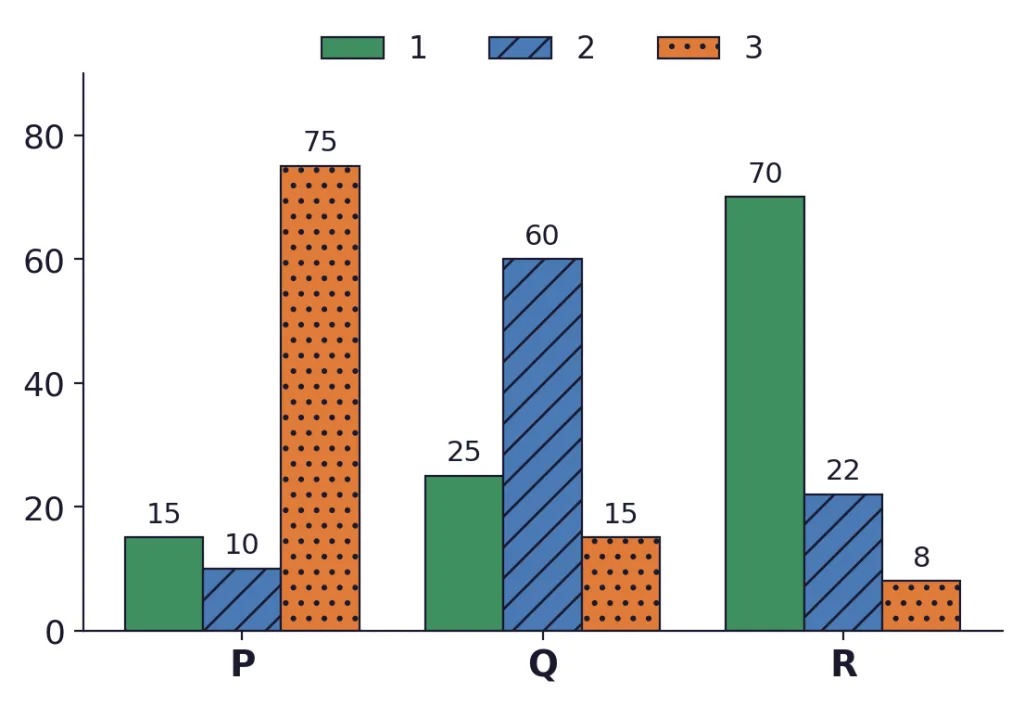
(a) Which state is most likely to be a north-eastern state? Give a reason. (1 mark)
Answer.
Model answer:
P, since 75 per cent of its forest is unclassed, as in the north-eastern states, where local communities manage such forests.
Marking scheme:
- P, because three-quarters of its forest is unclassed; the north-eastern states have a very high share of unclassed forests managed by local communities. — 1 mark
(b) In which state do permanent forest estates make up the largest share of the forest area, and what is that share? (1 mark)
Answer.
Model answer:
R, with 70 + 22 = 92 per cent, since permanent forest estates are the reserved and protected forests together.
Marking scheme:
- R: permanent forest estates are reserved plus protected forests, 70 + 22 = 92 per cent (Q has 85, P only 25). — 1 mark
(c) State Q wants the share of its permanent forest estates to equal that of R. By how many percentage points must this share rise, and from which category of Q's forest could the extra land come? (2 marks)
Answer.
Model answer:
- Q has 25 + 60 = 85 per cent and R has 92 per cent, so the rise needed is 7 percentage points.
- It must come from Q's unclassed forests (15 per cent), by declaring part of them reserved or protected.
Marking scheme:
- Q's permanent forest estates are 25 + 60 = 85 per cent and R's are 92 per cent, so the share must rise by 7 percentage points. — 1 mark
- The land can come only from Q's unclassed forests (15 per cent), which the Forest Department could declare reserved or protected. — 1 mark
Question 10 (5 marks)
A visitor to a forest office remarks, 'The best way to save forests is to keep people out of them.' Do you agree? Support your answer with five points drawn from India's experience.
Answer.
Model answer:
I do not agree. In India, people have often been the forests' best guards.
- Joint Forest Management: village committees guard degraded forests with the Forest Department and get forest produce in return.
- Sariska: villagers used the Wildlife Protection Act to stop mining near the tiger reserve.
- Sonchuri: five villages of Alwar set aside 1,200 hectares, banned hunting and keep outsiders away.
- Beej Bachao Andolan and Navdanya: they showed that farming without synthetic chemicals works, which eases pressure on land and forests.
- Lesson: local people must be at the centre of decisions, with development that is people-centric, environment-friendly and economically rewarding.
Marking scheme:
- Disagree. Joint Forest Management: village institutions, working with the Forest Department, protect degraded forest land and help it recover; members get forest produce in return. — 1 mark
- Sariska: villagers near the tiger reserve fought mining by citing the Wildlife Protection Act. — 1 mark
- Bhairodev Dakav 'Sonchuri': five villages of Alwar declared 1,200 hectares of forest, made their own rules against hunting and keep outsiders away. — 1 mark
- Beej Bachao Andolan (Tehri) and Navdanya showed that diversified crops can be grown without synthetic chemicals, easing pressure on land and forests. (Also accept: the Chipko movement, sacred groves, or Bishnoi villages protecting blackbuck, nilgai and peacocks.) — 1 mark
- Lesson: local communities have to be at the centre of decision-making, and only people-centric, environment-friendly and economically rewarding activities should be accepted. — 1 mark
OR
Describe the three categories into which India's forests are divided, and name where each is found in large proportion.
Answer.
Model answer:
- Reserved forests: more than half of the forest land and the most valuable for conservation.
- Where: a large share in Kerala, Tamil Nadu, Uttarakhand, West Bengal and Maharashtra.
- Protected forests: about one-third of the forest area, declared by the Forest Department and guarded against further loss.
- Where: most of the forest in Punjab, Haryana, Bihar, Odisha and Rajasthan.
- Unclassed forests: other forests and wastelands owned by the government, private people and communities; very high in the north-eastern states and parts of Gujarat.
Marking scheme:
- Reserved forests: more than half of the total forest land, regarded as the most valuable for conserving forests and wildlife. — 1 mark
- Reserved forests form a large share in Jammu and Kashmir, Andhra Pradesh, Uttarakhand, Kerala, Tamil Nadu, West Bengal and Maharashtra (any two). — 1 mark
- Protected forests: almost one-third of the forest area, declared by the Forest Department and protected from any further depletion. — 1 mark
- Protected forests form the bulk in Bihar, Haryana, Punjab, Himachal Pradesh, Odisha and Rajasthan (any two). — 1 mark
- Unclassed forests: other forests and wastelands belonging to the government, private individuals and communities; very high in all the north-eastern states and parts of Gujarat, where local communities manage them. — 1 mark
Question 11 (4 marks)
Read the source given below and answer the questions that follow.
From the Forest Guard's Notebook
March. The sal forest behind the village is in poor shape. Stumps everywhere, few young trees. I patrol alone, and the fellers simply wait until I have passed.
August. The village has formed a forest protection committee under the new scheme with our department. Young men take turns to walk the forest at night. Nobody can cut a tree now without the whole village knowing.
Two years later. Green shoots are coming up from the old stumps. The women collect fallen leaves and wild fruit, as the scheme allows them to take forest produce other than timber. The committee has also been told that when the trees are ready, the village will get a share of the timber from the forest it has protected.
(a) Name the programme described in the source. Which state first passed a resolution for it, and in which year? (1 mark)
Answer.
Model answer:
Joint Forest Management; Odisha passed the first resolution in 1988.
Marking scheme:
- Joint Forest Management; Odisha, 1988 (½ + ½). — 1 mark
(b) On what kind of land does this programme mostly work? (1 mark)
Answer.
Model answer:
Mostly on degraded forest land that the forest department manages.
Marking scheme:
- Mostly on degraded forest land managed by the forest department. — 1 mark
(c) Using the source, explain two reasons why the forest recovered once the villagers took part. (2 marks)
Answer.
Model answer:
- The villagers now gained from the forest: leaves and fruit now, a share of timber later. So protecting it was in their own interest.
- The whole village watched the forest in turns, which one guard alone could never do, so illegal cutting stopped.
Marking scheme:
- The villagers gained from the forest (non-timber forest produce now, a share of timber later), so they had a reason to protect it; their long-term livelihood depended on it. — 1 mark
- A whole village, living beside the forest and patrolling in turns, could watch it far better than a single guard, so illegal felling stopped. — 1 mark