
Minerals and Energy Resources
Minerals and Energy Resources carried 2 marks in the 2026-27 sample paper and May 2026, and 7 in February 2026, when it set the Geography 5-marker (petroleum or coal: importance and distribution). Expect MCQs on how minerals occur, iron ore belts and types, bauxite and mines, often as statements or a scenario, and a power plant on the map (a nuclear plant in 2025 and February 2026).
Marks are most often lost on mixing up the types of coal or iron ore, on placing a mine or oil field in the wrong state, on confusing conventional with non-conventional sources, and on look-alike names on the map (Narora and Namrup, Kakrapara and Kalpakkam, Durg and Durgapur).
Revise in 5 Minutes
How minerals occur: veins and lodes in igneous and metamorphic rocks (tin, copper, zinc, lead); beds in sedimentary rocks (coal, some iron ore) and by evaporation (gypsum, potash, sodium salt); residual weathering (bauxite); placer deposits in valley sands (gold, silver, tin, platinum); ocean waters (salt, magnesium, bromine; manganese nodules on the bed). Rat-hole mining: Jowai and Cherrapunjee, Meghalaya.
| Mineral | Remember |
|---|---|
| Iron ore | magnetite up to 70% iron (finest); hematite 50-60% (most used). Belts: Odisha-Jharkhand (Badampahar, Gua, Noamundi); Durg-Bastar-Chandrapur (Bailadila, exported via Visakhapatnam); Ballari-Chitradurga-Chikkamagaluru-Tumakuru (Kudremukh, was a 100% export unit); Maharashtra-Goa (Marmagao) |
| Manganese | about 10 kg per tonne of steel; bleaching powder, insecticides, paints |
| Copper | Balaghat (MP), Khetri (Rajasthan), Singhbhum (Jharkhand) |
| Bauxite | Amarkantak, Maikal hills, Bilaspur-Katni; Odisha leads (Panchpatmali, Koraput) |
| Mica | Koderma-Gaya-Hazaribagh (Jharkhand), Ajmer, Nellore |
| Limestone | cement; blast furnace |
Coal: peat → lignite (Neyveli, electricity) → bituminous (metallurgical coal) → anthracite. Gondwana (over 200 million years; Damodar valley: Jharia, Raniganj, Bokaro) and tertiary (about 55 million years; north-east).
Oil and gas: anticlines and fault traps in tertiary rocks; Mumbai High, Gujarat (Ankaleshwar), Assam oldest (Digboi, Naharkatia, Moran-Hugrijan). Gas: Krishna-Godavari basin, Mumbai High, Gulf of Cambay, Andaman and Nicobar.
Non-conventional: nuclear (uranium, thorium: Jharkhand, Aravallis; monazite sands of Kerala); solar (photovoltaic); wind (Nagarcoil to Madurai; Jaisalmer); biogas (gobar gas: fuel + manure); tidal (Gulfs of Khambhat and Kachchh, Sundarbans); geothermal (Parvati valley near Manikarn, Puga Valley).
Map: iron ore Mayurbhanj, Durg, Bailadila, Bellary, Kudremukh; coal Raniganj, Bokaro, Talcher, Neyveli; oil Digboi, Naharkatia, Mumbai High, Bassein, Kalol, Ankaleshwar; thermal Namrup, Singrauli, Ramagundam; nuclear Narora, Kakrapara, Tarapur, Kalpakkam.
Traps
- Lignite and anthracite are coal, not iron ore.
- Hydel and thermal electricity are conventional; nuclear is non-conventional.
- Neyveli is lignite (coal), not an oil field.
How to use this page: try each question on paper first, then read the answer. The marks against each step show what an examiner looks for. The 1-mark MCQs and Assertion-Reason questions are in the quiz at the end, together with questions that test how well you understand the chapter; every quiz answer comes with its explanation.
Short Answer Questions (2 and 3 Marks)
Question 1 (3 marks)
On the outline map of India given below, locate and label the following with suitable symbols.
(a) The thermal power plant in Assam that is on your map list.
(b) The nuclear power plant from your map list on the Maharashtra coast, north of Mumbai.
(c) The nuclear power plant from your map list on the Tamil Nadu coast, south of Chennai.
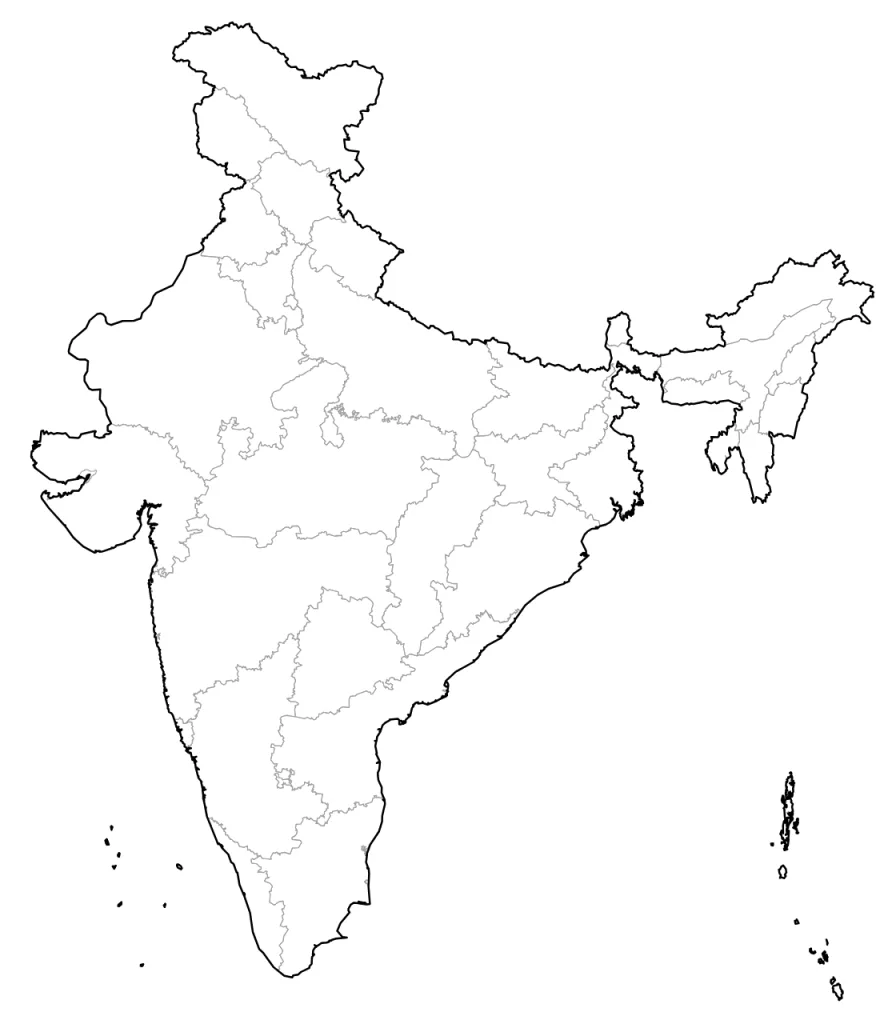
Answer.
Model answer:
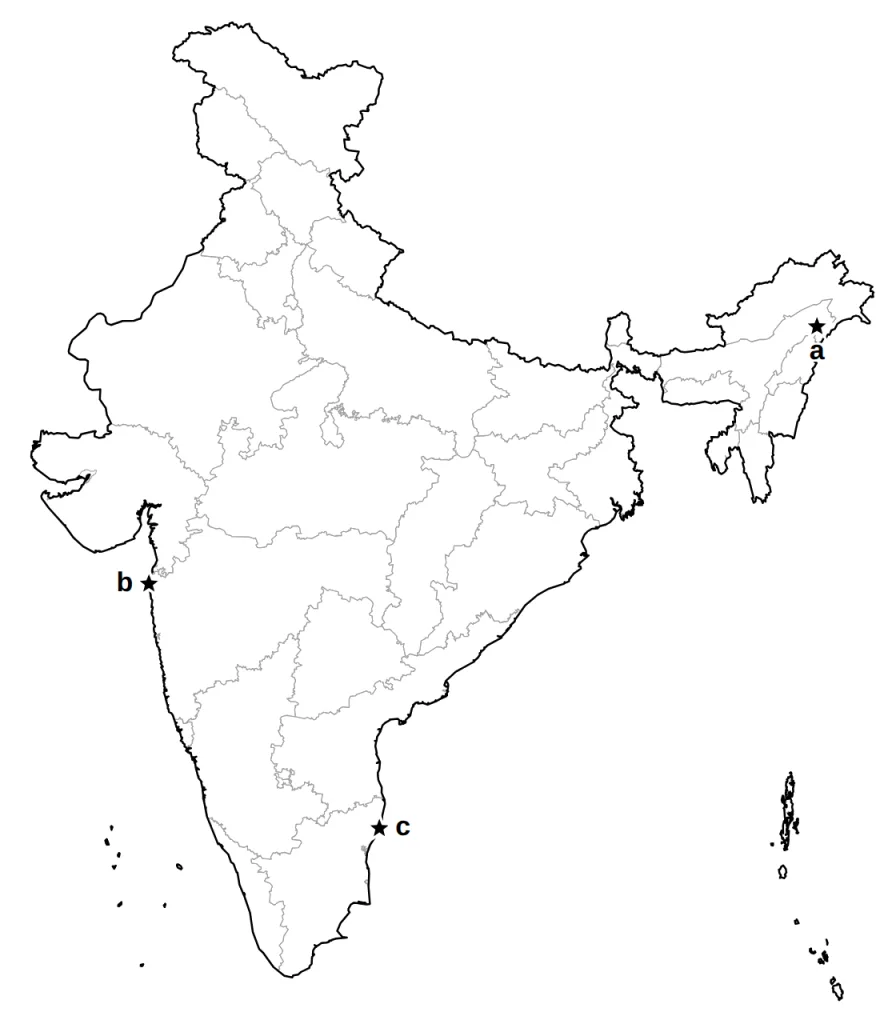
(a) Namrup, in the far east of Assam, south of the Brahmaputra.
(b) Tarapur, on the Maharashtra coast, north of Mumbai.
(c) Kalpakkam, on the Tamil Nadu coast, south of Chennai.
The answer map shows the three plants with stars marked a, b and c.
Marking scheme:
- (a) Namrup, in eastern Assam, correctly located and labelled — 1 mark
- (b) Tarapur, on the Maharashtra coast north of Mumbai, correctly located and labelled — 1 mark
- (c) Kalpakkam, on the coast south of Chennai, correctly located and labelled — 1 mark
Question 2 (2 marks)
Classify the following minerals as ferrous or non-ferrous: iron ore, manganese, copper, bauxite, lead. Manganese is not iron, so why is it grouped with the ferrous minerals?
Answer.
Model answer:
- Ferrous: iron ore and manganese. Non-ferrous: copper, bauxite and lead.
- Manganese is used mainly along with iron, to make steel and ferro-manganese alloy, so it is grouped with iron.
Marking scheme:
- Ferrous: iron ore, manganese. Non-ferrous: copper, bauxite, lead. (All five right: 1 mark; three or four right: 0.5.) — 1 mark
- Manganese is used mainly with iron, in making steel and ferro-manganese alloy (about 10 kg per tonne of steel), so it belongs with the ferrous group of iron and the minerals used with it. — 1 mark
Question 3 (3 marks)
Why is aluminium such a useful metal? How is bauxite formed, and where in India are its deposits found?
Answer.
Model answer:
- Aluminium is strong like iron but very light, conducts well and can be shaped easily.
- Bauxite is a clay-like substance formed when rocks rich in aluminium silicates decompose.
- Its deposits are in the Amarkantak plateau, the Maikal hills and the Bilaspur-Katni plateau; Odisha is the largest producer.
Marking scheme:
- Aluminium combines the strength of metals like iron with extreme lightness, good conductivity and great malleability. — 1 mark
- Bauxite, the ore of aluminium, is a clay-like substance formed by the decomposition of rocks rich in aluminium silicates. — 1 mark
- Deposits: the Amarkantak plateau, the Maikal hills and the plateau region of Bilaspur-Katni; Odisha is the largest producer (Panchpatmali deposits in Koraput). — 1 mark
Question 4 (3 marks)
Describe mica: what it looks like, why it suits the electrical industry, and where it is found in India.
Answer.
Model answer:
- Mica is made of thin plates or leaves and splits easily into thin sheets. It may be clear, black, green, red, yellow or brown.
- It insulates well, loses little power and resists high voltage, so it suits electric and electronic goods.
- The Koderma-Gaya-Hazaribagh belt of Jharkhand leads; mica also comes from around Ajmer and from Nellore.
Marking scheme:
- It is made of a series of plates or leaves and splits easily into thin sheets; it can be clear, black, green, red, yellow or brown. — 1 mark
- Its excellent di-electric strength, low power loss, insulating properties and resistance to high voltage make it one of the most useful minerals in the electric and electronic industries. — 1 mark
- It is found on the northern edge of the Chota Nagpur plateau; the Koderma-Gaya-Hazaribagh belt of Jharkhand leads; also around Ajmer in Rajasthan and the Nellore mica belt of Andhra Pradesh. — 1 mark
Question 5 (2 marks)
In what kind of rocks is limestone found? Give two of its industrial uses.
Answer.
Model answer:
- Limestone is found in sedimentary rocks made of calcium carbonate, or calcium and magnesium carbonates.
- It is the main raw material for cement and is needed to smelt iron ore in the blast furnace.
Marking scheme:
- It is found with rocks made of calcium carbonate or calcium and magnesium carbonates, in sedimentary rocks of most geological formations. — 1 mark
- It is the basic raw material of the cement industry (0.5) and is needed for smelting iron ore in the blast furnace (0.5). — 1 mark
Question 6 (3 marks)
Coal in India occurs in rocks of two main geological ages. Distinguish between Gondwana coal and tertiary coal on three points.
Answer.
Model answer:
- Gondwana coal is a little over 200 million years old; tertiary coal is only about 55 million years old.
- Gondwana coal is mostly metallurgical coal and gives most of India's coal; tertiary coal gives only a little.
- Gondwana coal lies in the Damodar valley (Jharia, Raniganj, Bokaro); tertiary coal lies in Meghalaya and Assam.
Marking scheme:
- Age: Gondwana coal is a little over 200 million years old; tertiary coal is about 55 million years old. — 1 mark
- Quality/use: the major Gondwana resources are metallurgical coal, used for smelting iron; Gondwana coal gives most of India's coal, while tertiary coal gives only a small part. — 1 mark
- Where: Gondwana coal in the Damodar valley (Jharia, Raniganj, Bokaro) and the Godavari, Mahanadi, Son and Wardha valleys; tertiary coal in Meghalaya, Assam, Arunachal Pradesh and Nagaland. — 1 mark
Question 7 (2 marks)
Distinguish between hydroelectricity and thermal electricity on two points.
Answer.
Model answer:
- Hydroelectricity uses fast-flowing water to turn turbines; thermal electricity burns coal, petroleum or natural gas.
- Water is renewable, but thermal plants use non-renewable fossil fuels.
Marking scheme:
- Source: hydroelectricity is made by fast-flowing water turning turbines; thermal electricity is made by burning coal, petroleum or natural gas to drive turbines. — 1 mark
- Renewability: water is a renewable resource, while thermal plants use non-renewable fossil fuels. (Also accept an example of each: Bhakra Nangal or Kopili; Namrup, Singrauli or Ramagundam.) — 1 mark
Question 8 (3 marks)
Solar power plants are now being set up in rural and remote parts of India. Explain three ways in which they help village homes, forests and farming.
Answer.
Model answer:
- Panels turn sunlight into electricity right in the village, so homes far from power lines get light.
- Families burn less firewood, so fewer trees are cut.
- Solar pumps can water the fields without diesel.
Marking scheme:
- Homes: photovoltaic panels change sunlight straight into electricity on the spot, so remote villages get power even where grid lines have not reached. — 1 mark
- Forests: households need less firewood for light and cooking, so fewer trees are cut. — 1 mark
- Farming: solar-powered pumps can lift water for irrigation without diesel or grid power. (Also accept: less dung is burnt, so more manure reaches the fields.) — 1 mark
Question 9 (3 marks)
Name the iron ore belt described in each case, and the port or route by which its ore leaves the country.
(a) A range of hills in the Bastar district holds deposits of super high grade hematite, which is sold to Japan and South Korea.
(b) A mine high in the Western Ghats of Karnataka sold all its output abroad; its ore was mixed with water and pumped down to the coast.
(c) The ores of Goa and the Ratnagiri district are not of very high grade, but they are mined well and sent abroad.
Answer.
Model answer:
(a) The Durg-Bastar-Chandrapur belt; its Bailadila ore goes out through Visakhapatnam.
(b) The Ballari-Chitradurga-Chikkamagaluru-Tumakuru belt; Kudremukh ore was piped as slurry to a port near Mangaluru.
(c) The Maharashtra-Goa belt; its ore is shipped from Marmagao.
Marking scheme:
- (a) Durg-Bastar-Chandrapur belt (Bailadila hills); exported through the Visakhapatnam port. — 1 mark
- (b) Ballari-Chitradurga-Chikkamagaluru-Tumakuru belt (Kudremukh, which was a 100 per cent export unit); its ore went as slurry through a pipeline to a port near Mangaluru. — 1 mark
- (c) Maharashtra-Goa belt; exported through the Marmagao port. — 1 mark
Long Answer and Case-Based Questions
Question 10 (5 marks)
Minerals are found in the Earth's crust in several different forms. Describe any five ways in which minerals occur, with an example of each.
Answer.
Model answer:
- Veins and lodes: in igneous and metamorphic rocks, minerals fill cracks and faults, as tin, copper, zinc and lead do.
- Beds or layers: in sedimentary rocks, minerals build up in horizontal layers, like coal.
- Evaporation: in dry regions, gypsum and salts of potash and sodium are left behind when water evaporates.
- Residual weathering: when surface rocks decompose, a residual mass such as bauxite is left.
- Placer deposits: gold, silver, tin and platinum collect in the sands of valley floors because water does not corrode them.
Marking scheme:
- In igneous and metamorphic rocks, minerals fill cracks, crevices, faults or joints: small ones are veins, large ones are lodes (tin, copper, zinc, lead). — 1 mark
- In sedimentary rocks, minerals occur in beds or layers formed by deposition, accumulation and concentration in horizontal strata (coal, some forms of iron ore). — 1 mark
- Some beds form by evaporation, especially in dry regions (gypsum, potash salt, sodium salt). — 1 mark
- Decomposition of surface rocks and removal of their soluble parts leaves a residual mass containing ores (bauxite). — 1 mark
- Placer deposits in the sands of valley floors and at the base of hills contain minerals not corroded by water (gold, silver, tin, platinum); or ocean waters and beds (common salt, magnesium, bromine; manganese nodules). (Any five.) — 1 mark
OR
A company plans to open an iron ore mine in a forested hill district close to a river. Describe the dangers the mine could bring to its workers and to the surroundings, and suggest how they can be reduced.
Answer.
Model answer:
- Dust and fumes: miners breathe them in and can get lung diseases.
- Accidents: mine roofs may collapse, and mines may flood or catch fire.
- Water: the river and wells nearby can get polluted.
- Land: dumped waste and slurry spoil the land and soil and pollute streams, and forest is lost.
- Safeguards: safety rules and environmental laws must be strictly followed, waste kept away from the river and mined land restored.
Marking scheme:
- Workers breathe dust and harmful fumes, which makes them vulnerable to lung (pulmonary) diseases. — 1 mark
- There is a risk of mine roofs collapsing, flooding (inundation) and fires in the mines. — 1 mark
- The river and other water sources in the region can get contaminated. — 1 mark
- Dumping of waste and slurry degrades the land and soil and adds to stream and river pollution; clearing forest for the mine harms the hills. — 1 mark
- Measures: strict safety rules and environmental laws must be enforced; waste should be kept away from the river, and the mined land restored. (Any other fair measure.) — 1 mark
Question 11 (5 marks)
Explain why India needs to use more non-conventional sources of energy. Then describe how tidal energy and geothermal energy are produced, naming one suitable place in India for each.
Answer.
Model answer:
- Why: India's growing energy use makes it depend more on coal, oil and gas. Their prices keep rising and supply may fall short.
- Burning more fossil fuels also harms the environment, so renewable sources are needed.
- Tidal energy: a dam with floodgates traps sea water at high tide; when the tide falls, the water flows back through a turbine.
- Geothermal energy: deep inside, the Earth is hot; groundwater heated by the rocks rises as steam and turns turbines.
- Places: tidal, the Gulf of Kachchh; geothermal, the Puga Valley in Ladakh.
Marking scheme:
- Growing energy use has made India more and more dependent on fossil fuels such as coal, oil and gas; rising oil and gas prices and possible shortages make the supply of energy uncertain for the economy. — 1 mark
- Burning more fossil fuels causes serious environmental problems, so renewable sources such as solar, wind, tidal, geothermal and biogas are needed. — 1 mark
- Tidal: floodgate dams are built across inlets; at high tide water flows in and is trapped when the gate closes; after the tide falls, the water flows back to the sea through a pipe that runs a turbine. — 1 mark
- Geothermal: the Earth gets hotter with depth; where this rise is steep, groundwater absorbs heat from the rocks and rises as steam, which drives turbines. — 1 mark
- Places: tidal - the Gulf of Khambhat, the Gulf of Kachchh or the Sundarban region of the Ganga delta; geothermal - the Parvati valley near Manikarn (Himachal Pradesh) or the Puga Valley (Ladakh). — 1 mark
OR
A new oil refinery is being planned in India. Explain three ways in which petroleum and its refineries help the country's economy, and describe where India's petroleum is found.
Answer.
Model answer:
- Fuel: after coal it is our main energy source, giving fuel for heat, light and transport.
- Machines and industry: it gives lubricants for machines and raw materials for factories.
- Nodal industry: synthetic textile, fertiliser and chemical industries grow around refineries.
- Where: it is trapped in folds and faults of tertiary rocks; Mumbai High, off the coast, gives the most.
- Gujarat (Ankaleshwar, Kalol) and Assam, the oldest producer (Digboi, Naharkatia), give the rest.
Marking scheme:
- It is the next major energy source after coal and gives fuel for heat and lighting, including for transport. — 1 mark
- It gives lubricants for machinery and raw materials for many manufacturing industries. — 1 mark
- Refineries act as a nodal industry: synthetic textile, fertiliser and many chemical industries grow around them. — 1 mark
- Most petroleum occurs in anticlines and fault traps in rocks of the tertiary age; the largest share comes from Mumbai High offshore (with Bassein). — 1 mark
- Gujarat (Ankaleshwar, the most important field, and Kalol) and Assam, the oldest oil-producing state (Digboi, Naharkatia, Moran-Hugrijan). — 1 mark
Question 12 (4 marks)
Read the source given below and answer the questions that follow.
Narrow Tunnels in the Hills
On the hill slopes around Jowai and Cherrapunjee in Meghalaya, you can still find small dark openings, hardly wider than a person's shoulders. Behind each one, a tunnel runs deep into the hill, following a thin seam of coal. Miners crawled in, chipped out the coal and dragged it back in baskets. Because the holes look like the burrows of rats, the method came to be called 'rat-hole' mining.
It needed almost no machines or money, so a single family could work a tunnel. Families could do this because, in the hill areas of the north-east, minerals are owned by individuals or communities and not by the government. The cost came in other ways. Tunnels caved in or filled with water without warning, and the water that seeped out of old workings spoilt the streams below. The National Green Tribunal banned the practice in 2014.
(a) Who owns the minerals in the hill areas of the north-east? (1 mark)
Answer.
Model answer:
Individuals or communities own them.
Marking scheme:
- Individuals or communities. — 1 mark
(b) Why is this method called 'rat-hole' mining? (1 mark)
Answer.
Model answer:
The coal is taken out through a long, narrow tunnel, like a rat's burrow, that a miner crawls into.
Marking scheme:
- Coal is dug out through a long, narrow tunnel that looks like a rat's burrow and has to be crawled into. — 1 mark
(c) Explain one danger of this method to the miners and one danger to the environment. (2 marks)
Answer.
Model answer:
- The tunnels can cave in or flood suddenly and trap the miners inside.
- Water flowing out of the mines pollutes nearby streams.
Marking scheme:
- Miners: the narrow tunnels can collapse or flood without warning, trapping the people inside. — 1 mark
- Environment: water draining out of the mines pollutes streams, and the dug-up hillsides and waste degrade the land. — 1 mark
Question 13 (4 marks)
Read the source given below and answer the questions that follow.
The Plant Behind the Cowshed
Sunita's family in a village of Haryana keeps four cows. Until a few years ago their dung was patted into cakes, dried on the wall and burnt in the kitchen, and the house was always full of smoke. Now the dung, along with farm waste, goes into a small closed tank behind the cowshed. Inside, it slowly decomposes and gives off a gas that is piped to the stove. The gas burns with a clean flame and gives more heat than kerosene, dung cake or charcoal.
What comes out after the gas is made is a rich manure, which goes straight to the fields. Such 'gobar gas' plants can be run by a single family, by a cooperative or by a municipality. (The family described here is imaginary.)
(a) What goes into the biogas plant described in the source? (1 mark)
Answer.
Model answer:
Cattle dung and farm waste.
Marking scheme:
- Cattle dung and farm waste (also accept shrubs, animal and human waste). — 1 mark
(b) Why is biogas a better kitchen fuel than dung cake? (1 mark)
Answer.
Model answer:
It gives more heat than dung cake and burns cleanly, without filling the house with smoke.
Marking scheme:
- It gives more heat (higher thermal efficiency) than dung cake, kerosene or charcoal, and burns with a clean flame without smoke. — 1 mark
(c) A biogas plant is said to give a farmer 'twin benefits'. Explain the two benefits. (2 marks)
Answer.
Model answer:
- It gives the family a clean fuel that burns well.
- The leftover slurry is good manure, so the dung that was once burnt now makes the fields richer.
Marking scheme:
- Energy: it gives a clean, efficient fuel for cooking (and lighting). — 1 mark
- Manure: the dung is not burnt as cakes, and the slurry left after the gas is made is better manure, so more and better manure reaches the fields. — 1 mark