
Manufacturing Industries
Manufacturing Industries carried 4 marks in the 2026-27 sample paper, 1 in February 2026 and 6 in May 2026, when it set the Geography 5-marker (why manufacturing matters, or how agriculture and industry are linked). The sample paper had a reasoning MCQ on weaving and an Assertion-Reason on Bengaluru's IT industry, and every recent paper had a steel plant, cotton textile centre or software technology park on the map.
Marks are most often lost on mixing up the ways industries are classified, on giving the wrong raw materials or locating factors for an industry, on pollution answers that name a problem without a control measure, and on map places with look-alike names (Durg and Durgapur, Salal and Salem).
Revise in 5 Minutes
Why manufacturing matters: share in GDP only about 17% (NMCC set up to raise productivity); modernises agriculture; gives jobs outside farming; helps remove unemployment and poverty; reduces regional disparities (industries in tribal and backward areas); exports bring foreign exchange. Agriculture and industry move hand in hand.
Location: raw material, labour, capital, power, market. Urbanisation follows industry; agglomeration economies in big cities. Before 1947: port cities (Mumbai, Kolkata, Chennai).
| Basis | Classes (examples) |
|---|---|
| Raw material | agro-based (textiles, sugar, edible oil); mineral-based (iron and steel, cement, aluminium) |
| Main role | basic or key (iron and steel, copper and aluminium smelting); consumer (sugar, toothpaste, fans) |
| Capital | small-scale (investment within ₹1 crore); large-scale |
| Ownership | public (BHEL, SAIL); private (TISCO, Bajaj Auto, Dabur); joint (Oil India Ltd); cooperative (sugar in Maharashtra, coir in Kerala) |
| Bulk | heavy (iron and steel); light (electrical goods) |
Industries at a glance
- Cotton: first mill Mumbai 1854; early in Maharashtra-Gujarat; spinning centralised, weaving decentralised; problems: erratic power, old machines, low labour output, synthetic fibres.
- Jute: Rishra 1855; Hugli belt; National Jute Policy 2005; mandatory jute packaging.
- Sugar: seasonal, so suits cooperatives; second in sugar, first in gur and khandsari.
- Iron and steel: iron ore, coking coal, limestone about 4 : 2 : 1; manganese hardens steel; integrated plants (all stages at one site) vs mini plants (electric furnaces, scrap, sponge iron); Chotanagpur plateau; problems: costly coking coal, low labour productivity, irregular energy, poor infrastructure.
- Aluminium: electricity + cheap bauxite. Chemicals: inorganic spread out; organic near refineries. Fertilisers: potash fully imported. Cement: limestone, silica, gypsum; Chennai 1904; Gujarat for Gulf markets; decontrol 1989. IT: Bengaluru; STPs; BPO.
Pollution: air, water (incl. thermal), land, noise. Control: reuse and recycle water, rainwater harvesting, treat effluents (primary, secondary, tertiary), precipitators and filters, silencers.
Traps
- Iron and steel is both basic (role) and heavy (bulk).
- Oil India Ltd is joint sector, not public.
- Durgapur (steel, West Bengal) is not Durg (iron ore, Chhattisgarh).
How to use this page: try each question on paper first, then read the answer. The marks against each step show what an examiner looks for. The 1-mark MCQs and Assertion-Reason questions are in the quiz at the end, together with questions that test how well you understand the chapter; every quiz answer comes with its explanation.
Short Answer Questions (2 and 3 Marks)
Question 1 (3 marks)
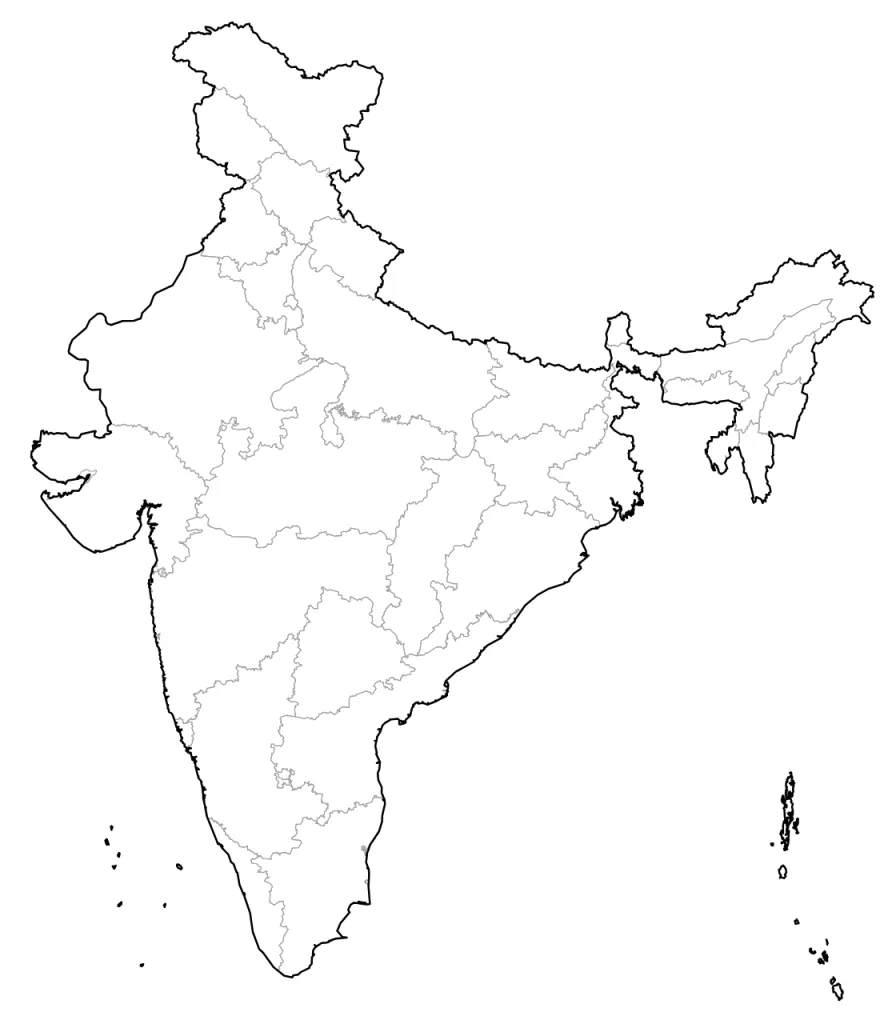
On the outline map of India given below, locate and label the following with suitable symbols.
(a) The iron and steel plant of West Bengal on your map list.
(b) The cotton textile centre of Madhya Pradesh from your map list.
(c) The software technology park of Gujarat from your map list.
Answer.
Model answer:
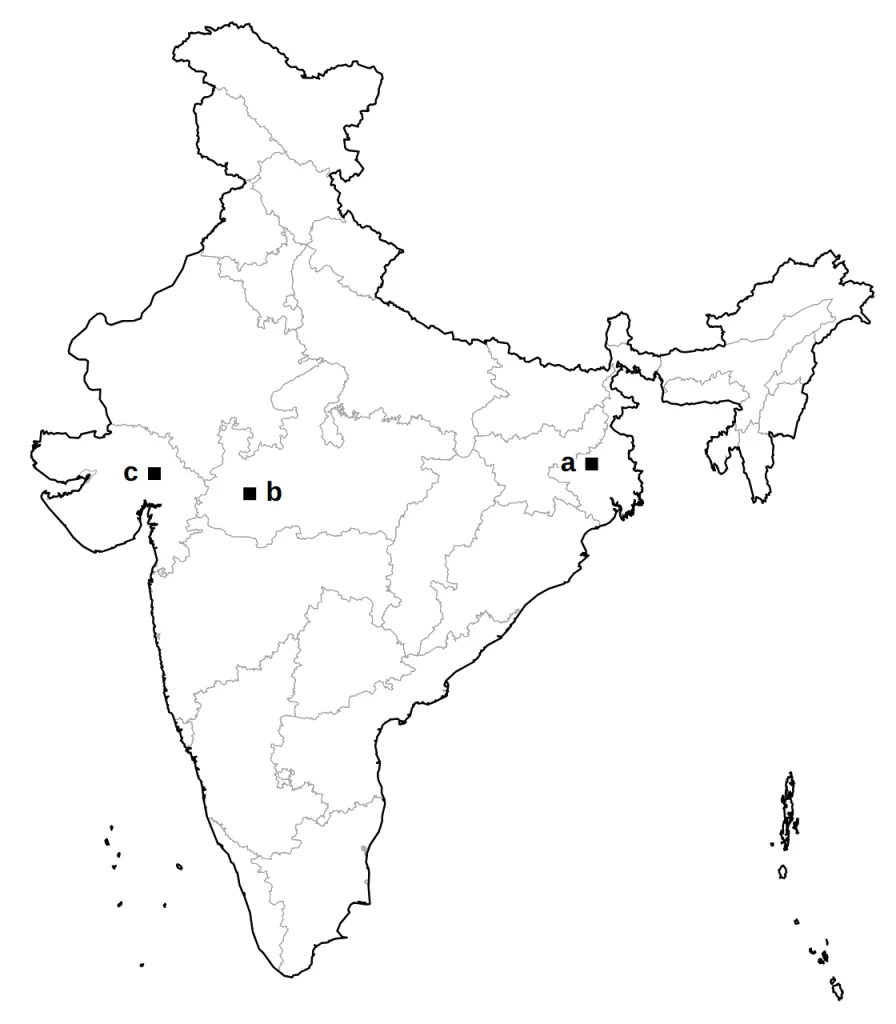
(a) Durgapur, in the Damodar valley of West Bengal, north-west of Kolkata.
(b) Indore, on the Malwa plateau in western Madhya Pradesh.
(c) Gandhinagar, the capital of Gujarat, just north of Ahmedabad.
The answer map shows the three places with squares marked a, b and c.
Marking scheme:
- (a) Durgapur, in the Damodar valley of West Bengal, correctly located and labelled — 1 mark
- (b) Indore, in western Madhya Pradesh, correctly located and labelled — 1 mark
- (c) Gandhinagar, near Ahmedabad in Gujarat, correctly located and labelled — 1 mark
Question 2 (2 marks)
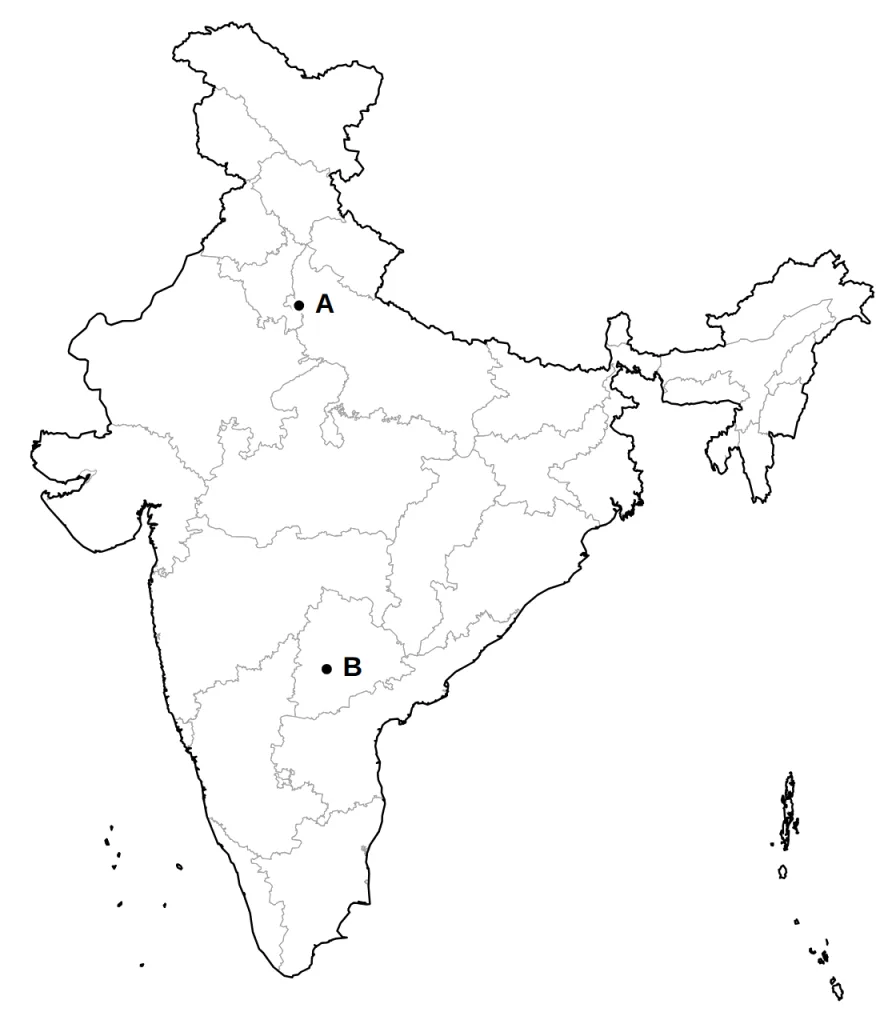
Two places, A and B, are marked on the outline map of India given below. Identify them with the help of the following information and write their correct names.
A. The software technology park from your map list in Uttar Pradesh, next to Delhi.
B. The software technology park from your map list in Telangana.
Answer.
Model answer:
A. Noida, in Uttar Pradesh, next to Delhi.
B. Hyderabad, in Telangana, on the Deccan plateau.
Marking scheme:
- A: Noida (Uttar Pradesh) — 1 mark
- B: Hyderabad (Telangana) — 1 mark
Question 3 (2 marks)
State the two main factors that decide where an aluminium smelting plant is set up, and name two states that have such plants.
Answer.
Model answer:
- A smelter needs a regular supply of electricity and a sure, cheap supply of bauxite.
- Such plants are found in Odisha and Chhattisgarh.
Marking scheme:
- A regular supply of electricity (0.5) and an assured source of raw material (bauxite) at minimum cost (0.5). — 1 mark
- Any two: Odisha, West Bengal, Kerala, Uttar Pradesh, Chhattisgarh, Maharashtra, Tamil Nadu (0.5 each). — 1 mark
Question 4 (3 marks)
In its early years the cotton textile industry was concentrated in the cotton-growing belt of Maharashtra and Gujarat. Explain any three reasons.
Answer.
Model answer:
- Raw cotton grew nearby in the black soil region.
- There was a large market, and good transport, including ports such as Mumbai, to move cloth.
- Plenty of workers were available, and the moist climate suited spinning and weaving.
Marking scheme:
- Raw cotton was available close by in the black soil cotton belt. — 1 mark
- A large market and good transport, including port facilities (Mumbai) for trade, were at hand. — 1 mark
- Plenty of labour, and a moist climate that suits spinning and weaving cotton. (Any three of: raw cotton, market, transport and ports, labour, moist climate.) — 1 mark
Question 5 (3 marks)
Explain three problems faced by the cotton textile industry in India.
Answer.
Model answer:
- Power supply is irregular, so machines often stand idle.
- Machines in weaving and processing are old and need to be replaced with better ones.
- Workers produce little per head, and synthetic fibres give cotton cloth stiff competition.
Marking scheme:
- Power supply is erratic, which stops machines and cuts output. — 1 mark
- Machinery, especially in the weaving and processing sectors, is old and needs to be upgraded. — 1 mark
- Output per worker is low, and there is stiff competition from the synthetic fibre industry. (Any three.) — 1 mark
Question 6 (3 marks)
India is an important steel-producing country, yet the industry has not reached its full potential. Explain three reasons.
Answer.
Model answer:
- Coking coal is costly and in short supply.
- Workers' productivity is low, and the energy supply is irregular.
- Infrastructure such as transport is poor, which raises costs.
Marking scheme:
- High cost and limited availability of coking coal. — 1 mark
- Lower productivity of labour, and an irregular supply of energy. — 1 mark
- Poor infrastructure (transport and other facilities). (Also accept: too little spent on research and development.) — 1 mark
Question 7 (3 marks)
How has the information technology and electronics industry helped India's economy? Explain three points.
Answer.
Model answer:
- It has created a large number of jobs.
- The fast-growing BPO sector has made it a big earner of foreign exchange.
- It has helped new centres such as Bengaluru, Hyderabad and Pune grow, spreading jobs and development.
Marking scheme:
- It has made a major impact on employment, creating many jobs. — 1 mark
- It has become a major earner of foreign exchange because of the fast-growing Business Process Outsourcing (BPO) sector. — 1 mark
- It has made new centres grow, such as Bengaluru, Hyderabad, Pune, Chennai and Noida, spreading development and jobs to more cities, with software technology parks supporting them. — 1 mark
Question 8 (3 marks)
Jamshedpur, Bokaro and Durgapur all lie on or near the Chotanagpur plateau. Explain three reasons why this region has the largest concentration of iron and steel industries.
Answer.
Model answer:
- High-grade iron ore and coal lie close together here, so heavy raw materials need not travel far.
- Iron ore is cheap, and plenty of cheap labour is available.
- The home market for steel is large and still growing.
Marking scheme:
- High-grade raw materials lie close by, such as iron ore from the Odisha-Jharkhand belt and coal from the Damodar valley, so transport costs are low. — 1 mark
- Iron ore is available at low cost, and cheap labour is available. — 1 mark
- There is vast growth potential in the home market for steel. (Accept any three of: low-cost iron ore, high-grade raw materials nearby, cheap labour, growth potential in the home market.) — 1 mark
Question 9 (2 marks)
Distinguish between an integrated steel plant and a mini steel plant on two points.
Answer.
Model answer:
- An integrated plant is large and does every step, from raw material to rolled steel, at one site.
- A mini plant melts scrap and sponge iron in electric furnaces for mild and alloy steel.
Marking scheme:
- Size and process: an integrated plant is large and does everything in one complex, from putting together raw materials to making steel and rolling and shaping it; a mini plant is smaller. — 1 mark
- Inputs and output: a mini plant uses electric furnaces with steel scrap and sponge iron (and re-rollers for ingots) and makes mild and alloy steel of given specifications. — 1 mark
Question 10 (2 marks)
For about two decades, manufacturing's share in India's GDP stayed at around 17 per cent. What does this figure suggest, and what step has the government taken to improve it?
Answer.
Model answer:
- The share is low: some East Asian countries get 25 to 35 per cent of GDP from manufacturing.
- To raise productivity, the government set up the National Manufacturing Competitiveness Council (NMCC).
Marking scheme:
- It is low: some East Asian economies get 25 to 35 per cent of their GDP from manufacturing, so India's manufacturing needs to grow faster. — 1 mark
- The government set up the National Manufacturing Competitiveness Council (NMCC) to improve productivity through the right policies and fresh efforts by industry. — 1 mark
Question 11 (2 marks)
In India, spinning is concentrated in Maharashtra, Gujarat and Tamil Nadu, but weaving is spread across a very large number of small units. State one advantage and one problem of this arrangement.
Answer.
Model answer:
- Advantage: small units keep traditional weaving skills and designs alive and give weavers work at home.
- Problem: they cannot use much of the fine yarn India spins, so the cloth is of lower quality.
Marking scheme:
- Advantage: scattered weaving on handlooms and powerlooms keeps traditional skills and designs in cotton, silk, zari and embroidery alive and gives work to weavers in their homes. — 1 mark
- Problem: the small weaving units cannot use much of the high-quality yarn that India spins, so the fabric is often of lower quality; spinners export yarn while garment makers import fabric. — 1 mark
Long Answer and Case-Based Questions
Question 12 (5 marks)
Industries can be classified in several ways. Classify industries on the basis of (i) the source of raw materials, (ii) their main role, (iii) capital investment, (iv) ownership and (v) the bulk and weight of raw materials and finished goods, giving examples.
Answer.
Model answer:
- Raw materials: agro-based, like cotton textiles and sugar; mineral-based, like iron and steel and cement.
- Main role: basic industries, like iron and steel, supply other industries; consumer industries, like toothpaste and fans, make goods for people.
- Capital: small-scale units have investment within ₹1 crore; large-scale units have more.
- Ownership: public (SAIL), private (Bajaj Auto), joint (Oil India Ltd) and cooperative (sugar mills of Maharashtra).
- Bulk and weight: heavy industries, like iron and steel; light industries, like electrical goods.
Marking scheme:
- (i) Raw materials: agro-based (cotton, woollen, jute, silk textiles, rubber, sugar, tea, coffee, edible oil) and mineral-based (iron and steel, cement, aluminium, machine tools, petrochemicals). — 1 mark
- (ii) Main role: basic or key industries whose products are raw materials for other goods (iron and steel, copper and aluminium smelting) and consumer industries (sugar, toothpaste, paper, sewing machines, fans). — 1 mark
- (iii) Capital: small-scale industries, where investment on assets is within the limit (at present ₹1 crore), and large-scale industries above it. — 1 mark
- (iv) Ownership: public (BHEL, SAIL), private (TISCO, Bajaj Auto, Dabur), joint (Oil India Ltd) and cooperative (sugar in Maharashtra, coir in Kerala). — 1 mark
- (v) Bulk and weight: heavy industries such as iron and steel, and light industries such as electrical goods. — 1 mark
OR
What factors decide where an industry is located? Explain five points, including the link between industry and cities.
Answer.
Model answer:
- Raw material: a factory is best placed where its raw material is at hand or cheap to bring.
- Labour, capital and power: it needs workers, money and energy.
- Market: goods must reach buyers easily. Since all factors are rarely found in one place, the factory goes where they cost least.
- Cities: once industry starts, a town grows around it, and cities give markets, banks, insurance, transport and advisers.
- Agglomeration economies: so many industries crowd together in and around big cities to share these benefits.
Marking scheme:
- Raw material: industries tend to locate where their raw material is available or can be brought at low cost. — 1 mark
- Labour, capital and power: a supply of workers, money for investment and energy is needed. — 1 mark
- Market: goods must reach buyers easily; rarely are all factors found at one place, so industry locates where they can be arranged at the lowest cost. — 1 mark
- Industry and cities grow together: once industry starts, urbanisation follows, and cities offer markets and services such as banking, insurance, transport, labour and financial advice. — 1 mark
- Agglomeration economies: many industries cluster in and around big cities to use these shared advantages. (Also accept: before independence, industries grew at ports such as Mumbai, Kolkata and Chennai for overseas trade.) — 1 mark
Question 13 (5 marks)
Describe the chemical industry and the fertiliser industry of India, bringing out the kinds of products each makes and where they are located.
Answer.
Model answer:
- The chemical industry has large and small units and has grown fast in both inorganic and organic chemicals.
- Inorganic: sulphuric acid, nitric acid, alkalis, soda ash and caustic soda; these plants are spread across the country.
- Organic: petrochemicals for synthetic fibres, rubber, plastics, dyes and medicines; these plants stand near oil refineries. The industry is its own biggest buyer.
- Fertilisers: nitrogen fertilisers such as urea, phosphates, DAP and NPK mixes are made; potash is fully imported.
- The industry spread after the Green Revolution; Gujarat, Tamil Nadu, Uttar Pradesh, Punjab and Kerala make about half.
Marking scheme:
- Chemical industry has both large and small units and has grown fast in both the inorganic and organic sectors. — 1 mark
- Inorganic chemicals include sulphuric acid (for fertilisers, synthetic fibres, plastics, paints, dyes), nitric acid, alkalis, soda ash (for glass, soaps, detergents, paper) and caustic soda; these units are spread over the country. — 1 mark
- Organic chemicals include petrochemicals used for synthetic fibres, synthetic rubber, plastics, dyes, drugs and pharmaceuticals; the plants are near oil refineries or petrochemical plants. The industry is its own largest consumer. — 1 mark
- Fertiliser industry makes nitrogenous fertilisers (mainly urea), phosphatic fertilisers, ammonium phosphate (DAP) and complex fertilisers with N, P and K; potash is entirely imported. — 1 mark
- After the Green Revolution the fertiliser industry spread to many parts; Gujarat, Tamil Nadu, Uttar Pradesh, Punjab and Kerala make about half the output. — 1 mark
OR
A district in Maharashtra grows a lot of cotton but has no factories. A cotton textile mill and a factory making pumps and farm machines now open there. Explain five ways in which farming and these industries in the district will support each other.
Answer.
Model answer:
- Market for cotton: the mill buys the farmers' cotton, so they get a nearby buyer and better prices.
- Inputs for farms: the factory sells pumps and machines, and industry supplies fertilisers and pipes, so yields rise.
- Modern farming: machines make farm work quicker and more efficient.
- Jobs: spare farm workers find work in the mill and factory, so families do not live on farm income alone.
- More work around cotton: ginning, weaving, dyeing, packing and transport grow, and higher incomes raise demand for farm and factory goods.
Marking scheme:
- The mill depends on farmers for raw cotton, so farmers get a steady market close by and better prices. — 1 mark
- The factory sells irrigation pumps, machines and tools (and industry supplies fertilisers, pesticides and PVC pipes), which raise farm productivity. — 1 mark
- Industry helps to modernise agriculture, making farm work quicker and more efficient. — 1 mark
- Surplus farm workers get jobs in the mill and factory (secondary sector), so families depend less on farm income alone. — 1 mark
- The mill creates more work around cotton: ginning, spinning, weaving, dyeing, packaging and transport, and higher incomes then raise demand for both farm goods and factory goods. (Accept any five fair points.) — 1 mark
Question 14 (4 marks)
Read the source given below and answer the questions that follow.
The River That Changed Colour
In a small textile town, which we shall call Rangpur, the river used to run a different colour each week, depending on which dye the printing units were using. The units let out their waste water straight into it, carrying dyes, detergents, acids and salts. Fish vanished, and farmers downstream found that their wells tasted of chemicals.
Things began to change when the units came together to build a common treatment plant. The waste water first passes through screens and settling tanks, where solids are removed by mechanical means. It then moves to tanks in which bacteria break down much of the dirt. In the last stage, a mix of biological, chemical and physical processes cleans it well enough to be used again in the factories. Some units have also started collecting rainwater from their roofs, so they draw less water from the river in the first place. (Rangpur is an imaginary town.)
(a) Name any two pollutants that the printing units released into the river. (1 mark)
Answer.
Model answer:
Dyes and acids.
Marking scheme:
- Any two: dyes, detergents, acids, salts (0.5 each). — 1 mark
(b) Which stage of effluent treatment is described as 'screens and settling tanks'? What happens in it? (1 mark)
Answer.
Model answer:
It is primary treatment, in which solids are removed by mechanical means such as screening and settling.
Marking scheme:
- Primary treatment (0.5): solids are removed by mechanical means such as screening, grinding, flocculation and sedimentation (0.5). — 1 mark
(c) Apart from treating effluents, suggest two ways in which industries can reduce the pollution of fresh water. (2 marks)
Answer.
Model answer:
- Reuse and recycle the same water in two or more stages, so less fresh water is needed.
- Harvest rainwater to meet part of the factory's needs.
Marking scheme:
- Use less water for processing by reusing and recycling it in two or more successive stages. — 1 mark
- Harvest rainwater to meet water needs. (Also accept: cool hot water before release; legally regulate overdrawing of groundwater by industries.) — 1 mark
Question 15 (4 marks)
Read the source given below and answer the questions that follow.
A Mill That Sleeps in Summer
From November to April the gates of a cooperative sugar mill in western Maharashtra stay open day and night. Tractors and bullock carts queue up with cane from the farms around it, because cane that waits too long after cutting loses sugar and fetches less. The farmers who grow the cane are members of the cooperative, so they share in its profits as well as its problems.
By May the queues vanish. There is no fresh cane to crush, and most of the workers go back to their fields until the next season. Some of the machines are old and waste a lot of cane juice, and during the rush the mill cannot always collect cane from distant villages on time. One thing it has learnt to use well is bagasse, the crushed stalks left after the juice is taken out; it now burns them in its boilers to make its own power. (The mill described here is imaginary.)
(a) Why must cane reach the mill soon after it is cut? (1 mark)
Answer.
Model answer:
Cane loses its sucrose if it waits or travels too long, so it gives less sugar.
Marking scheme:
- Its sucrose (sugar) content falls if it waits or is hauled for long, so it gives less sugar. — 1 mark
(b) Why is the sugar industry well suited to the cooperative sector? (1 mark)
Answer.
Model answer:
It is seasonal, working only while cane is harvested, so the growers can run it together and share its gains and risks.
Marking scheme:
- It is seasonal in nature, working only while cane is harvested, so the cane growers themselves can run it together and share its gains and risks. — 1 mark
(c) Identify two challenges of the sugar industry that are seen in this mill, and state how the mill has handled one other challenge. (2 marks)
Answer.
Model answer:
- The mill works only part of the year, and its old machines waste juice.
- It meets the need to use bagasse well by burning it in its boilers to make its own power.
Marking scheme:
- Any two challenges seen: its seasonal nature; old and inefficient methods of production; delay in transporting cane to the mill (0.5 each). — 1 mark
- The need to make the best use of bagasse: the mill burns bagasse in its boilers to produce its own power. — 1 mark