
Restructuring Centre-State Relations
Restructuring Centre-State relations is one more way in which federalism has been strengthened in practice. How the constitutional arrangements for sharing power actually work in reality depends greatly on how the ruling parties and leaders follow these arrangements.
Constitutional rules, by themselves, do not guarantee good federal practice. If leaders respect the autonomy of the States, federalism flourishes; if they try to dominate the States, the same constitution can be misused. The story of Centre-State relations in India shows both of these tendencies at different times.
Before 1990 - Undermining the States
For a long time, the same party ruled both at the Centre and in most of the States. This meant that the State Governments did not exercise their rights as autonomous federal units.
As and when the ruling party at the State level was different from the party at the Centre, the party in power at the Centre often tried to undermine the power of those States. In those days, the Central Government would frequently misuse the Constitution to dismiss State Governments that were controlled by rival parties. This clearly undermined the spirit of federalism, because a State Government elected by the people could be removed simply for being ruled by a different party.
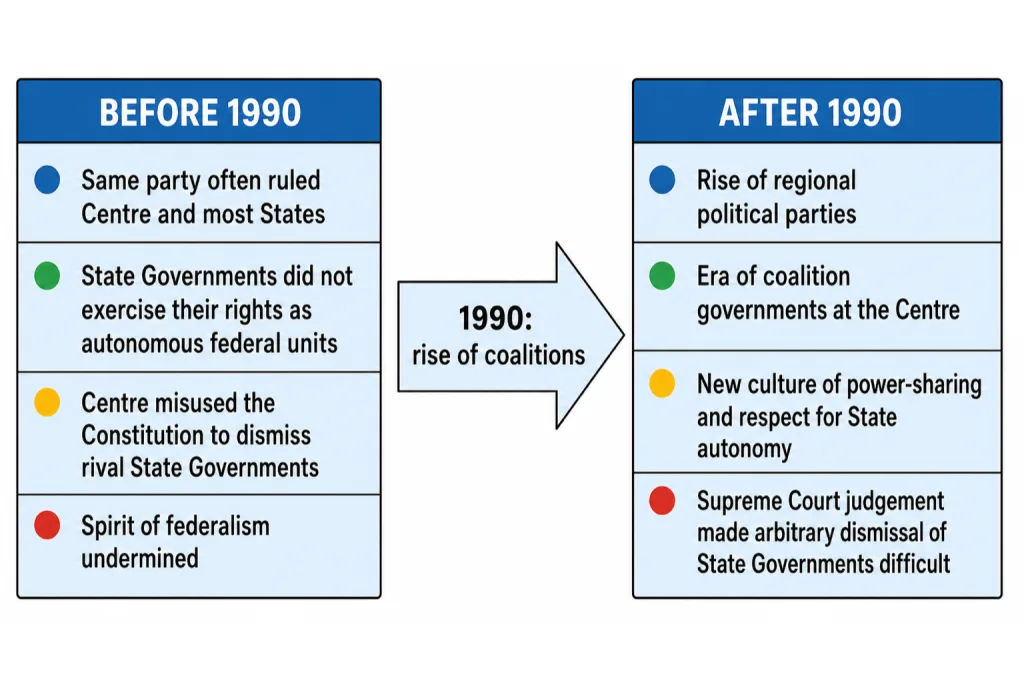
After 1990 - A New Culture of Power-Sharing
All this changed significantly after 1990. This period saw:
- the rise of regional political parties in many States, and
- the beginning of the era of coalition governments at the Centre.
Since no single party got a clear majority in the Lok Sabha, the major national parties had to enter into an alliance with many parties, including several regional parties, to form a government at the Centre. This led to a new culture of power-sharing and respect for the autonomy of State Governments.
This trend was supported by a major judgement of the Supreme Court that made it difficult for the Central Government to dismiss State Governments in an arbitrary manner. Thus, federal power-sharing is more effective today than in the early years after the Constitution came into force.
Questions and Answers
Q1. How were the rights of the States undermined before 1990?
Answer: For a long time the same party ruled at the Centre and in most States, so State Governments did not exercise their rights as autonomous federal units. When a different party ruled a State, the Centre often tried to undermine its power and even misused the Constitution to dismiss such rival State Governments. This weakened the spirit of federalism.
Q2. How did the rise of coalition governments after 1990 strengthen federalism?
Answer: After 1990, the rise of regional parties and the era of coalition governments meant that no single party won a clear majority in the Lok Sabha, so national parties had to form alliances including regional parties. This created a new culture of power-sharing and respect for State autonomy. A Supreme Court judgement that made arbitrary dismissal of State Governments difficult further strengthened federal practice.
Q3. What is a coalition government?
Answer: A coalition government is a government formed by the coming together of at least two political parties. Usually the partners form a political alliance and adopt a common programme. The era of coalition governments at the Centre after 1990 gave regional parties a real share in power and strengthened the autonomy of the States.