
Federal versus Unitary Government
Federations are best understood by contrasting them with unitary governments.
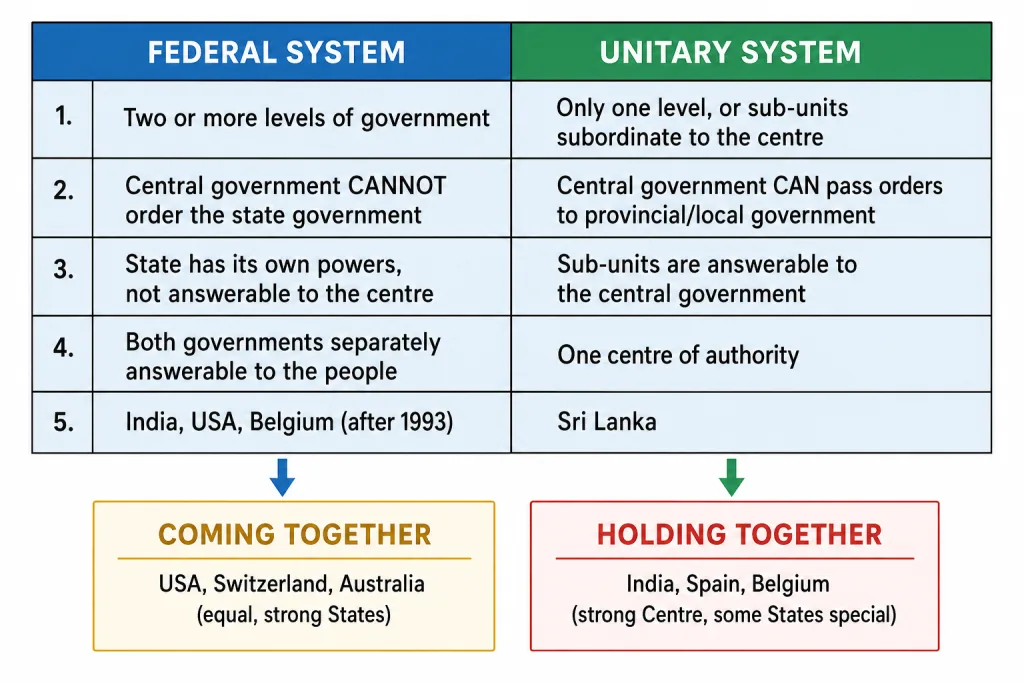
Under a unitary system, either there is only one level of government, or the sub-units are subordinate to the central government. The central government can pass on orders to the provincial or local government, which must obey.
In a federal system, this is not possible. The central government cannot order the state government to do something. The state government has powers of its own for which it is not answerable to the central government. Both governments are separately answerable to the people.
Coming Together Federations
The exact balance of power varies from one federation to another, depending on how the federation was formed. There are two routes to forming a federation.
The first route is 'coming together'. Here, independent States come together on their own to form a bigger unit. By pooling sovereignty and retaining their identity, they can increase their security. Examples of coming-together federations include the USA, Switzerland and Australia.
In this first category, all the constituent States usually have equal power and are strong in relation to (vis-a-vis) the federal government. The States joined voluntarily, so they guard their equality carefully.
Holding Together Federations
The second route is 'holding together'. Here, a large country decides to divide its power between the constituent States and the national government. Examples include India, Spain and Belgium.
In this second category, the Central Government tends to be more powerful in relation to the States. Very often, different constituent units of the federation have unequal powers, and some units are granted special powers.
India is a holding-together federation: it was already one country that chose to share power with its States, rather than separate States choosing to join. This is why, in India, the Centre is comparatively strong and some States enjoy a special status.
Questions and Answers
Q1. What is the main difference between a federal and a unitary form of government?
Answer: In a unitary system there is either only one level of government, or the sub-units are subordinate to the central government, which can pass orders to them. In a federal system, the central government cannot order the state government; the state has its own powers for which it is not answerable to the centre, and both levels are separately answerable to the people. For example, India is federal while Sri Lanka is, in practice, unitary.
Q2. Distinguish between 'coming together' and 'holding together' federations with examples.
Answer: In a 'coming together' federation, independent States join together on their own to form a larger unit; the States are usually equal and strong relative to the centre. Examples: USA, Switzerland, Australia. In a 'holding together' federation, a large country divides its power among its States; the Centre is more powerful, and some units may have unequal or special powers. Examples: India, Spain, Belgium.
Q3. Why is India called a 'holding together' federation?
Answer: India was already a single large country that chose to divide its power between the national government and the States, rather than being formed by separate States coming together. In such federations the Central Government is comparatively strong, the constituent units may have unequal powers, and some States are granted special status (for example, under Article 371). All of these features are true of India, so it is a holding together federation.