
Linguistic States - The First Test
Constitutional provisions are necessary for the success of federalism but they are not sufficient. The real success of federalism in India owes as much to the nature of its democratic politics - which made respect for diversity and the desire to live together shared ideals.
The creation of linguistic States was the first and a major test for democratic politics in our country. If you compare the political map of India in 1947 with that of 2019, you would be surprised: many old States have vanished and many new States have been created; areas, boundaries and names have changed.
In 1947, the boundaries of several old States were changed to create new States, mainly so that people who spoke the same language lived in the same State. Some States - like Nagaland, Uttarakhand and Jharkhand - were created not on the basis of language but to recognise differences of culture, ethnicity or geography.
Did Linguistic States Divide the Country?
When the demand for forming States on the basis of language was raised, some national leaders feared it would lead to the disintegration of the country. The Central Government resisted linguistic States for some time.
But experience has shown the opposite: the formation of linguistic States has actually made the country more united, and it has also made administration easier. Instead of breaking India apart, respecting language brought people the reassurance that their identity was safe within the Union. This is a classic example of how accommodating diversity can strengthen, rather than weaken, national unity.
Language Policy - Hindi and the Scheduled Languages
The language policy is a second test for Indian federalism. Our Constitution did not give the status of national language to any one language.
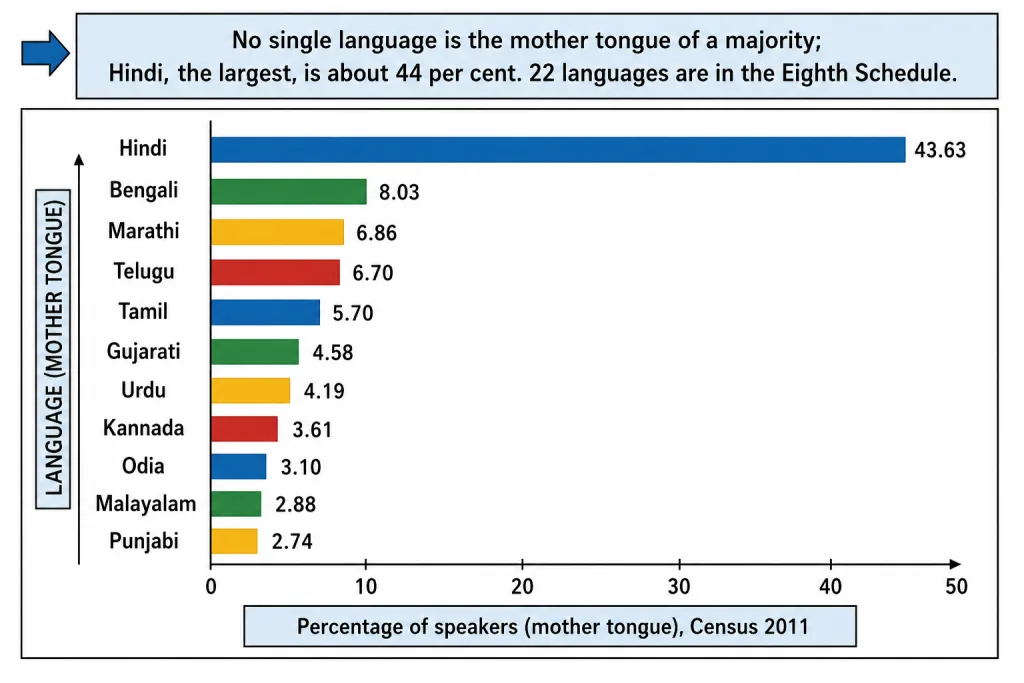
- Hindi was identified as the official language. But Hindi is the mother tongue of only about 40 per cent of Indians, so there are many safeguards to protect other languages.
- Besides Hindi, there are 21 other languages recognised as Scheduled Languages by the Constitution (in the Eighth Schedule). A candidate in an examination for a Central Government position may take the exam in any of these languages.
- States too have their own official languages, and much government work is done in the official language of the concerned State.
According to the 2011 Census, India recorded more than 1300 mother tongues, grouped into 121 major languages, of which 22 are Scheduled Languages; Hindi, the largest, is the mother tongue of about 44 per cent of Indians.
The Cautious Spread of Hindi
Unlike Sri Lanka, the leaders of our country adopted a very cautious attitude in spreading the use of Hindi.
According to the Constitution, the use of English for official purposes was to stop in 1965. However, many non-Hindi speaking States demanded that the use of English continue. In Tamil Nadu, this movement even took a violent form. The Central Government responded by agreeing to continue the use of English along with Hindi for official purposes.
Many critics think this favoured the English-speaking elite. Promotion of Hindi continues to be the official policy, but 'promotion' does not mean the Centre can impose Hindi on States where people speak a different language. This flexibility helped India avoid the kind of language conflict that troubled Sri Lanka.
Questions and Answers
Q1. Why is the creation of linguistic States called the first major test of Indian federalism, and how did it turn out?
Answer: After Independence, boundaries were redrawn so that people speaking the same language lived in the same State. Some leaders feared this would break up the country, and the Centre resisted it at first. But experience proved the opposite: linguistic States made India more united and administration easier. Hence the test was passed, showing that accommodating diversity can strengthen unity.
Q2. Describe India's language policy.
Answer: The Constitution gave no language the status of national language. Hindi was made the official language, but since it is the mother tongue of only about 40 per cent of Indians, 21 other languages were recognised as Scheduled Languages, and States have their own official languages. English was to be dropped for official use in 1965, but after protests (violent in Tamil Nadu) the Centre agreed to continue English along with Hindi. This flexible, accommodating policy helped India avoid the conflict seen in Sri Lanka.