
India: A Union of States
India is a vast country with many languages, religions and regions. What are the power-sharing arrangements in such a country?
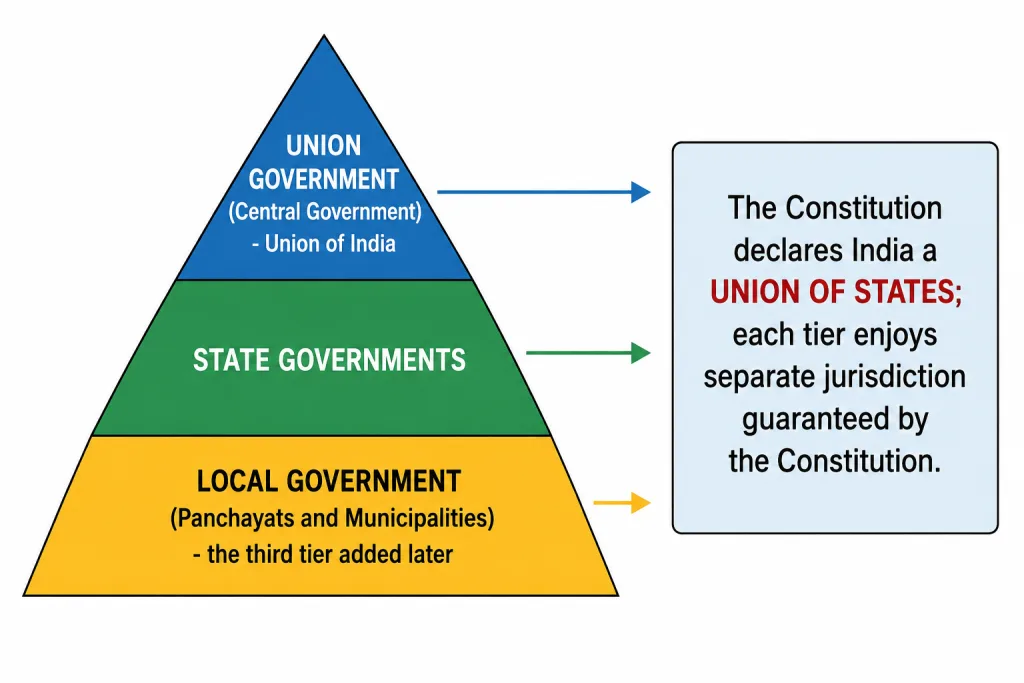
India emerged as an independent nation after a painful and bloody partition. Soon after Independence, several princely states became part of the country. The Constitution declared India a Union of States. Although it did not use the word 'federation', the Indian Union is based on the principles of federalism.
If we go back to the seven features of federalism, we find that all of them apply to the provisions of the Indian Constitution. India is therefore a federal country in substance, even though the Constitution prefers the phrase 'Union of States'.
From Two Tiers to Three Tiers
The Constitution originally provided for a two-tier system of government:
- the Union Government (also called the Central Government), representing the Union of India, and
- the State Governments.
Later, a third tier of federalism was added in the form of Panchayats and Municipalities - the local government. As in any federation, these different tiers enjoy separate jurisdiction. So Indian federalism today is a three-tier system: Union, State and Local.
A Three-Fold Distribution of Legislative Powers
The Constitution clearly provided a three-fold distribution of legislative powers between the Union Government and the State Governments. It contains three lists:
- the Union List,
- the State List, and
- the Concurrent List.
Each list specifies the subjects on which the different levels can make laws. This clear, constitutionally fixed division of subjects is exactly what a federation requires, and it is one of the strongest proofs that India is a federal country. We will study these three lists in detail in the next section.
Questions and Answers
Q1. The Indian Constitution does not use the word 'federation'. Then why is India called a federal country?
Answer: Although the Constitution describes India as a 'Union of States' and never uses the word 'federation', India is federal because all seven features of federalism apply to it: there are multiple tiers of government, each with its own jurisdiction guaranteed by the Constitution; the three-fold distribution of powers through the three Lists; power-sharing that cannot be changed unilaterally; and courts that act as umpire. In substance, therefore, India is a federation.
Q2. Explain how India moved from a two-tier to a three-tier federation.
Answer: The Constitution originally provided for a two-tier system - the Union Government and the State Governments. Later, a third tier was added in the form of Panchayats (rural) and Municipalities (urban), that is, local government. Each of these three tiers enjoys separate jurisdiction, making India a three-tier federation.
Q3. What is meant by the three-fold distribution of legislative powers in India?
Answer: The Constitution divides law-making subjects among three lists: the Union List (subjects on which only the Union Government can legislate), the State List (subjects for the State Governments), and the Concurrent List (subjects on which both can legislate). This clear division of subjects is called the three-fold distribution of legislative powers and is a central feature of Indian federalism.