
Why Decentralisation?
Federal governments have two or more tiers. But a vast country like India cannot be run through only two tiers. States in India are as large as independent countries of Europe: in population, Uttar Pradesh is bigger than Russia, and Maharashtra is about as big as Germany. Many States are also internally very diverse.
There is thus a need for power-sharing within the States as well. This is the rationale for decentralisation of power, which created a third tier of government called local government.
When power is taken away from Central and State governments and given to local government, it is called decentralisation. The basic idea is that a large number of problems are best settled at the local level, because local people know their problems better, have better ideas on how to spend money, and can directly participate in decision-making. Local government is the best way to realise the principle of local self-government.
Local Government Before 1992 - Weak and Ineffective
The need for decentralisation was recognised in our Constitution, and panchayats and municipalities were set up in all the States. But in practice there was very little decentralisation because:
- these bodies were directly under the control of State Governments;
- elections to them were not held regularly; and
- local governments had no powers or resources of their own.
As a result, local self-government remained mostly on paper. The bodies existed, but they could not take real decisions or command real resources, so they could not serve their purpose.
The 1992 Amendment - A Powerful Third Tier
A major step towards decentralisation was taken in 1992. The Constitution was amended to make the third tier of democracy more powerful and effective. Its key provisions are:
- Now it is constitutionally mandatory to hold regular elections to local government bodies.
- Seats are reserved in the elected bodies and their executive heads for the Scheduled Castes (SC), Scheduled Tribes (ST) and Other Backward Classes (OBC).
- At least one-third of all positions are reserved for women.
- An independent State Election Commission has been created in each State to conduct panchayat and municipal elections.
- The State Governments are required to share some powers and revenue with local government bodies; a State Finance Commission reviews this sharing, though the nature of sharing varies from State to State.
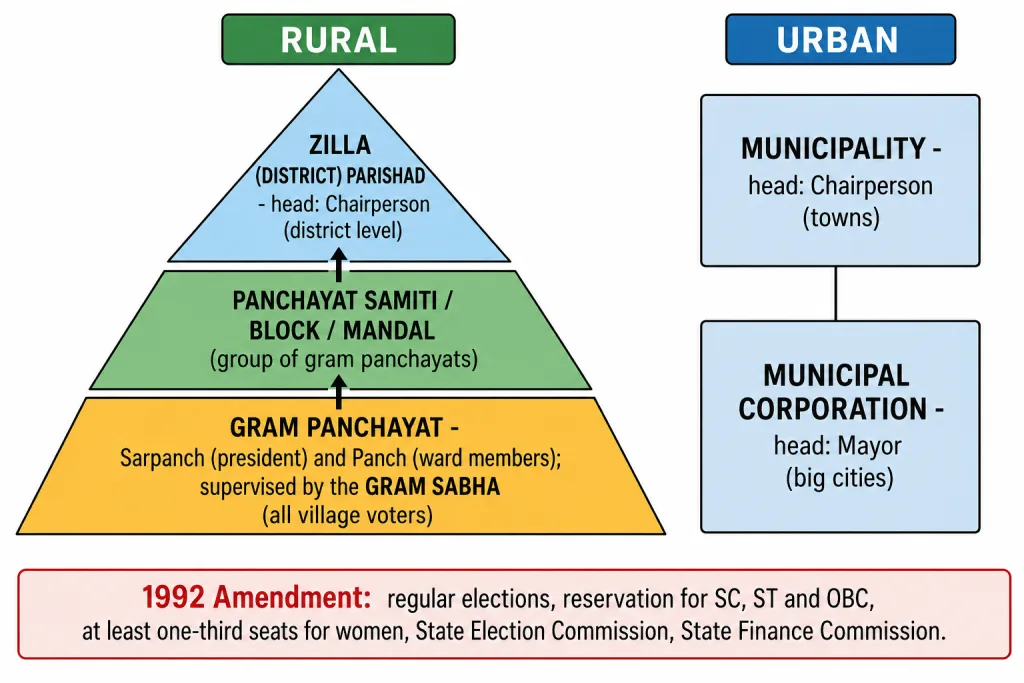
The Three-Tier Structure - Rural and Urban
Rural local government is popularly known as panchayati raj, and it has three levels:
- Gram Panchayat: Each village (or a group of villages) has a gram panchayat - a council of ward members (panch) and a president (sarpanch), directly elected by the village's adult population. It works under the supervision of the gram sabha (all the voters of the village), which meets to approve the budget and review performance.
- Panchayat Samiti (Block / Mandal): A few gram panchayats are grouped to form a panchayat samiti, whose members are elected by the panchayat members of that area.
- Zilla (District) Parishad: All the panchayat samitis of a district together form the zilla parishad, most of whose members are elected. Its chairperson is its political head.
For urban areas, municipalities are set up in towns and municipal corporations in big cities. The political head of a municipality is its chairperson, and of a municipal corporation, the mayor. This is the largest experiment in democracy in the world - about 36 lakh elected representatives now serve in these bodies. However, gram sabhas are not always held regularly, and many States have not transferred enough powers or resources, so we are still far from the ideal of self-government.
Questions and Answers
Q1. What is decentralisation, and why is it needed in a country like India?
Answer: Decentralisation means taking power away from the Central and State governments and giving it to local government. It is needed because India is vast and diverse - some States are as large as European countries - so problems are best settled at the local level, where people know their problems, can spend money wisely, and can participate directly in decision-making, realising the ideal of local self-government.
Questions and Answers
Q2. State the main provisions of the 1992 constitutional amendment on local government.
Answer: The 1992 amendment made the third tier powerful by providing: (i) it is now mandatory to hold regular elections to local bodies; (ii) seats are reserved for SC, ST and OBC; (iii) at least one-third of positions are reserved for women; (iv) an independent State Election Commission conducts local elections; and (v) State Governments must share powers and revenue with local bodies, reviewed by a State Finance Commission.
Q3. Describe the three-tier structure of rural local government.
Answer: Rural local government (panchayati raj) has three levels: the Gram Panchayat (village council of panch and sarpanch, under the gram sabha); the Panchayat Samiti (block/mandal), formed by grouping gram panchayats; and the Zilla Parishad at the district level, headed by a chairperson.